
Cross Slide Table for Drill Press: Compatibility and Setup Explained
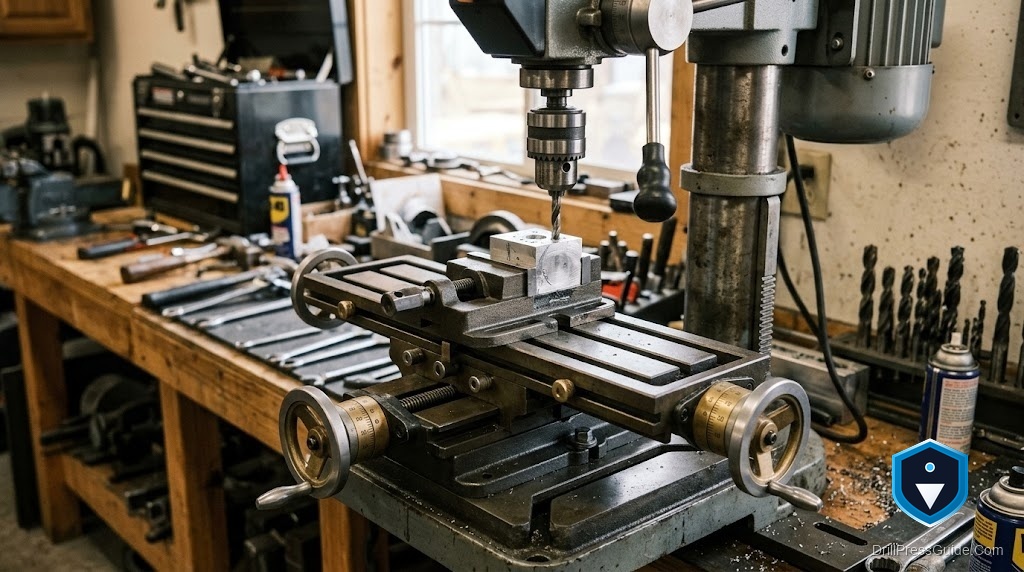
The first time I bolted a cross slide table onto my drill press, I felt like I had unlocked a secret mode on a machine I thought I understood. Suddenly I could dial a workpiece left, right, forward, and back with the turn of a handle, placing holes with a precision my shaky hands had never managed. I also learned, over the following weeks, exactly where these tables shine and where they will let you down if you ask too much of them.
That mix of genuine capability and honest limitation is what this guide is about. A cross slide table is one of the most useful upgrades you can add to a drill press, but only if you buy the right one for your machine and understand what a drill press was built to do. Let me save you the trial and error I went through.
What a Cross Slide Table Actually Does
A cross slide table, sometimes called a compound table or XY table, mounts to your drill press and lets you move the workpiece along two axes using lead screws and hand wheels. Turn one wheel and the table travels left to right, turn the other and it moves front to back. Graduated dials let you measure that movement, so you can place a series of holes at exact intervals.
This transforms repetitive or precise work. Drilling a row of evenly spaced holes, positioning a hole a precise distance from an edge, or working on small parts that are awkward to clamp and nudge by hand all become straightforward. The Proxxon 27100 KT 70 cross slide table is a compact, well-machined example that suits small precision work beautifully, with fine-thread spindles and clear graduated collars.
The Compatibility Question Comes First
Before you fall in love with any table, you have to confirm it fits your machine, and this is where many buyers stumble. The table needs to bolt onto your existing drill press table or replace it, which means the mounting slots and overall footprint have to line up. Measure your drill press table, note the slot spacing and the size, and compare it against the cross slide table’s base.
Height is the other half of the equation. A cross slide table raises your workpiece, sometimes by several inches, which eats into your quill travel and the distance between the chuck and the table. On a benchtop press with limited travel, a tall table like a heavier Grizzly cross slide table can leave you cramped for space, so check that you will still have room for both your workpiece and the drill bit.
Build Quality and the Backlash You Should Expect
Here is where honesty matters more than marketing. Most affordable cross slide tables have some backlash, a small amount of play in the lead screws where you turn the handle and nothing moves for a fraction of a turn. This is normal on budget units, and you manage it by always approaching your target from the same direction rather than fighting it.
Heavier cast iron tables generally feel more solid and hold their settings better, while lighter units can flex under load. A mid-weight option like the Mophorn cross slide drill press table balances rigidity and price for general shop use, and a compact WEN cross slide table offers an accessible entry point for lighter, occasional tasks. Just go in knowing the smoother the action and the less the flex, the more you will typically pay.
The One Rule You Cannot Break
I need to be blunt about this because it protects both your safety and your machine. A drill press is designed for axial loads, meaning force straight down the spindle. A cross slide table can tempt you into treating your drill press like a milling machine, feeding the workpiece sideways into a cutting bit. Do not do this.
Side loads from milling can bend the quill, wreck the bearings, and cause the bit to grab and throw the workpiece or shatter. The cross slide table is for positioning your work precisely and then drilling straight down, not for cutting slots or profiles by moving the table under load. Respect that line and the tool serves you well; cross it and you risk injury and an expensive repair.
Getting the Most From Your Table
Once you have a table that fits, a little setup pays off enormously. Clean the factory grease off the ways and re-lubricate with a light machine oil so the action stays smooth. Check that the table is mounted securely, because any looseness in the mounting translates directly into inaccurate holes and unsafe operation.
For clamping, use the T-slots in the table with proper hold-down clamps rather than trying to hold parts by hand, since the whole point is precision you cannot achieve by feel. Take a moment to zero your dials before a series of holes, and make test movements to feel out the backlash. These small habits turn a decent table into a genuinely precise one.
Verdict
A cross slide table is a superb upgrade if you value precision and repeatability, provided you buy one that fits your machine and respect its limits. For small, fine work, the Proxxon KT 70 is hard to beat on machining quality. For general shop use, the Mophorn cross slide table offers a sensible balance of rigidity and cost, while the WEN table is a fine budget starting point and the Grizzly table rewards those who want more mass. Measure your machine first, mind the height, manage the backlash, and never mill with it. Do that, and you will wonder how you drilled without one.
- A cross slide table lets you position a workpiece precisely along two axes for accurate, repeatable holes.
- Always confirm the mounting footprint and added height fit your drill press before buying.
- Expect some backlash on affordable tables and manage it by approaching targets from one direction.
- Never use a cross slide table to mill sideways, because a drill press handles only downward axial loads.
FAQ
What is a cross slide table for a drill press used for? It lets you move a workpiece precisely along two axes using hand wheels and graduated dials, so you can place holes at exact intervals. This is ideal for rows of evenly spaced holes, precise edge distances, and small parts that are hard to position by hand. It brings repeatable accuracy to drilling.
Will a cross slide table fit any drill press? No, you must confirm compatibility first. The table’s mounting slots and footprint need to match your drill press table, and the added height must leave enough quill travel for your workpiece and bit. Measure your machine and compare before buying.
Can I use a cross slide table to turn my drill press into a milling machine? No, and this is important for safety. A drill press is built for downward axial loads, not the side loads that milling creates. Feeding a workpiece sideways into a bit can bend the quill, damage bearings, and throw the workpiece, so use the table only to position work and then drill straight down.
Why does my cross slide table have play in the handles? That play is backlash, a normal trait of affordable lead-screw tables where the handle turns slightly before the table moves. You manage it by always approaching your target position from the same direction. Heavier, better-machined tables generally have less of it.
How do I keep a cross slide table accurate? Clean off the factory grease and re-lubricate the ways with light machine oil, mount the table securely, and use the T-slots with proper clamps rather than holding parts by hand. Zero your dials before a series of holes and account for backlash. These habits preserve precision.
Are heavier cast iron cross slide tables better? Generally yes, because more mass means less flex under load and better retention of settings. The trade-off is added weight and often a higher price. Lighter tables are fine for occasional, smaller tasks where you do not need maximum rigidity.
Do I need to clamp the workpiece on a cross slide table? Yes, always use the table’s T-slots with hold-down clamps. Holding parts by hand defeats the precision the table provides and is unsafe if the bit grabs. Secure clamping is essential for both accuracy and safety.
References
- Proxxon official product documentation and specifications
- Grizzly Industrial machine and accessory manuals
- Machinery’s Handbook, Industrial Press, on spindle loads and workholding
- Fine Woodworking, drill press setup and accuracy articles
- Manufacturer owner manuals for benchtop and floor drill presses


