Drill Press Vise Clamp: Fit, Capacity, and Setup Explained
A friend once showed up at my shop with a bandage on his hand and a story he was not proud of. He had set a small steel plate on his drill press table, held it with his fingers, and let the bit grab. The plate spun, the corner caught him, and he learned in a half second why we clamp things down. He got lucky. Plenty of people do not.
I tell that story because a drill press vise clamp is not an accessory you add for convenience. It is the part of the setup that decides whether the workpiece stays put or becomes a spinning blade at the point of operation. A vise holds the part, and a clamp holds the vise or the part to the drill-press table. Skip either job and the rotating chuck will remind you why both matter.
This piece explains how to fit and clamp things properly, what capacity you actually need, and which real products do the job. It is not glamorous work, but it is the difference between clean holes and a trip to the urgent care clinic.
Two clamping jobs people confuse
There are two separate clamping tasks on a drill press, and mixing them up causes trouble. First, you clamp the workpiece inside a vise, using vise jaws that grip the material. Second, you clamp that vise, or the bare workpiece, down onto the table so nothing rotates when the drill bit bites.
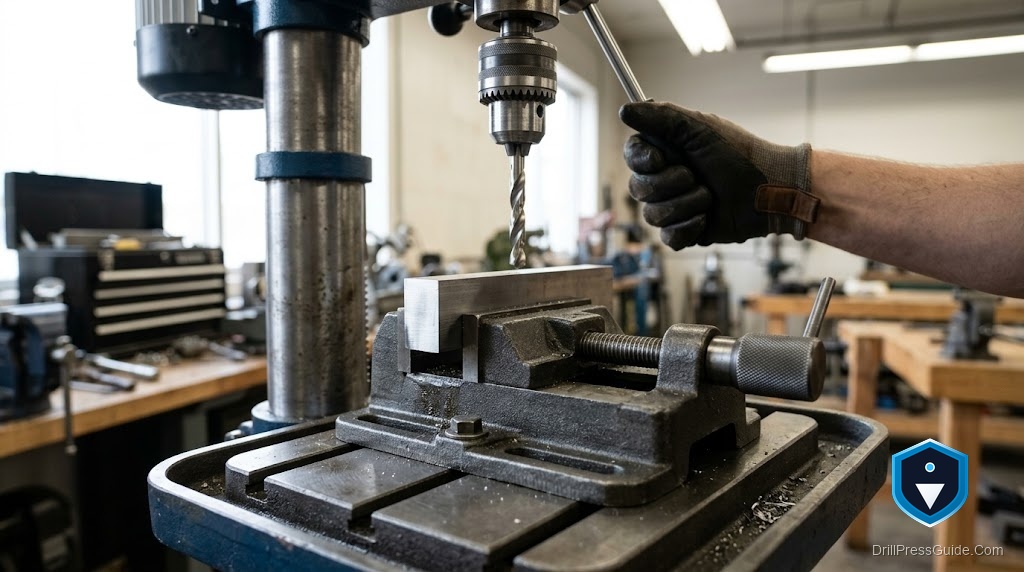
A 4-inch drill press vise handles the first job well, gripping small and medium parts between hardened jaws. But a vise that only rests on the table can still spin as a whole unit under drilling torque. That is why hold-down clamps, T-track clamps, and mounting bolts through the table slots exist. Both jobs have to be covered.
Start with a solid vise
If you do not already own one, begin with a dependable vise. The PONY 4-inch drill press vise is a straightforward, heavy-duty steel option with slotted ears in its base so you can bolt it straight through the mounting holes into your table slots. That base is the feature that lets you turn it from a resting vise into a truly secured one.
Grip the workpiece so the cutting area sits just past the jaw edge, giving the drill bit clearance while keeping the part supported. Add a scrap of workpiece support underneath thin stock so it does not bow as the bit breaks through.
Hold-down clamps for the vise and the work
To lock the vise to the table, or to pin down an odd-shaped part a vise cannot grab, hold-down clamps are the answer. A pair of long-reach clamps like the Elsjoy 9-inch drill press clamps drop a stud into the table slots and press a foot onto the vise base or workpiece, so drilling torque has nothing to spin against.
For flatter, lighter fixturing and for holding jigs, a set of low-profile T-slot clamps like these drill press hold-down clamps spread pressure without towering over the work. They are handy when a full step clamp would get in the way of the chuck. Between a long hold-down and a set of T-slot clamps, you can secure almost anything to the table.
Matching clamps to your table slots
Clamps only work if their studs and feet match your table. Measure your table slots before buying anything. The stud or bolt has to pass through the slot, and the fasteners have to thread into nuts or a T-track that actually fits. A delta drill press vise clamp setup, for example, depends entirely on the slot width of that particular Delta table, so the brand on the press matters less than the slot dimension.
Drill press vise clamp bolts should be long enough to reach through your vise base and the table slot with threads to spare, but not so long that they bottom out. If your table uses cast slots rather than a T-track, step blocks help you get the clamp foot level with the vise base for even pressure.
How to clamp a vise to a drill press, step by step
Here is the routine I use every time. Position the vise where the drill bit will meet the workpiece over an open slot or a clearance hole, never over solid table where the bit would strike metal. Drop bolts or studs through the vise mounting holes into the table slots. Snug both sides evenly so the vise cannot rock.
Then set the workpiece in the vise jaws, tighten for secure clamping, and add a hold-down clamp on the vise base as a second line of defense if the part will see heavy cutting. When people ask how to clamp vise to drill press safely, that layered approach, vise plus mounting plus hold-down, is the honest answer.
Safety is the whole point
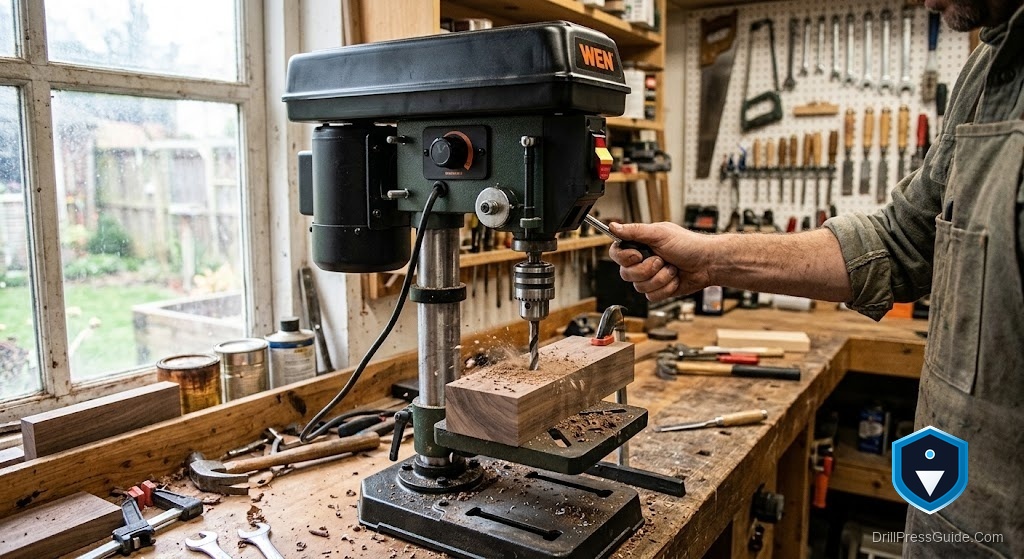
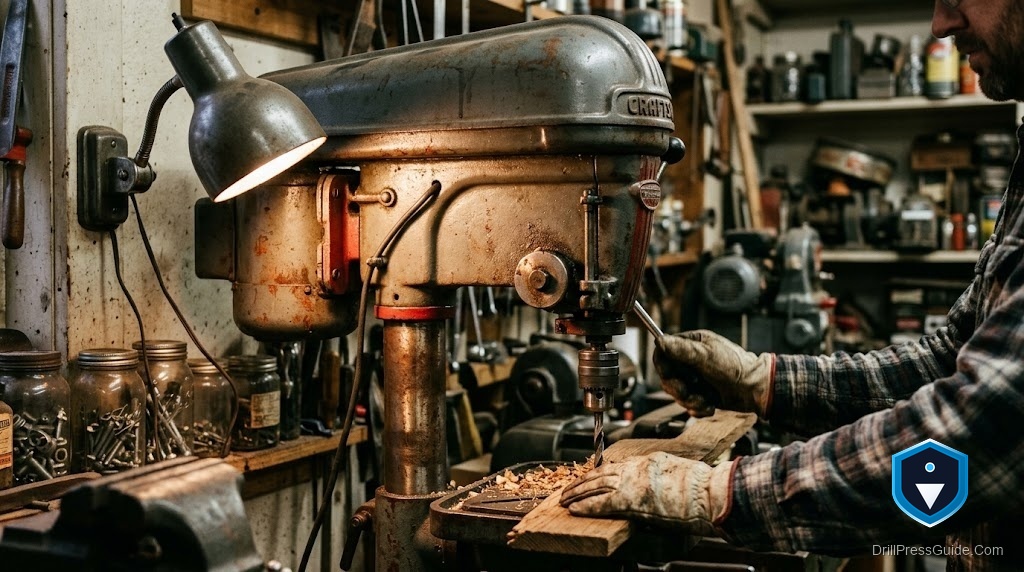
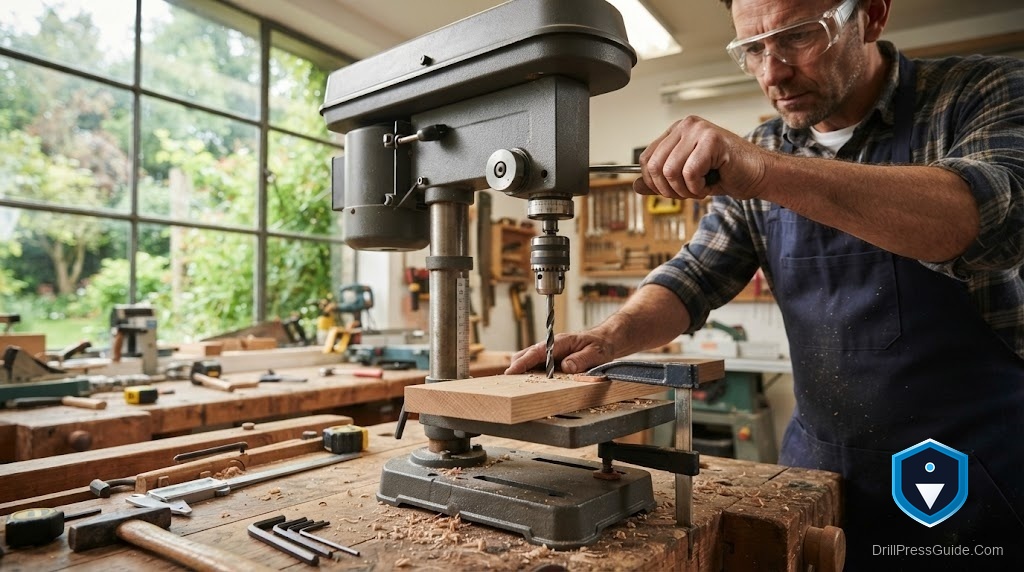
Never hold a workpiece by hand at the drill press. The rotating chuck and drill bit generate more torque than your grip can resist, and a part that grabs becomes a projectile. Wear eye protection, because swarf and hot chips fly off the cutting area without warning.
Keep hands well clear of the point of operation, clear chips with a brush and never your fingers, and let hot chips cool before handling. A quick clamp drill press vise setup or a bench clamp arrangement is not just faster, it keeps your hands where they belong.
Verdict
If you are building a safe setup from scratch, start with a solid vise like the PONY 4-inch drill press vise, then back it up with the Elsjoy 9-inch drill press clamps for heavy hold-down duty and a set of T-slot hold-down clamps for lighter fixturing and jigs. Measure your table slots first, use bolts sized to fit, and remember the golden rule: if it is not clamped, it is not safe. The small effort of clamping is nothing next to what a spinning part can cost you.
- A vise holds the workpiece, a clamp holds the vise or part to the table, and you need both.
- Measure your table slots before buying clamps or vise mounting bolts.
- Long hold-down clamps and low-profile T-slot clamps cover different fixturing needs.
- Never hold work by hand, and always wear eye protection against swarf and hot chips.
FAQ
What do drill press vise clamps do that a vise alone cannot? Clamps lock the vise, or an odd-shaped part, down to the table so the whole unit cannot spin under drilling torque. A vise grips the workpiece, but a vise resting loose on the table can still rotate. Clamps close that gap.
How do I set up a Delta drill press vise clamp? Measure the slot width on your Delta table, then choose clamps and bolts whose studs pass through those slots. Bolt the vise base down through its mounting holes and add a hold-down on the base for heavy cuts. The Delta name matters less than getting the slot dimension right.
What size drill press vise clamp bolts do I need? Pick bolts or studs long enough to pass through the vise base and the table slot with a few threads to spare, and sized to fit your slot width. Too short and they will not engage, too long and they bottom out. Confirm the thread matches your nuts or T-track.
How do I clamp a vise to a drill press securely? Position the vise over an open slot or clearance hole, drop studs through the mounting holes into the table slots, and tighten both sides evenly. Then clamp the workpiece in the jaws and add a hold-down on the base for extra security. That layered method resists spinning.
Do I always need to clamp a drill press workpiece? Yes, without exception for anything you would otherwise hold by hand. The rotating chuck can overpower your grip and fling a part instantly. Clamping is the single most important safety habit at the drill press.
What is a drill press vise bench clamp arrangement good for? A bench clamp setup lets you fix a jig or fixture, or a portable vise, to the table quickly for repetitive work. It speeds up loading parts while keeping everything secured. It is ideal when you drill many similar pieces in a row.
Is a quick clamp drill press vise worth it over bolts? A quick-clamp or lever-action setup trades a little ultimate rigidity for much faster loading, which is great for repetitive drilling. For the heaviest cuts, through-bolts still hold best. Many shops keep both and match the method to the job.
References
- OSHA, machine guarding and drilling operation safety guidance
- Machinery’s Handbook, workholding and clamping references
- Milescraft and Kreg, drill press clamping accessory documentation
- Popular Mechanics, drill press safety and setup guides
- Manufacturer owner manuals for benchtop and floor drill presses