Wilton Drill Press Vise: Compatibility and Setup Guide
I still remember the afternoon a scrap of round bar stock spun out from under my thumb on the drill press and buried itself in the shop wall. I had been holding it by hand because the part was small and I was in a hurry. That was the day I stopped being cheap about workholding and bought my first real vise. It happened to be a Wilton, and I have not gone back.
There is something reassuring about a heavy, well-machined vise. You feel it the moment you clamp a part. The workpiece stops being a projectile and becomes a fixture. Wilton has built these things for a long time, and the reputation is earned, though not every model is right for every table.
This guide walks you through choosing among genuine Wilton drill press vises, fitting one to your table, and setting it up so it actually protects you. I will also be honest about the parts that are a nuisance, because no tool is perfect and pretending otherwise helps no one.
The Wilton lineup, from low profile to precision
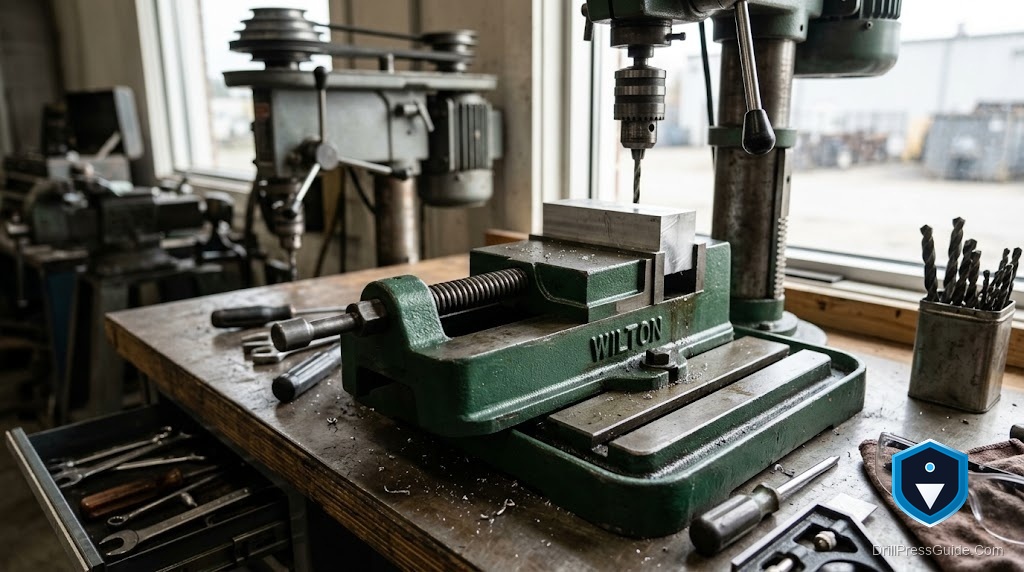
Wilton drill press vises come in a few distinct flavors, and picking the wrong one causes most of the frustration I see. The classic is the low-profile design, sized around a 4-inch jaw width, built specifically to sit close to the table so it does not eat into your quill travel. The Wilton 4-inch low-profile drill press vise is the one I reach for most, with hardened V-grooved jaws that hold round stock as happily as flat.
If you want a taller, more rectangular body that you can stand on its base, side, or end for angled work, the Wilton 11624 precision drill press vise is the flexible choice. When people search for Wilton drill press vise 4 options, these two cover the vast majority of needs.
Choosing your size: the vise 4 versus the vise 6 question
Jaw width is the number that trips people up. A 4-inch vise suits most benchtop and midsize presses and small to medium parts. Step up to a larger body, like the Wilton 6-inch low-profile drill press vise, when you routinely clamp wider stock or want more jaw surface gripping the workpiece.
The tradeoff is blunt. A Wilton drill press vise 6 is heavier, occupies more table, and costs you space you might want for clamps. A Wilton drill press vise 4 is nimble and preserves table real estate but limits how wide a part you can hold. Match the vise to your typical work, not to your biggest imaginable job.
When you need to move the part: cross slide
Sometimes you need to nudge a workpiece precisely between holes without unclamping. That is where a cross slide drill press vise Wilton owners love comes in. The Wilton cross-slide drill press vise adds two knobs that move the part horizontally and longitudinally in fine increments, turning your press into something closer to a light milling setup.
It is heavier and taller than a plain vise, so it is not the answer for everyday drilling. But for hole patterns and repeatable spacing, the control is worth the extra bulk.
Why low profile matters more than you think
The phrase low profile drill press vise Wilton uses is not marketing fluff. Quill travel on a drill press is finite. Every inch of vise height under the bit is an inch you cannot plunge. A tall vise plus a tall workpiece can leave you unable to reach through the part.
A low-profile body keeps the jaws close to the table so you preserve travel and keep the point of operation where you can see it. On smaller presses, this single feature is the difference between a vise that works and one that forces awkward workarounds.
Fitting the vise to your table
Wilton bases have mounting slots or lugs that line up with the table slots on your drill-press table. Drop bolts or studs through the mounting holes, into the table slots, and snug them down. A vise that only rests on the table and is not bolted can spin under drilling torque, which is exactly the hazard that sent my bar stock into the wall.
The V-grooved jaws are the quiet hero here. They cradle round stock so a shaft or pipe cannot roll while the drill bit enters. For flat parts, the flat jaw faces do the work, and a bit of workpiece support underneath keeps thin stock from flexing over the cutting area.
Being honest about the downsides
These vises are heavy, and that weight is a double edged quality. It makes them stable and it makes them a chore to reposition or store. The mounting can also be fussy, because your table slots and the vise base do not always align perfectly, so you may fiddle with washers, T-nuts, or step blocks to get a clean bolt-down.
Wilton drill press parts and accessories are available if you wear something out, and Wilton drill press reviews consistently praise the castings and jaw hardening. Just go in knowing you are buying a serious, weighty tool rather than a featherweight convenience.
Verdict
For most readers, the Wilton 4-inch low-profile drill press vise is the sweet spot. It preserves quill travel, holds round and flat stock with its V-grooved jaws, and fits typical benchtop presses without fuss. Choose the Wilton 11624 precision drill press vise if you value the rectangular, multi-orientation body, step up to the 6-inch low-profile model for wider work, and add the cross-slide vise only if precise part movement is part of your routine. Whichever you pick, bolt it down and wear eye protection every single time.
- Wilton offers low-profile, precision, and cross-slide drill press vises for different jobs.
- Match jaw width to your typical parts, not your largest possible job.
- Low profile preserves precious quill travel on smaller presses.
- These vises are heavy and mounting can be fussy, but the holding power is excellent.
FAQ
Are Wilton drill press vises worth the weight? Yes, for anyone who values stability and long service life. The heavy castings resist flex and vibration, which shows up as cleaner holes and safer work. The heft is a storage and handling annoyance, not a performance flaw.
How do I choose a Wilton drill press vise 6 over a smaller one? Go with the 6-inch model when you regularly clamp stock wider than a 4-inch jaw can span or want more gripping surface. If most of your parts are small, the larger vise just wastes table space. Measure your common workpieces before deciding.
Is a Wilton drill press vise 4 big enough for general shop use? For most benchtop and midsize presses, a 4-inch vise handles the majority of drilling tasks comfortably. It grips small to medium parts securely and leaves room on the table for clamps. Only step up if your work is consistently wide.
What does a cross slide drill press vise Wilton model add? It lets you move the clamped workpiece precisely along two axes without unclamping. That makes repeatable hole spacing and light positioning work far easier. The cost is added height and weight, so it is best kept for jobs that need it.
Why pick a low profile drill press vise Wilton design? A low-profile vise sits close to the table and preserves quill travel, which matters on presses with limited plunge. It also keeps the cutting area visible and the setup rigid. On tall workpieces, that saved travel can be the deciding factor.
Where do I find genuine Wilton drill press parts? Wilton supports its vises with replacement components through the manufacturer and authorized sellers. Keep your model number handy so you order the correct jaws, screws, or handles. Genuine parts preserve the fit and hardening the vise was built with.
Do Wilton drill press reviews reflect real reliability? The consensus in owner feedback points to durable castings, effective V-grooved jaws, and long life. The common complaints are weight and occasional mounting alignment fuss, not failure. That pattern matches my own bench experience.
References
- Wilton Tools, official drill press vise product line and specifications
- JPW Industries, Wilton owner manuals and parts documentation
- Machinery’s Handbook, workholding and clamping fundamentals
- OSHA machine guarding guidance on drilling operations
- Home Machinist and metalworking community reference threads