XY Table for Drill Press: Fit, Capacity, and Setup Explained
The first time I tried to drill a row of evenly spaced holes in a small brass plate, I did what most people do. I marked each center with a punch, eyeballed the alignment, and clamped the piece down by hand. Three holes in, the pattern wandered. The fourth hole crept sideways, and the whole plate went in the scrap bin. That night I went looking for a better way, and that is how I ended up learning what an XY table actually does, and just as importantly, what it does not do.
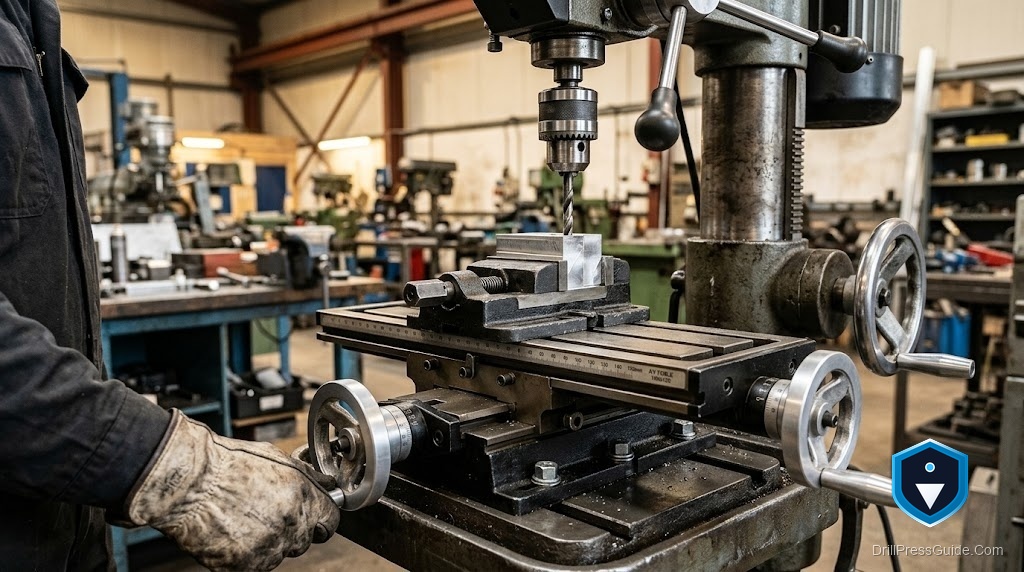
An XY table, sometimes called a cross-slide table or a compound table, is a positioning stage. It sits on your drill-press table and lets you move the workpiece precisely in two directions using two hand wheels. You dial in a coordinate, lock it, drill, then dial in the next one. For repeatable hole patterns, it feels like a superpower after years of squinting at punch marks.
Here is the honest part I wish someone had told me sooner. This tool positions holes. It is not a milling machine. A drill press spindle is built to take load straight down the axis, not sideways, so pushing a cutter into the side of a workpiece can wreck bearings and fling parts. Keep that in your head as we go, and you will buy the right thing for the right reason.
What an XY Table Actually Buys You
The core value is coordinate positioning. You clamp your workpiece once, then walk the drill bit to exact locations using the onboard rulers and the graduated dials. On a good unit, one full turn of a hand wheel moves the slide a known amount, and each pitch line on the dial is a small, predictable step. That means you can place holes on a grid without re-marking and re-clamping between every operation.
The better tables give you generous travel on the long axis and a shorter travel on the cross axis, which matches how most hole patterns are laid out. You also get T-slots that accept your own clamps, a stop block or adjustable fence for repeat parts, and sometimes a left stop and right stop so you can bracket a range of motion.
For small, precise work, the Proxxon KT 70 is a jewel-box example of the type. I have leaned on the Proxxon 27100 Micro Compound Table KT 70 for tiny plates and model parts, where its surface-treated aluminum body, three longitudinal T-slots, and dials graduated in fine increments make placement feel effortless. It is small, though, so match it to small parts.
Fit: Will It Even Sit on Your Drill Press
This is where a lot of buyers get burned. An XY table adds height, and it adds a footprint. Before you buy, measure the distance from your drill-press table to the tip of a chucked bit at the top of its travel. That is your real working clearance, and the table plus your workpiece plus the drill bit all have to fit inside it.
Column clearance matters too. A wide table can bump into the column at the back of the drill-press table, which quietly steals usable travel. Larger cast iron units like the VEVOR Milling Working Table 17.7 x 6.7 inch give you a lot of surface and long travel, but they are heavy and tall, and they can swallow a big chunk of your quill travel. On a small benchtop drill press, that is a real tradeoff.
If your parts are modest and your machine is compact, a mid-size aluminum unit such as the Mophorn cross slide milling work table splits the difference with a smaller footprint and lighter weight, at the cost of less rigidity than a heavy cast iron table.
Capacity, Travel, and the Numbers That Matter
Think in three numbers. Long-axis travel tells you the widest pattern you can reach without re-clamping. Cross-axis travel is usually shorter, so plan your part orientation around it. Table height is the tax you pay in lost bit clearance.
Pay attention to whether the specs are given in imperial dimensions or metric dimensions, because many of these tables are designed in metric and converted afterward. The screw sizes, mounting hardware, and T-slot widths follow the same pattern, so if you plan to bolt the table down through your drill-press table slots, confirm the slot spacing and the bolt diameter before you order mounting hardware.
Clamping and the Removable Insert Problem
An XY table gives you T-slots, but you still need a way to hold the work. Small hold-down clamps, a sliding fence, or a compact vise all work, as long as whatever you add does not raise the part so high that you run out of travel. This is the moment people discover that stacking a tall vise on top of a tall table leaves almost no room for the drill bit.
One thing an XY table does not solve is the table insert or removable insert question on your drill press itself. If you want a drill bit to break through the bottom of a part cleanly, you need clearance under the work. On the XY table you handle that with a sacrificial backer or by positioning the part over an open T-slot, not by relying on a drill-press table insert.
The Milling Temptation, and Why to Resist It
Search around and you will find plenty of people running end mills on a drill press XY table attachment. It looks like a tiny milling setup, and the marketing often leans into that drill press milling XY table fantasy. I understand the pull. I felt it too.
The physics do not care about the marketing. A drill press spindle and its bearings are designed for axial load, meaning force straight down. Side load from a cutter is exactly what they are not built for. You can get away with the lightest cleanup passes in soft material, but you risk chatter, a wandering cut, bearing wear, and a bit or part launching sideways. If you genuinely need to mill, buy a mill. Use the XY table for what it is brilliant at, which is placing holes.
Assembly, Materials, and First Setup
Most of these tables arrive coated in shipping grease. Plan for assembly time. Wipe everything down, work the slides through their full range, and check the gib adjustment so the motion is smooth without slop. Cast iron units feel dead solid but are heavy to muscle onto the machine. Aluminum units are friendlier to lift and less prone to flash rust, though they flex more under a firm clamp.
Once mounted, zero your dials at a known reference edge, then practice walking to a coordinate and back. A few minutes of this teaches you the backlash in your particular table, which is the small amount of dial movement before the slide actually moves. Always approach a target from the same direction and that backlash stops mattering.
Verdict
If your goal is accurate, repeatable hole placement, an XY table is one of the best upgrades you can bolt to a drill press. For small and precision parts, the Proxxon KT 70 is my pick for feel and finish. For larger work where you have the clearance and want maximum surface, a heavy cast iron VEVOR table earns its keep, as long as you accept the weight and the height it steals. The Mophorn aluminum table is the sensible middle choice for a compact benchtop machine.
Buy it as a positioning tool, respect the axial-load limit, measure your clearance first, and you will love it. Buy it expecting a milling machine and you will be disappointed and possibly hurt.
- An XY table is for precise hole positioning, not for real milling on a drill press.
- Measure your bit-to-table clearance before buying, because the table plus vise plus bit must all fit.
- Long-axis and cross-axis travel define the largest pattern you can drill without re-clamping.
- Match the size to your parts: small Proxxon for tiny work, heavy cast iron for big work with clearance to spare.
FAQ
What is an XY table for a drill press? It is a two-axis positioning stage that mounts on your drill-press table. Two hand wheels move the workpiece left-right and front-back so you can place holes at exact coordinates. It replaces repeated marking and re-clamping with dialed-in, repeatable positioning.
What is the best XY table for a drill press? There is no single winner, because the best table depends on your parts and your machine clearance. For small precision work the Proxxon KT 70 is hard to beat, while heavy cast iron units suit larger jobs. Match travel and height to the work you actually do.
Is there a Craftsman XY drill press table? Craftsman has sold drill presses and accessories over the years, but the compound and cross-slide table market today is dominated by brands like Proxxon, Grizzly, and VEVOR. If you find a Craftsman-branded unit, judge it by the same measures, which are travel, rigidity, T-slot fit, and height. The badge matters less than the specs.
Can I build a homemade XY table for a drill press? Many woodworkers build a simple flat drill-press table from MDF with an adjustable fence, a stop block, and a removable insert, which handles a lot of everyday work. A true two-axis DIY drill press XY table with fine positioning is much harder to make accurate, since it needs precise slides and low backlash. For coordinate work, a manufactured table is usually the better value of your time.
How does a drill press XY table attachment mount? Most tables bolt down through the T-slots or holes in your drill-press table using the supplied mounting hardware. Confirm your slot spacing and bolt diameter before ordering, and check that the table does not foul the column at the back. A secure mount is what keeps positioning honest.
Can I use a drill press milling XY table for real milling? No, not safely for anything beyond the lightest cleanup in soft material. A drill press spindle is designed for downward axial load, not the side load that milling creates, so cutting sideways risks bearing damage and thrown parts. If you need to mill, use a milling machine.
What is the difference between a drill press XY table and a drill press with an XY vise? An XY table is a standalone positioning stage that you add your own clamping to, while a drill press with an XY vise combines the positioning slides and the jaws into one unit. The vise style is quicker for gripping small parts, but it adds height and flex. The table style offers more surface and flexible clamping options.
References
- Proxxon, manufacturer technical specifications and product documentation (proxxon.com)
- Grizzly Industrial, machine and accessory catalog and manuals (grizzly.com)
- Fine Woodworking, drill press setup and jig guidance (finewoodworking.com)
- Popular Woodworking, shop accuracy and fixturing articles (popularwoodworking.com)
- Machinery’s Handbook, general references on spindle loading and fixturing (industrialpress.com)