Choosing a Drill Press Vise That Fits the Work and the Table
The first time a small steel bracket spun loose under my bit, it taught me more than any manual ever did. I had one hand pinching the part, the other reaching for the start/stop button, and a fresh gouge across my knuckle to show for it. That is the moment most people go looking for a drill press vise, and honestly, it is the moment they should. Holding a part with your fingers near a rotating chuck is a gamble you lose eventually. A good vise turns that gamble into a boring, repeatable, safe operation, which is exactly what you want when a drill bit is spinning an inch from your hand.
So let me walk you through how to actually pick one, because “just buy a vise” hides a surprising number of ways to buy the wrong thing.
Match the vise to your table first, not to the part
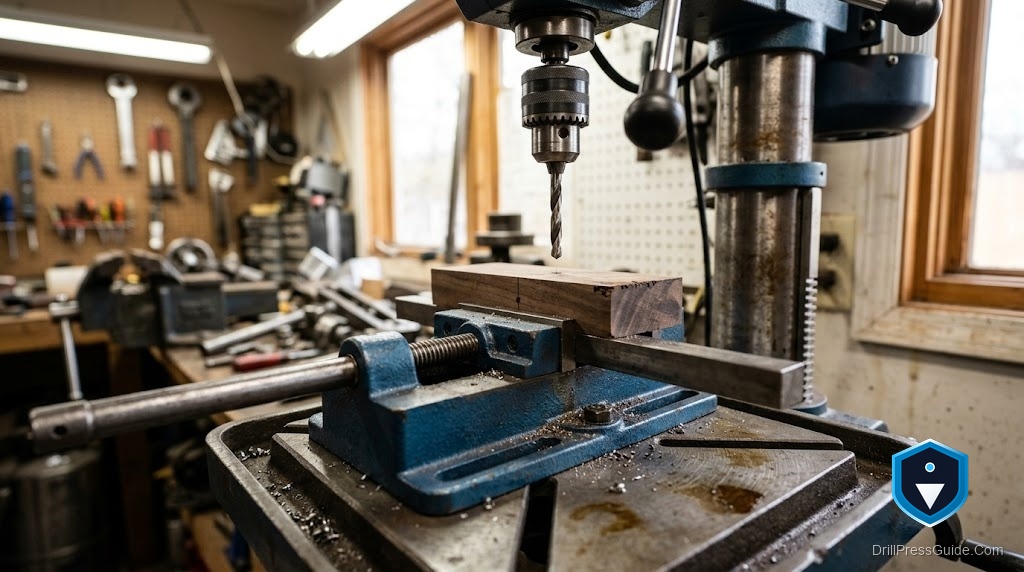
Everyone shops by jaw width. That is backward. Before you think about the workpiece, look at your drill-press table. Note the table slots, their width, and how far apart they sit, because that is what determines how you will bolt the vise down. A vise with elongated mounting holes gives you room to line up the fasteners with slots that were never designed for your specific brand. If the base is drilled for a spacing your table cannot match, you end up clamping the vise with a separate hold-down clamp, which works but wastes real estate.
Secure clamping is the whole point. A vise that only sits on the table, rather than getting bolted through its mounting holes, can walk sideways the instant the bit grabs. I want at least two fasteners into the table slots on any vise I trust with metal.
How wide should the jaws be?
The honest answer: smaller than you think. A 4-inch drill press vise handles the overwhelming majority of hobby and shop work, and the classic 4-inch low-profile Wilton drill press vise is the one I hand to people who ask. The low profile matters more than the width. A tall vise eats your quill travel, and suddenly your drill bit cannot reach the workpiece without cranking the table up awkwardly close to the cutting area.
Here is the rough ladder I use:
- A 3-inch drill press vise suits tiny parts, hobby stock, and benchtop machines with short travel.
- A 4-inch drill press vise is the everyday sweet spot for most tables.
- A 5-inch drill press vise, or a true 5 inch drill press vise with a wider throat, earns its keep once you drill larger plate and wider stock.
- An 8-inch drill press vise is a specialty tool for big fabrication tables, not a bench machine.
If you run a compact bench drill press vise setup, resist the urge to oversize. A vise that overhangs the table blocks your table slots and makes clamping harder, not easier.
The vise jaws do the quiet work
Look at the vise jaws themselves. V-grooved jaws hold round stock horizontally and vertically, which is the difference between drilling a clean hole in a rod and watching that rod cartwheel across the shop. Hardened jaws resist the dings that eventually keep a part from seating flat. Flat-bottom seating matters too, because a workpiece that rocks will grab the bit on breakthrough every single time.
When you actually need X-Y movement
Most people do not need a compound vise. But if you drill hole patterns, bolt circles, or anything that needs precise spacing without re-clamping, an X-Y drill press vise changes your day. Being able to nudge the part along two axes with handwheels means you set the workpiece once and move the table-bound vise instead of the part. The HFS two-way X-Y compound cross slide vise is a genuinely useful example, with cross and longitudinal travel that lets you creep up on a layout line.
The trade-off is real, and I will not sugarcoat it. A cross slide vise raises the work higher off the table, stealing quill travel, and the slides introduce a little flex that precision milling would hate. For drilling, though, that flex is a non-issue. Just do not buy one expecting a milling machine.
Where the cheaper vises fall down
I have owned bargain vises, and the flaws follow a pattern. The screw feels gritty and the jaws rack, meaning they close tighter at the top than the bottom, so thin stock lifts. The castings are rough, and swarf packs into the ways until the slide binds. And the base slots are sometimes too narrow for common fasteners, so you fight the mounting the entire time.
A more precision-oriented vise, like the Wilton 11624 precision drill press vise, addresses most of that with a ground base and a rectangular body you can stand on its side or end. It costs you in weight and setup fuss, but the hold is confidence-inspiring.
Verdict
A drill press vise is one of the few accessories that makes your machine both safer and more accurate at the same time, which almost never happens in this hobby. Buy for your table first, keep the profile low, and get real jaws before you get wide jaws.
- Bolt the vise through its mounting holes into the table slots, not just on top of the table.
- A low-profile 4-inch vise fits the widest range of work and preserves quill travel.
- V-grooved, hardened jaws are the feature that pays off on round stock and repeat work.
- Choose an X-Y vise only for hole patterns, and accept the lost travel as the cost.
FAQ
Is a 4-inch drill press vise big enough for most projects? Yes. A 4-inch drill press vise covers the vast majority of woodworking and light metal work. Wider jaws mostly add weight and eat table space, so most people are better served staying at four inches unless a specific part demands more.
When does a 3 drill press vise make more sense than a bigger one? A 3-inch drill press vise shines on benchtop machines with short quill travel and on small parts, because its lower height keeps the workpiece close to the drill bit without cranking the table up into the cutting area.
Do I really need a 5 inch drill press vise or an 8 drill press vise? Only if your stock is genuinely wide. A 5-inch drill press vise handles larger plate comfortably, and an 8-inch drill press vise is a fabrication-table tool. On a bench machine, either one usually overhangs the table and blocks your clamping slots.
What is an X-Y drill press vise for? An X-Y drill press vise lets you move the workpiece along two axes with handwheels, so you can drill spaced hole patterns without re-clamping. It is excellent for layout work and poor for true milling because the slides flex.
Can I use a drill press vise on a drill press from any brand, like a Delta or Craftsman? Generally yes. A Delta drill press vise or a Craftsman drill press vise is not really brand-specific hardware. What matters is whether the vise base slots line up with your table slots so you can bolt it down with proper fasteners.
How do I keep a bench drill press vise from shifting during a cut? Secure clamping is everything. Bolt the vise through its mounting holes, and if your table slots do not align, add a hold-down clamp. A vise that only rests on the table can spin the instant the bit grabs.
What safety habits matter most with a vise? Wear eye protection, keep your hands away from the point of operation, and never reach across the rotating chuck. Let hot chips and swarf cool before you brush them, and use proper workpiece support so nothing lifts on breakthrough.
References
- Wilton Tools, official drill press vise product documentation, wiltontools.com
- WEN Products, drill press vise specifications, wenproducts.com
- Occupational Safety and Health Administration, machine guarding and point-of-operation guidance, osha.gov
- Grizzly Industrial, cross-sliding vise specifications and usage notes, grizzly.com