
How to Remove a Chuck from a Drill Press: The Complete Method
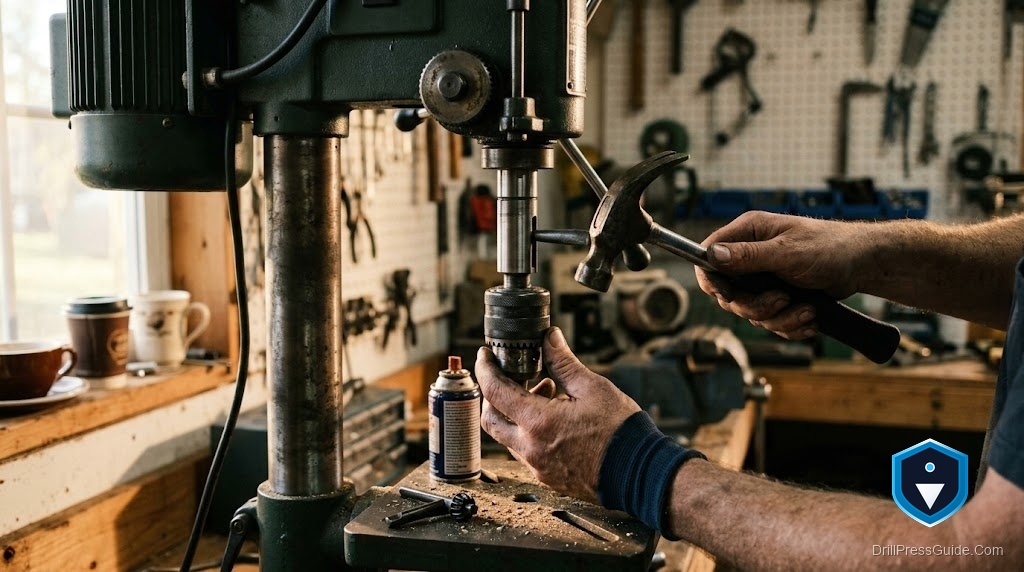
The bit keeps wobbling, or you want to fit a keyless chuck, or the jaws are packed with grit and rust. Whatever brought you here, learning how to remove a chuck from a drill press is a skill every owner should have, and it is far easier than it looks once you know which of three mounts you are dealing with.
The chuck is the three jaw clamp that holds your bit, and it attaches to the spindle in one of three ways. Identify the mount, use the matching method, and the chuck comes off cleanly. Guess, and you risk cracking a casting or bruising the spindle.
Identify your mount first
Unplug the press, then open the chuck jaws all the way and look inside and around the top of the chuck.
- Tapered arbor or integral taper: a smooth shoulder with no fastener means the chuck is pressed onto a taper, either a removable arbor with a Morse taper into the quill, or a Jacobs taper machined onto the spindle nose. This is the most common setup.
- Bolt retained: a screw head or Allen socket at the bottom of the bore means a fastener holds the chuck. It is often a left hand thread.
- Threaded collar: a collar with small spanner holes above the chuck means turning the collar ejects the chuck.
A flashlight makes this obvious. Matching the method to what you actually see is the whole job.
Method 1: taper mounted chuck (wedges)
This is the classic drill press chuck. Lower the quill and lock it so it cannot ride up, and set a block of wood under the chuck to catch it.
Slide a pair of chuck removal wedges into the gap between the back of the chuck and the spindle shoulder, one on each side for even pressure. Tap or squeeze them together, alternating sides, until the taper releases with a crack and the chuck drops. A proper drill chuck removal wedge set seats in the shoulder gap and pushes the chuck off square, which beats improvising with screwdrivers that gouge the spindle. If the gap is tight, tap the jaws down first to open room for the wedges.
Method 2: removable arbor with a drift slot
Some presses have an elongated hole through the quill, called a spindle access window. Lower the quill to line up the slot, then drive a taper drift key through it with a mallet. The drift pushes against the top of the arbor and ejects the whole arbor and chuck together as one unit. Catch it on a wood block. You then separate the chuck from the arbor on the bench with wedges if needed.
Method 3: bolt retained or threaded collar
For a bolt retained chuck, open the jaws fully, insert a hex key or screwdriver, and back out the retaining screw, turning clockwise if it is a left hand thread. With the screw out, the chuck lifts off or the arbor drifts free.
For a threaded collar, insert a short rod into a collar hole and turn the collar in the direction that walks it toward the chuck, which presses the chuck off the shaft.
Dealing with a stuck chuck
Rust is the usual villain. Apply penetrating oil at the seam and wait several minutes, or longer for a badly seized fit, then try again. Keep pressure even, since a cocked chuck jams harder than a square one. Never pry against the head casting with a screwdriver, because cast iron chips and cracks rather than flexes. As a true last resort on a scrap chuck, you can drill through the chuck body and press the taper out from behind, sacrificing the chuck to save the spindle.
Reinstalling a chuck that runs true
Clean both mating surfaces bone dry with a rag, removing every trace of oil, grit, and rust, because contamination is the top cause of runout. Seat a taper chuck by closing the jaws, resting them on a wood block, and giving one firm push straight down. The taper self holds. For threaded or bolt retained chucks, reverse the removal steps. Never seat a chuck by running the motor down into the table. Finish by spinning the spindle by hand to confirm the bit runs true.
The verdict
Removing a drill press chuck is a fifteen minute job when you read the mount first.
- Unplug the press and identify the mount by opening the jaws and looking inside.
- Use wedges for tapers, a drift for a removable arbor, and unscrew threaded or bolt retained chucks.
- Treat rust with penetrating oil and patience, and never pry on the casting.
- Clean both surfaces dry before reseating so the new chuck runs true.
FAQ
How do I remove a chuck from a drill press without special tools? For a bolt retained chuck you only need a hex key. For a taper mount, wedges are strongly preferred, but in a pinch two stout flat bars can substitute, though proper wedges avoid marring the spindle. A drift works for a removable arbor.
How do I know if my chuck is taper mounted or threaded? Open the jaws fully and look. A smooth shoulder with no fastener means a taper, a screw or socket inside means bolt retained, and a collar with holes means a threaded ejection collar.
What is the slot above my chuck for? That is the spindle access window, or drift slot. You lower the quill to expose it and drive a taper drift through it to eject a removable Morse taper arbor along with the chuck.
My chuck will not come off. What now? Apply penetrating oil at the seam and wait, then try again with even pressure on the wedges. Heavy rust can need an overnight soak. Never pry against the casting, and if the chuck is scrap, drilling it out is the last resort.
Will removing the chuck damage my drill press? Not if you use the right method and keep force even. Damage comes from prying on the casting or hammering the chuck body with steel, so use wedges or a drift and support the chuck as it drops.
Do I need to remove the whole spindle to get the chuck off? No. The chuck comes off with the head assembled and in place. You only remove the spindle for deeper bearing or quill service.
How do I stop my new chuck from wobbling? Clean the taper on the spindle and the chuck bore until they are bone dry, remove any burrs, and seat the chuck with one firm tap on a wood block. Runout almost always traces back to a dirty or damaged taper.
References
- Jacobs Chuck Manufacturing, Mounting and Removing Chucks (jacobschuck.com)
- VintageMachinery.org Knowledge Base, drill press chuck and arbor removal (vintagemachinery.org)
- Popular Woodworking, Drill Press Setup and Maintenance (popularwoodworking.com)


