Harbor Freight 8-Inch Drill Press Chuck Replacement: A Workshop Troubleshooting Guide
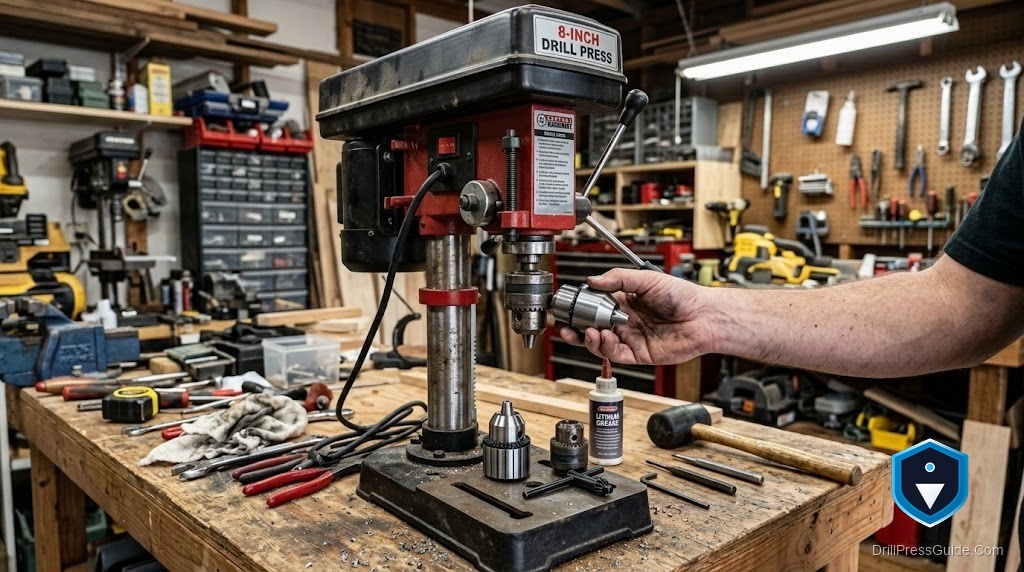
The 8-inch Harbor Freight benchtop press is a fixture in home shops, and its small factory chuck is often the first thing owners want to upgrade when the jaws stop gripping straight. Harbor Freight 8-inch drill press chuck replacement is a quick job, and the key is matching the new chuck to the small press’s taper and capacity, because an 8-inch press uses a lighter mount than its bigger siblings.
The chuck is the three-jaw clamp that holds the bit. On the 8-inch Harbor Freight press it is a 1/2-inch chuck on a JT33 Jacobs taper, sometimes seated directly on a JT33 spindle stub and sometimes on a small arbor. Replacing it means removing the old chuck and fitting a matching JT33 chuck so bits run true.
Short answer: unplug the press, remove the old chuck by breaking its taper, confirm whether your press has a JT33 spindle stub or an MT2 arbor, then fit a matching JT33 chuck, keyed with a k-32 key or keyless, and check runout on a straight bit.
Troubleshoot and identify first
- Bit slips or sits off-center: worn jaws; a new chuck fixes it.
- Confirm the capacity: the 8-inch press takes a 1/2-inch chuck, not the larger sizes its bigger presses use.
- Confirm the mount: many 8-inch presses have a JT33 spindle stub that takes a JT33 chuck directly; some use a small arbor.
- Chuck key size: the factory keyed chuck uses a k-32 self-ejecting key, stamped on the chuck.
The chuck to fit
A keyless drill chuck with a JT33 mount and MT2 arbor suits the common JT33 setup and lets you change bits without a key, which is handy on a small press used mostly for wood and light work. Confirm whether your press takes the chuck on a JT33 spindle stub directly or on an arbor before ordering, and match accordingly.
The honest drawback: a keyless chuck can loosen under heavy metal drilling, where a keyed chuck grips firmer, and if your press seats the chuck directly on a JT33 stub you want a JT33 chuck without the extra arbor. Who should keep a keyed chuck: anyone drilling hard into steel who can simply fit a fresh k-32 key.
Replacing it, step by step
- Unplug the press.
- Remove the old chuck: on a taper mount, expose the spindle slot by lowering and locking the quill and drive a drift or wedges into the slot; on a JT33 stub, press or wedge the chuck off the stub.
- Clean the mount, spindle stub or arbor, and the new chuck bore until dry and bright.
- Press the new JT33 chuck onto the stub or arbor with the jaws open.
- Chuck a straight bit, spin by hand, and confirm no wobble.
- Test on scrap before real work.
Match the taper and capacity, seat it clean
Replacing the chuck on an 8-inch Harbor Freight press is quick once you match the JT33 taper and 1/2-inch capacity and confirm whether it seats on a stub or an arbor. Seat it clean and dry, and the small press drills true again.
Three takeaways:
- The 8-inch press uses a 1/2-inch JT33 chuck, lighter than its bigger presses.
- Confirm a JT33 spindle stub versus an arbor before choosing a chuck.
- Seat on clean, dry tapers and check runout with a straight bit.
FAQ
What chuck does the Harbor Freight 8-inch drill press use? A 1/2-inch chuck on a JT33 Jacobs taper, seated on a JT33 spindle stub or a small arbor depending on the model. Confirm yours before buying.
What chuck key size does it use? The factory keyed chuck uses a k-32 self-ejecting key, with the size stamped on the chuck. Match that, or switch to a keyless chuck to skip the key.
How do I remove the old chuck? On a taper mount, expose the spindle slot by lowering and locking the quill and drive a drift or wedges in; on a JT33 stub, press or wedge the chuck off the stub.
Can I fit a bigger chuck for larger bits? The 8-inch press is built around a 1/2-inch chuck. A larger chuck exceeds its capacity and spindle, so stay with the 1/2-inch size.
Keyed or keyless for this press? Keyless is quick for wood and light work; keyed grips firmer for metal. Choose for the work you do most on a small press.
Why does the new chuck wobble? Usually a dirty or nicked taper. Clean the mount and chuck bore dry and bright, reseat, and recheck runout with a straight bit.
References
- Harbor Freight, 8-inch bench drill press manual and parts: https://www.harborfreight.com
- Grizzly Support, drill chucks and arbors guide: https://support.grizzly.com/hc/en-us/articles/4412902171415-How-to-drill-chucks-arbors-101