
How to Adjust Drill Press Without Chuck Key: What to Check Before You Start
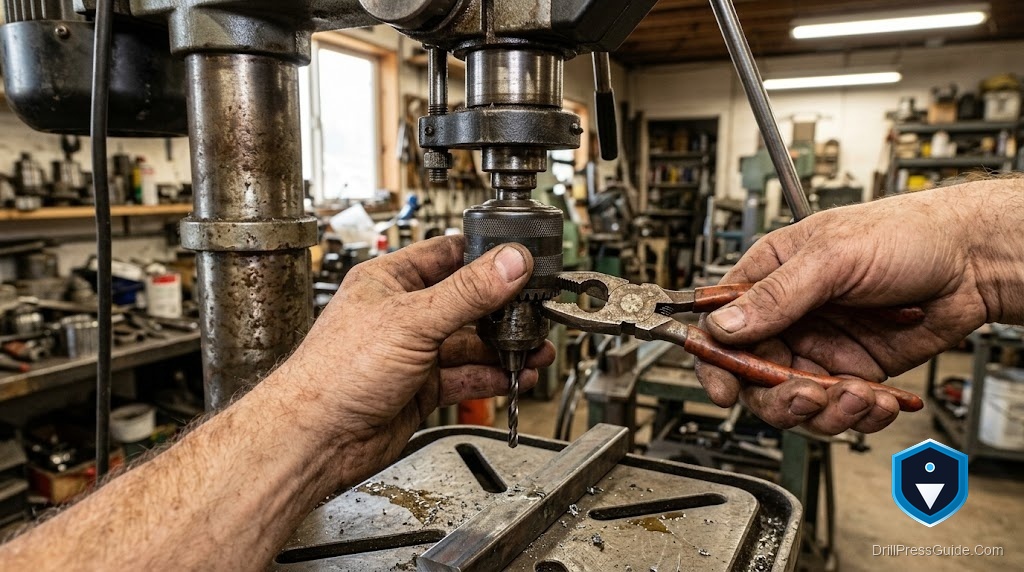
Losing the chuck key is the classic workshop headache: the press is ready, the bit is waiting, and the one small tool you need has vanished. Knowing how to adjust a drill press without a chuck key gets you working again, and what you check before you start, which chuck you have and whether a lasting fix makes more sense, decides whether this is a one-time workaround or a permanent upgrade.
The chuck is the three-jaw clamp that grips the bit, and on a keyed chuck a toothed key turns the collar to open and close the jaws. Adjusting without the key means opening and closing those jaws by another safe method, or switching to a keyless chuck that needs no key at all.
Short answer: first check whether your chuck is keyed or keyless. A keyless chuck needs no key, just a firm hand grip. For a keyed chuck with no key, use a correctly sized replacement key, and for a lasting fix, switch to a keyless chuck.
What to check before you start
- Keyed or keyless. A keyless chuck opens and closes by hand; you never needed a key. Confirm which you have first.
- Key size. Keyed chucks take a specific key size stamped on the chuck; a replacement of the right size solves it properly.
- Safety. Never run the press to tighten or loosen the jaws, and never grip a spinning chuck. Both are how people get hurt.
- Long-term fit. If keys keep vanishing, a keyless chuck removes the problem for good.
The lasting fix
If you are tired of hunting for a key, a keyless drill chuck with a JT33 mount and MT2 arbor lets you tighten and release bits by hand, no key ever again, and it fits the common benchtop setup. Confirm your arbor’s Jacobs taper and spindle Morse taper before ordering.
The honest drawback: a keyless chuck can loosen under heavy drilling in metal, where a keyed chuck grips firmer. Who should keep a keyed chuck: anyone drilling hard into steel who wants the strongest hold, and who can simply buy a replacement key.
Safe workarounds in the meantime
- Unplug the press before touching the chuck.
- For a keyless chuck, grip the collar firmly by hand and turn to open or close the jaws.
- For a keyed chuck, fit a correctly sized replacement key; do not improvise with pliers on the collar teeth, which damages them.
- Never spin the motor to tighten or loosen the jaws.
Check the chuck, then work safely
Adjusting without a chuck key comes down to what you have: a keyless chuck needs no key, and a keyed one needs the right replacement key. For a permanent fix, a keyless chuck ends the problem. Whatever you do, keep the press unplugged and never grip a spinning chuck.
Three takeaways:
- Check keyed versus keyless first; a keyless chuck never needed a key.
- Use a correctly sized replacement key for a keyed chuck; do not improvise with pliers.
- A keyless chuck is the lasting fix if keys keep going missing.
FAQ
Can I adjust a keyed chuck without the key? Not safely with improvised tools; pliers damage the collar teeth. Use a correctly sized replacement key, or switch to a keyless chuck for a lasting fix.
How do I open a keyless chuck? Grip the collar firmly by hand and turn it to open or close the jaws. A keyless chuck needs no key at all.
What key size does my chuck take? The size is stamped on the chuck body. Match that number when buying a replacement key.
Can I run the motor to tighten the bit? No. Never spin the press to open or close the jaws, and never grip a spinning chuck. Both are serious injury risks.
Is a keyless chuck worth switching to? Yes, if you often misplace the key or do mostly wood and light work. It tightens by hand, though a keyed chuck grips firmer in heavy metal drilling.
Will a keyless chuck fit my press? Usually, if you match the Jacobs taper and the spindle Morse taper, commonly JT33 and MT2. Confirm both before buying.
References
- Grizzly Support, drill chucks and arbors guide: https://support.grizzly.com/hc/en-us/articles/4412902171415-How-to-drill-chucks-arbors-101
- VintageMachinery.org, drill press chuck documentation: http://vintagemachinery.org


