
How to Remove Chuck from Harbor Freight Drill Press: A Clear, Shop-Ready Method
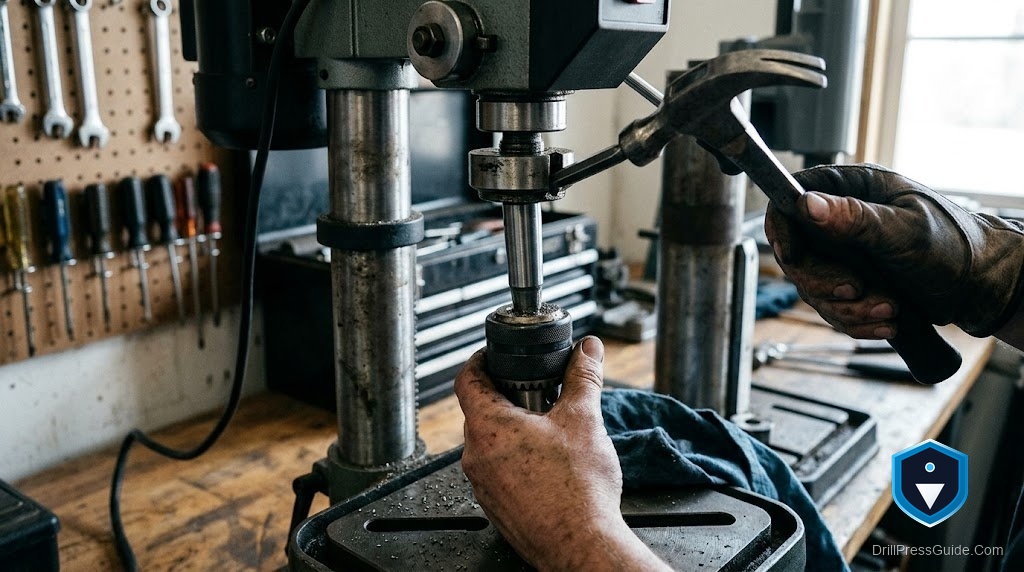
Swapping the chuck on a Harbor Freight press is one of the first upgrades most owners want, whether the factory chuck runs out or you are fitting a better keyless one. Knowing how to remove the chuck from a Harbor Freight drill press comes down to one fact: the chuck is held by a friction taper, not a bolt, so you break the joint rather than unscrew it, and doing it cleanly is what lets the next chuck run true.
The chuck sits on an arbor whose Morse taper wedges into the spindle, and the chuck itself grips that arbor on a shorter Jacobs taper. Removing it means driving a drift or wedges into the spindle slot to press the arbor and chuck out, then, if you are only changing the chuck, pressing the chuck off its arbor.
Short answer: unplug the press, lower and lock the quill to expose the spindle slot, then drive a drift key or a pair of tapered wedges into the slot to press the arbor and chuck straight out. Support the chuck as it drops and keep tools off the ground taper faces.
Keyed or keyless, and what you are fitting back
Before you pull anything, know what you are putting back:
- Harbor Freight benchtop presses use an MT2 spindle with a JT33 chuck.
- A keyed chuck grips harder for metal but needs the key; a keyless chuck is quicker for wood and light work.
- The chuck key size is stamped on the key or chuck; match it if you keep the keyed chuck.
- To attach a new chuck, you seat it on a clean arbor, then seat that arbor in the spindle.
The tool that protects accuracy
A factory drift key works in the spindle slot if you have one. A drill chuck removal wedge set covers both the Morse and Jacobs joints and spreads force on the shoulders instead of the ground faces, which is what preserves the surfaces that center the chuck. It fits the JT33 and JT6 tapers on these presses.
The honest drawback: the chuck drops the instant the taper releases, so support it. Who should skip the wedges: anyone with a clean spindle slot and the correct factory drift.
Removing it, step by step
- Unplug the press.
- Decide: whole assembly out, or just the chuck.
- For the assembly, lower and lock the quill to expose the spindle cross slot, then drive a drift or wedges into the slot.
- For the chuck alone, set wedges between the chuck and the arbor shoulder and press it off.
- Support the chuck so it lands soft; keep tools off the taper faces.
- Wipe every taper dry and bright before refitting.
Break the taper, keep it true
Removing a Harbor Freight chuck is a friction-joint job on a standard MT2 spindle. Decide which taper to break, use a drift or wedges on the shoulders, support the chuck, and reseat on clean, dry surfaces so the next chuck runs true.
Three takeaways:
- The chuck holds by a taper; break the joint, do not unscrew it.
- Match a keyed or keyless replacement to the JT33 arbor and MT2 spindle.
- Support the chuck, keep tools off the taper faces, and reseat dry.
FAQ
How is the chuck held on a Harbor Freight drill press? By a Morse taper arbor wedged into the MT2 spindle, with the chuck on a JT33 taper. It is friction, not threads, so you break the taper to remove it.
How do I remove the chuck? Lower and lock the quill to expose the spindle slot, then drive a drift key or wedges into the slot to press the arbor and chuck out.
What chuck key size does it use? The size is stamped on the key and chuck body. Match that number if you keep the keyed chuck, or switch to a keyless chuck to skip the key.
How do I attach a new chuck? Seat the chuck on a clean JT33 arbor, then seat the arbor’s MT2 taper firmly in the spindle. Clean, dry tapers are what hold it.
The taper will not release. What now? Soak the joint with penetrating oil, wait, and try again. A seized taper needs time, not more force.
Can I damage the press removing the chuck? Yes, if you pry the slot or taper with a screwdriver. Use a drift or wedges on the shoulders to protect the surfaces.
References
- Harbor Freight, drill press manuals and parts: https://www.harborfreight.com
- Grizzly Support, drill chucks and arbors guide: https://support.grizzly.com/hc/en-us/articles/4412902171415-How-to-drill-chucks-arbors-101


