
How to Remove and Reinstall a Drill Press Chuck: What to Check Before You Start
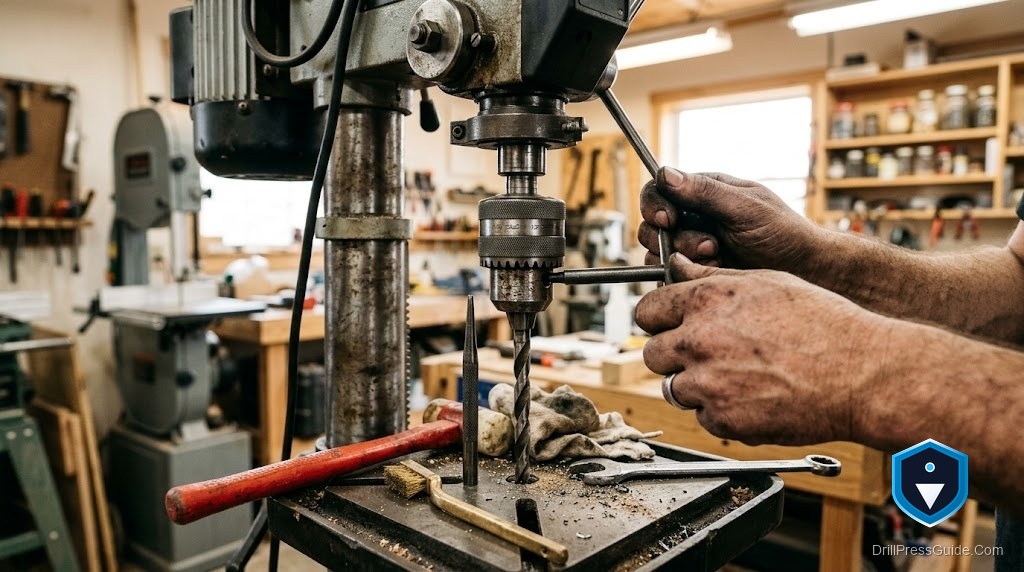
Removing and reinstalling a drill press chuck is one of those skills that looks intimidating until you understand that the chuck is held by nothing but a friction taper. How to remove and reinstall a drill press chuck comes down to breaking one taper cleanly and seating it again on spotless surfaces, and what you check before you start, which taper, how clean, and how to support the chuck, decides whether it runs true afterward.
A drill press chuck rides on an arbor whose Morse taper wedges into the spindle, while the chuck itself wedges onto the arbor with a shorter Jacobs taper. Removing and reinstalling it means breaking and remaking these friction joints without damaging the ground surfaces that center everything.
Short answer: unplug the press, expose the spindle slot by lowering and locking the quill, and drive a drift or wedges into the slot to press the arbor and chuck out. To reinstall, clean every taper, press the chuck onto the arbor, and seat the arbor firmly in the spindle.
What to check before you start
- Which taper. Are you removing the whole assembly (break the Morse taper) or just the chuck (break the Jacobs taper)? The tool goes in a different place for each.
- Cleanliness. Have a clean rag ready; the tapers must be dry and bright to grip.
- Support. Plan how you will catch the chuck, since it drops the instant the taper releases.
- No oil. Confirm you will seat the tapers dry, because oil stops them gripping.
Removing it, step by step
- Unplug the press.
- Lower and lock the quill to expose the spindle cross slot.
- Drive a drift key or a pair of wedges into the slot with steady taps.
- Press the arbor and chuck straight down and out, supporting the chuck.
- For the chuck alone, set wedges between the chuck and arbor shoulder and press it off.
The tool that does both jobs
A factory drift key handles the spindle slot, but a drill chuck removal wedge set breaks both the Morse and Jacobs tapers while spreading force on the shoulders instead of the ground faces, which is what keeps the chuck running true. It fits the JT33 and JT6 tapers on most presses.
The honest drawback: the chuck releases suddenly, so support it every time. Who should skip the wedges: anyone with a clean spindle slot and the correct factory drift key already.
Reinstalling it, step by step
- Clean the arbor’s Morse taper, the spindle bore, the JT33 stub, and the chuck bore until dry and bright.
- Press the chuck onto the arbor with the jaws open, one firm push or a soft-mallet tap on the arbor end.
- Retract the jaws, then seat the arbor in the spindle with a firm upward push.
- Chuck a straight bit, spin by hand, and confirm no wobble.
Break it clean, reseat it clean
Removing and reinstalling a chuck is a friction-taper job at both ends. Decide which taper to break, use a drift or wedges on the shoulders, support the chuck, then reseat on spotless, dry surfaces so it runs true.
Three takeaways:
- The chuck is held by a friction taper; break the joint, do not unscrew it.
- Decide which taper you are breaking before you start, and support the chuck.
- Reseat on clean, dry tapers, never oiled, so the chuck grips and runs true.
FAQ
How is a drill press chuck held on? By friction. The arbor’s Morse taper wedges into the spindle, and the chuck wedges onto the arbor with a shorter Jacobs taper. No threads are involved.
How do I remove the chuck? Expose the spindle slot by lowering and locking the quill, then drive a drift key or wedges into the slot to press the arbor and chuck out.
How do I reinstall it so it runs true? Clean every taper until dry and bright, press the chuck onto the arbor, then seat the arbor firmly in the spindle. Clean surfaces are what keep it true.
Should I oil the taper before reinstalling? No. Oil prevents the friction grip. Seat every taper clean and dry.
Where do I tap to seat the chuck? On the arbor end with a soft mallet, never on the chuck body, which can damage the jaws.
Why does the chuck wobble after reinstalling? Usually a dirty or nicked taper. Clean all mating surfaces and inspect the arbor, then reseat.
References
- VintageMachinery.org, drill press chuck and taper documentation: http://vintagemachinery.org


