
Harbor Freight Benchtop Drill Press Replacement Chuck: A Workshop Troubleshooting Guide
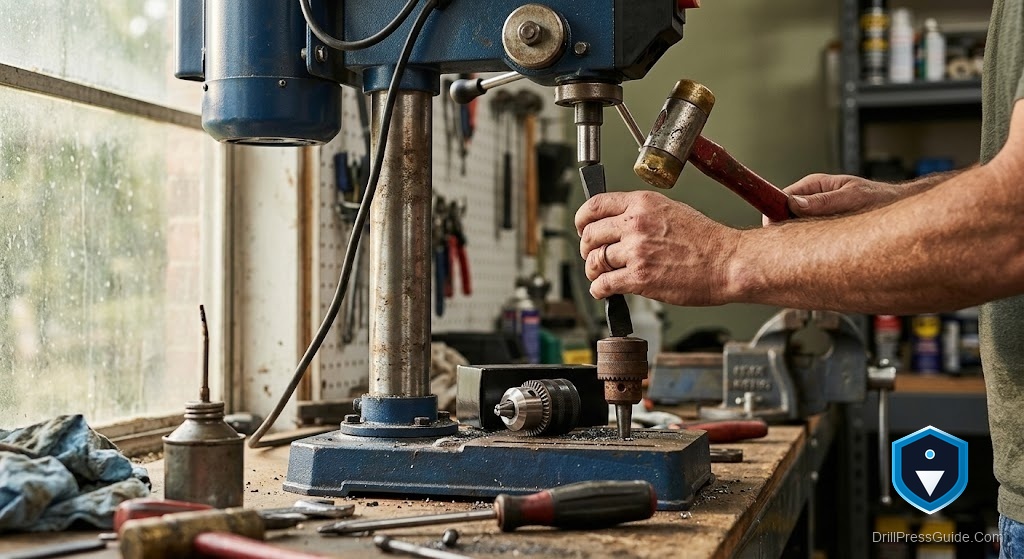
A worn chuck is the single most common reason a Harbor Freight benchtop press starts drilling sloppy holes, and it is also the easiest fix on the whole machine. A Harbor Freight benchtop drill press replacement chuck drops in cleanly because these presses use a standard MT2 spindle with a JT33 chuck, which means you are not hunting for a proprietary part, just matching a common taper.
A drill press chuck rides on a tapered arbor whose Morse taper seats into the spindle. Replacing it means removing the old chuck and fitting a new one, with a matching JT33-to-MT2 arbor, then seating the tapers clean so it grips and runs true.
Short answer: confirm the benchtop spindle is MT2 (most Harbor Freight benchtop presses are), rule out a dirty taper as the cause of wobble, then fit a JT33 chuck on an MT2 arbor, clean every surface, and seat with a firm push.
Troubleshoot before replacing
Sloppy holes are not always a dead chuck:
- Clean the arbor’s taper and the spindle bore, reseat, and test with a straight bit. A dirty taper mimics a worn chuck.
- Check that the jaws close evenly and the key seats fully.
- Confirm the arbor is not loose in the spindle.
If a clean taper and a straight bit still wobble, replace the chuck.
Choosing the replacement
Because these presses are MT2, options are wide. A heavy-duty MT2 keyless chuck with JT33 mount lets you change bits by hand and runs with low runout, the convenient pick for mixed shop work. The honest tradeoff: keyless chucks can loosen a little during aggressive metal drilling.
If you drill metal hard, a keyed JT33 chuck with MT2 arbor and key grips tightest under heavy cuts, with the usual drawback of a key to keep track of. Who should skip each: skip keyless for heavy metal work; skip the keyed chuck if hand changes matter more than maximum grip.
Replacing it, step by step
- Unplug the press.
- Lower and lock the quill, then drive the arbor out through the spindle slot or press the chuck off with wedges, supporting it.
- Clean the arbor’s MT2 taper, the spindle bore, the JT33 stub, and the chuck bore until dry and bright.
- Press the chuck onto the arbor with jaws open, one firm push or a soft-mallet tap on the arbor.
- Seat the arbor in the spindle with jaws retracted, pushing firmly.
- Chuck a straight bit and spin by hand to confirm no wobble.
MT2 keeps it simple, clean tapers keep it true
Replacing the chuck on a Harbor Freight benchtop press is one of the easiest upgrades you can make, thanks to the standard MT2 spindle. Rule out a dirty taper, match a JT33 chuck, and seat on clean surfaces.
Three takeaways:
- Harbor Freight benchtop presses use a standard MT2 spindle with a JT33 chuck.
- Rule out a dirty taper before deciding the chuck is worn.
- Clean all taper surfaces so the new chuck grips and runs true.
FAQ
What taper does a Harbor Freight benchtop drill press use? Most use an MT2 spindle with a JT33 chuck mount, a common combination that accepts many standard replacement chucks.
Why is my Harbor Freight chuck drilling sloppy holes? Often a worn chuck or a dirty taper. Clean the taper and reseat first; if a straight bit still wobbles, replace the chuck.
Can I fit a keyless chuck? Yes. A keyless JT33 chuck with an MT2 arbor fits and is convenient, though it can loosen a little in heavy metal drilling.
How do I remove the old chuck? Lower and lock the quill, then drive the arbor out through the spindle slot or press the chuck off with wedges, supporting it.
Do I need a new arbor? If your old MT2 arbor is undamaged and matches the new chuck’s JT33 taper, reuse it. Otherwise buy a matched chuck-and-arbor set.
Should I oil the taper? No. Oil stops the taper gripping. Clean and dry surfaces hold the chuck.
References
- Harbor Freight, drill press manuals and parts: https://www.harborfreight.com


