
A Practical Guide to Atlas Drill Press Model 1010 Remove Chuck
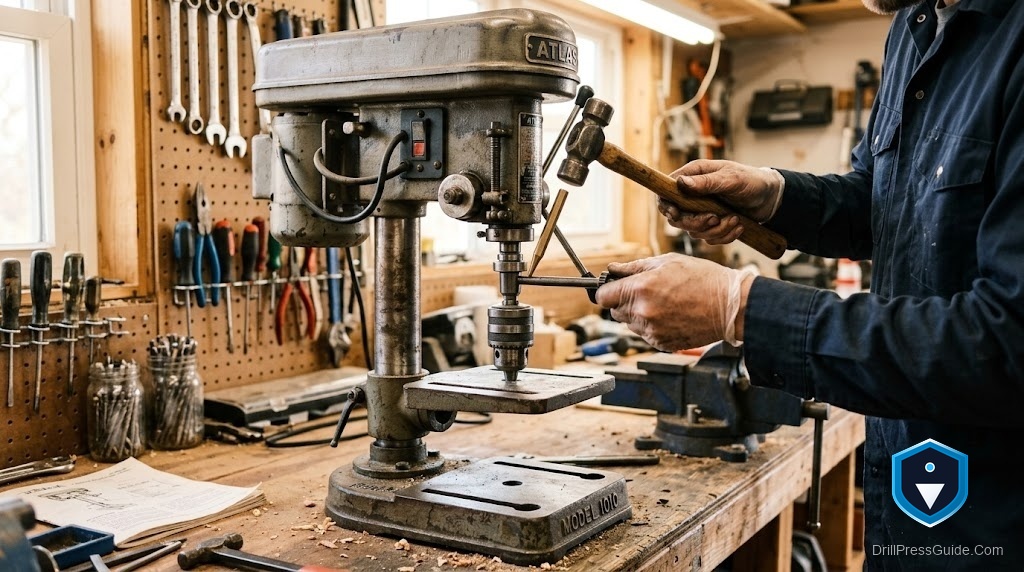
The Atlas Model 1010 is a vintage American press that has usually outlived its own paperwork, so when you need to pull the chuck, you are working from feel and first principles rather than a parts diagram. To remove the chuck on an Atlas drill press Model 1010 you break a Morse taper joint that may not have moved in decades, which means the job is less about force and more about penetrating oil, patience, and the right tool.
The chuck rides on an arbor whose Morse taper wedges into the spindle. Removing it means breaking that taper joint, either by driving the arbor out through the spindle slot or by pressing the chuck off its arbor with wedges.
Short answer: unplug the press, lower and lock the quill to expose the spindle slot, soak the taper joint with penetrating oil and wait, then drive a drift key or tapered wedges into the slot to press the arbor and chuck out. Support the chuck as it releases.
Practical steps for a vintage press
- Unplug the press.
- Lower the quill by hand and lock it so the cross slot in the spindle is exposed.
- Flood the taper joint with penetrating oil and give it fifteen minutes or more. On a machine this old, the soak does most of the work.
- Drive a drift key or a pair of tapered wedges into the slot with steady taps to press the arbor and chuck down and out.
- Support the chuck so it does not drop when the taper lets go.
- If the chuck presses off its arbor instead, use wedges between the chuck and the arbor shoulder.
The tool that suits a stuck vintage taper
A slotted drift key alone often will not budge a taper that has sat since the machine was new. A drill chuck removal wedge set spreads a steady separating force between the chuck and arbor, which is gentler and more effective on a seized joint than pounding, and it fits the JT33 and JT6 tapers on these old machines.
The honest drawback: even with wedges, a truly seized taper may need repeated soaks and attempts. Who should skip them: anyone whose 1010 has a free-moving arbor and a usable factory drift key.
Common sense on an old machine
- Never hammer the chuck body. Drive the arbor or the wedges.
- Do not pry with a screwdriver; it wrecks the spindle slot.
- Repeat the oil soak rather than escalating force.
- Clean the tapers once apart, so the next chuck seats true.
Patience frees the taper
Removing the chuck on an Atlas 1010 is simple in method and stubborn in practice. Expose the slot, soak the taper, and press it out with a drift or wedges instead of force. The old joint gives up once the oil has done its work.
Three takeaways:
- The chuck sits on a Morse taper; break the joint, do not unscrew it.
- Penetrating oil and time do most of the work on a decades-old taper.
- Use a drift or wedges, never a hammer on the chuck, and support the chuck as it drops.
FAQ
How is the chuck attached on an Atlas 1010? By a Morse taper arbor wedged into the spindle. It is not threaded, so you break the taper joint to remove it.
My Atlas 1010 chuck is seized. What do I do? Flood the taper joint with penetrating oil, wait, and press it out with a drift key or wedges. Repeat the soak if it resists.
Where do I drive the drift key? Into the cross slot that appears in the spindle when you lower and lock the quill.
Can I hammer the chuck off? Never hammer the chuck body. Drive the arbor out through the slot or press the chuck off with wedges.
Why is a vintage taper so hard to break? Decades of dried oil and grime effectively glue the taper. Penetrating oil breaks that bond, but it takes time.
How do I protect the chuck during removal? Support it with a hand or padded block so it does not fall and crack a jaw when the taper releases.
References
- VintageMachinery.org, Atlas drill press manuals and documentation: http://vintagemachinery.org


