
How to Install a Milling Chuck on a Drill Press: A Clear, Shop-Ready Method
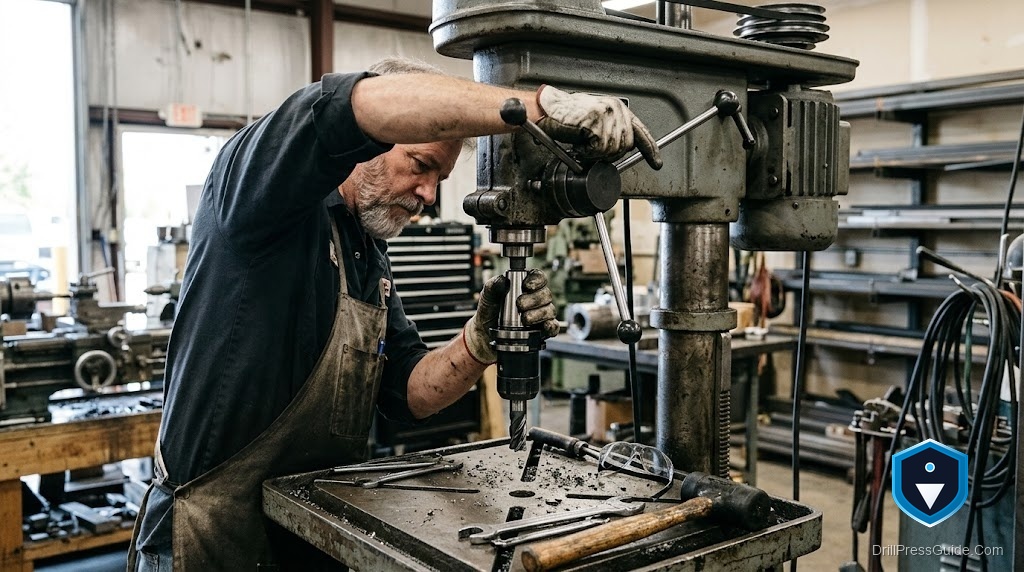
Let me be honest before the how-to: a drill press is built for downward force, not the sideways load of milling, and this is the one job where the wrong setup can throw a cutter. If you want to hold an end mill for light, careful work, the safe path is a collet holder that grips the shank, not an ordinary drill chuck. Learning how to install a milling chuck on a drill press starts with choosing the right holder and matching it to your spindle taper.
A milling chuck here means a collet holder that grips a cutter’s shank securely, mounted on a Morse taper to seat in the drill press spindle. Unlike a drill chuck, which grips with three jaws meant for round drill bits, a collet holder clamps the full shank so a side-loaded cutter is far less likely to pull loose.
Short answer: identify your spindle’s Morse taper (many benchtop presses are MT2), fit a matching collet holder, secure it with a drawbar if your press allows, take only light cuts, and accept that a drill press will never mill like a mill.
Why a drill chuck is the wrong tool
Machinists say it plainly: end mills do not belong in a drill chuck. The hardened jaws grip a hardened shank poorly, runout is high, and side load can walk the chuck, or the whole arbor, right out of the taper mid-cut. A collet holder addresses the grip; nothing fully addresses the drill press bearings, which are not designed for lateral load.
Choose the holder and taper
For an MT2 spindle, an MT2 collet holder that grips end mill shanks is the right style of tool: it clamps the shank in a collet rather than pinching it in jaws. Match the Morse taper to your spindle and the collet size to your cutter shank.
The honest drawback: even with a proper collet holder, a drill press lacks a drawbar on many models and cannot be trammed square, so accuracy and safety stay limited. Who should skip this entirely: anyone planning real material removal, who is far better served by an actual mill. If you only need very light, occasional work, a heavy-duty keyless MT2 chuck is sometimes used for the lightest touch-ups, but it shares all the side-load risks and should never hold an end mill for anything more than a whisper of a cut.
Installing it, step by step
- Unplug the press.
- Remove the drill chuck and arbor from the spindle.
- Clean the spindle bore and the collet holder’s Morse taper until dry and bright.
- Seat the collet holder firmly in the spindle. If your press has a drawbar, thread it through and tighten so the holder cannot drop under side load.
- Fit the correct collet and cutter, tightening fully on the shank.
- Set a slow speed, take the lightest possible cut, and keep the quill retracted as little as needed.
Right holder, light cuts, honest limits
Installing a milling chuck on a drill press is really about using a collet holder instead of a drill chuck, matching the taper, and respecting what the machine cannot safely do. Secure it with a drawbar if you can, take feather-light cuts, and stop expecting mill results.
Three takeaways:
- Use a collet holder, not a drill chuck, to hold cutter shanks.
- Match the Morse taper and use a drawbar if your press has one.
- A drill press cannot mill safely beyond very light work; a real mill is the right tool for material removal.
FAQ
Can I use a drill press as a milling machine? Only for very light work, and with real limits. Drill press bearings are not built for side load, and many presses cannot be trammed square, so accuracy and safety are limited.
Why should not I hold an end mill in a drill chuck? The jaws grip a hardened shank poorly, runout is high, and side load can pull the chuck or arbor out of the taper mid-cut. A collet holder grips the shank far better.
What taper do I need for a milling chuck? Match your spindle’s Morse taper. Many benchtop presses are MT2, but confirm before buying a holder.
Do I need a drawbar? If your press supports one, yes. A drawbar keeps the holder from dropping under side load, which is the main safety concern.
How deep a cut can I take? The lightest possible. Heavy cuts overload the bearings and risk pulling the tool loose.
Is a collet holder better than a keyless chuck for this? Yes. A collet grips the full shank, while a keyless chuck still pinches with jaws and shares the side-load risks.
References
- LittleMachineShop, end mill holders and collet reference: https://littlemachineshop.com/collections/end-mill-holders


