How to Change the Chuck on a SKIL Drill Press Without Losing Accuracy
A worn chuck shows up as bits that will not run true: you tighten everything down and the drill still wobbles, leaving oversized, ragged holes. On a SKIL benchtop press, changing the chuck is a quick way to get accuracy back, and because these are light-duty machines, the job is about a careful, clean fit rather than heavy tools.
A drill press chuck sits on a tapered arbor, and the arbor seats into the spindle with a Morse taper. Changing the chuck means fitting a new chuck (and, if needed, its arbor) matched to your SKIL spindle, then seating the tapers cleanly so the new chuck runs true.
Short answer: confirm your spindle taper (SKIL benchtop presses typically use a JT33 chuck on a Morse taper arbor), clean every mating surface, and seat the new chuck with one firm push. Runout, the wobble that ruins holes, usually comes from a dirty taper or a tired chuck, both of which this fixes.
Why accuracy is the whole point here
SKIL presses are built for light home use, so a little extra care at the taper pays off more than it would on a heavy machine. Two things cause the wobble people call inaccuracy:
- A worn chuck whose jaws no longer close concentrically.
- A dirty or nicked taper that seats the arbor off-center.
Changing to a clean, true chuck addresses both, but only if you clean the tapers as carefully as you choose the chuck.
Keyless keeps it simple
On a light-duty press used for wood and the occasional metal hole, a keyless JT33 drill chuck is an easy match: you change bits by hand, and a good keyless chuck runs with low runout for clean holes. Confirm it comes with or fits an arbor for your spindle’s Morse taper.
The honest drawback: keyless chucks can loosen a little during aggressive metal drilling, so if you push the press hard in steel, a keyed chuck holds better. Who should skip keyless: heavy metal drillers; everyone doing general wood and light work will appreciate the convenience.
Changing the chuck, step by step
- Unplug the press.
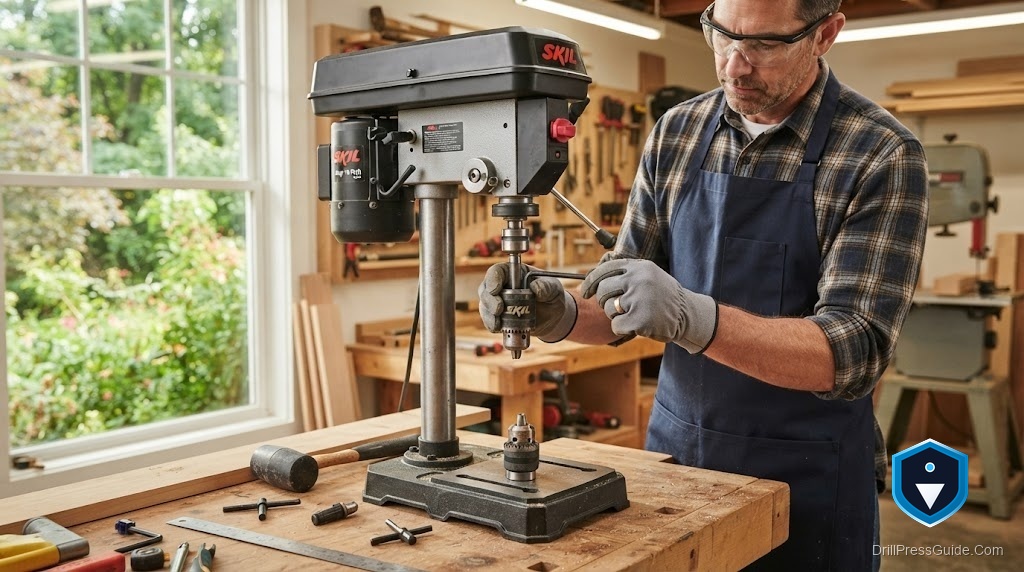
- Remove the old chuck and arbor: lower and lock the quill, then drive the arbor out through the spindle slot or press the chuck off with wedges. Support it so it does not fall.
- Clean the arbor’s Morse taper, the spindle bore, the JT33 stub, and the chuck bore until dry and bright. This is what protects your accuracy.
- Press the new chuck onto the arbor with the jaws open, one firm push or a soft-mallet tap.
- Seat the arbor into the spindle with jaws retracted, pushing firmly.
- Chuck a known-straight bit, spin by hand, and check for wobble before running.
Clean tapers, true holes
Changing a SKIL drill press chuck is a light-touch, high-care job. Match the JT33 chuck to your spindle taper, clean every surface, and seat firmly, and the wobble that was ruining your holes goes away.
Three takeaways:
- Runout usually comes from a worn chuck or a dirty taper; a clean new chuck fixes both.
- Match the JT33 chuck to your SKIL spindle’s Morse taper.
- Clean all mating surfaces before seating; accuracy depends on it.
FAQ
Why is my SKIL drill press drilling oversized holes? Usually a worn chuck that no longer closes concentrically, or a dirty taper seating the arbor off-center. A clean, true replacement chuck fixes both.
What chuck fits a SKIL drill press? Most SKIL benchtop presses use a JT33 chuck on a Morse taper arbor. Confirm your spindle taper before buying.
Is a keyless chuck accurate enough? A good keyless chuck runs with low runout and is plenty accurate for wood and light metal. For heavy metal drilling, a keyed chuck holds tighter.
How do I remove the old chuck? Lower and lock the quill, then drive the arbor out through the spindle slot or press the chuck off with wedges, supporting it as it releases.
How do I know the new chuck runs true? Chuck a known-straight bit, spin the spindle by hand, and watch the bit tip. Little to no wobble means the taper seated clean.
Do I need to oil the taper? No. Oil stops the taper from gripping and can let the chuck slip or fall. Keep the surfaces clean and dry.
Can I reuse the old arbor? Yes, if it is undamaged and matches the new chuck’s JT33 taper. Otherwise use a matched chuck-and-arbor pair.
References
- SKIL, power tool manuals and support: https://www.skil.com