
How to Change the Chuck on a Rockwell Drill Press: A Clear, Shop-Ready Method
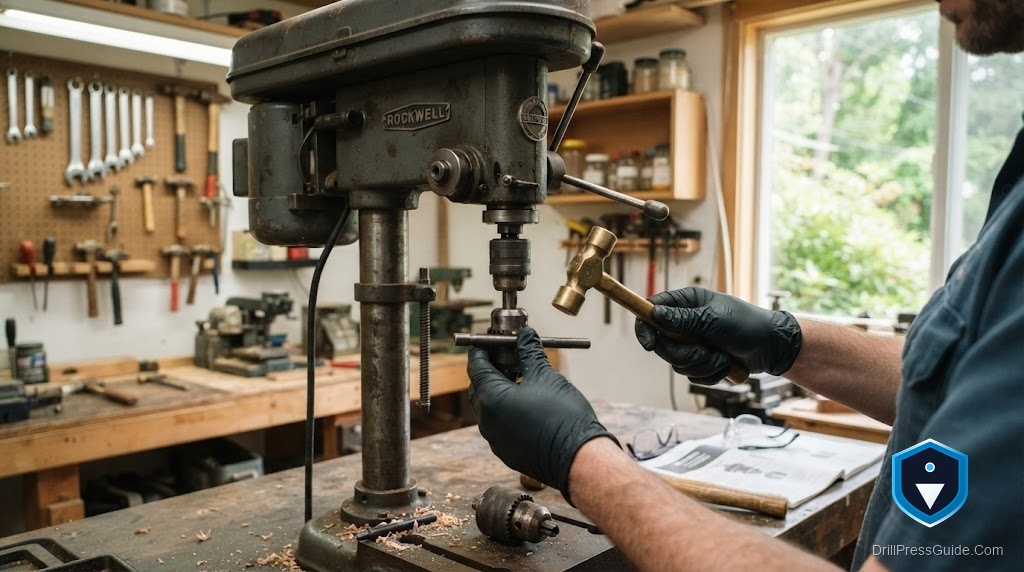
Rockwell presses have outlived their own parts catalogs, so when the chuck is worn out or you want to upgrade it, you are working with a machine older than most of the chucks on the shelf. That is fine. The taper standards these presses used are still in production, and changing the chuck on a Rockwell drill press is mostly a matter of identifying the arbor taper before you buy, then seating clean tapers with care.
A chuck rides on a tapered arbor whose other end is a Morse taper seated in the spindle. Changing the chuck means either pressing a new chuck onto the existing arbor, or fitting a fresh chuck-and-arbor assembly matched to your Rockwell spindle’s Morse taper.
Short answer: determine your spindle’s Morse taper (older Rockwell benchtop and floor presses commonly use MT2, but confirm), match a chuck with the correct JT33-to-Morse arbor, clean every taper, and seat with one firm push. On a vintage machine, expect the old arbor to be stubborn and plan to use penetrating oil and patience.
Check the taper before you buy
Vintage machines are where guesses go wrong, so verify:
- Spindle Morse taper. Measure the spindle bore or check documentation. MT2 is common on these presses, but do not assume.
- Arbor-to-chuck taper. Most chucks use JT33.
- Whether the old chuck has a threaded locking collar. Some older chucks add a ring that threads onto the arbor, which you must unthread before the chuck will release.
When you are unsure of the Morse taper
If you cannot confirm whether your spindle is MT1 or MT2, buy flexibility. A chuck set that includes both JT33-to-MT1 and JT33-to-MT2 arbors covers either spindle, so you are not stuck waiting on a return if your guess was wrong. The honest drawback is a spare arbor you may never use. Who should skip it: anyone who has already confirmed their exact Morse taper and only needs the one arbor.
Changing the chuck, step by step
- Unplug the press.
- If there is a threaded locking collar, unthread it first.
- Lower and lock the quill, then drive the old arbor out through the spindle cross slot with a drift, or press the chuck off the arbor with wedges. On a vintage press, soak the joint with penetrating oil and give it time.
- Clean the new arbor’s Morse taper, the spindle bore, the JT33 stub, and the chuck bore until dry and bright.
- Press the chuck onto the arbor with the jaws open, using a firm push or soft-mallet tap.
- Seat the arbor into the spindle with the jaws retracted, pushing firmly.
- Spin by hand and run briefly with no bit to confirm no wobble.
Confirm the taper, respect the age
Changing a Rockwell drill press chuck rewards patience and a confirmed taper. Verify the Morse taper, watch for a threaded collar, and clean every surface before seating. On a machine this old, penetrating oil is your friend and force is your enemy.
Three takeaways:
- Confirm the spindle’s Morse taper before buying; do not assume MT2.
- Watch for a threaded locking collar on older chucks and remove it first.
- Use penetrating oil and patience on a stubborn vintage arbor, not a hammer.
FAQ
What Morse taper does a Rockwell drill press use? Many use MT2, but it varies by model and era. Measure the spindle bore or check documentation before buying an arbor.
My old chuck will not come off. Why? It may have a threaded locking collar to unthread first, or the taper is seized. Soak it with penetrating oil and give it time before applying force.
Can I reuse my old arbor? Yes, if it is in good shape and matches the new chuck’s JT33 taper. Otherwise fit a matched chuck-and-arbor set.
What if I do not know my Morse taper? Buy a set with both MT1 and MT2 arbors so you are covered either way.
How do I get the chuck to stay on? Clean all four taper surfaces until dry and bright, then seat firmly. Clean tapers hold; oily or dirty ones let the chuck fall.
Should I oil the tapers before seating? No. Use penetrating oil only to free a seized old joint, then clean everything dry before fitting the new chuck.
Is a keyless chuck a good upgrade for a vintage press? It can be, for convenience. Just match the arbor to your spindle taper, and stay keyed if you drill metal hard.
References
- VintageMachinery.org, Rockwell/Delta drill press manuals and documentation: http://vintagemachinery.org


