
The Best Chuck Replacement for a Central Machinery Drill Press: What Actually Fits
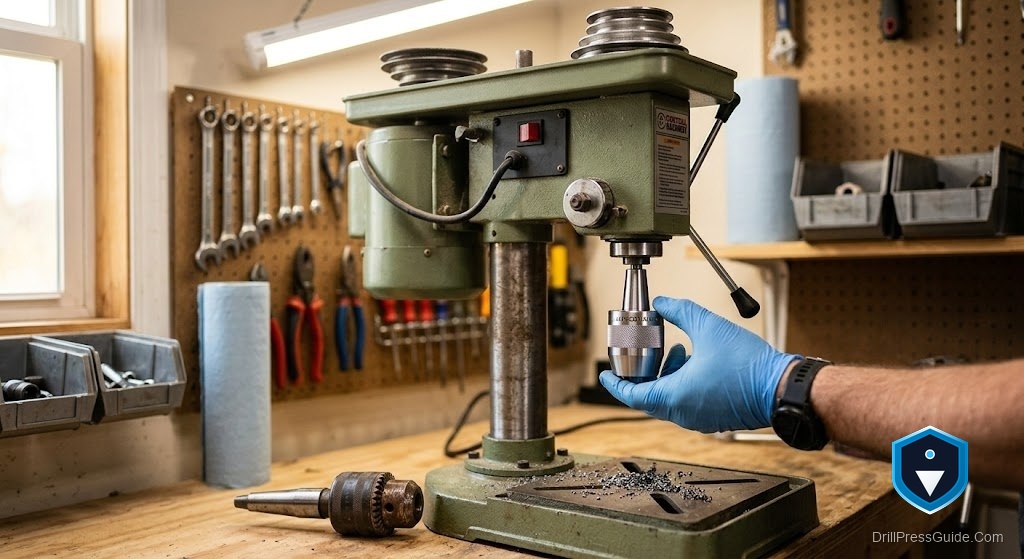
The chuck is usually the first thing to quit on a Central Machinery drill press. The jaws stop closing evenly, a bit walks off center, or the whole chuck works loose and drops onto the table mid-hole. Finding the best chuck replacement for a Central Machinery drill press is less about brand loyalty and more about two measurements: how the chuck mounts to the spindle, and how big a bit you need it to hold.
A drill press chuck is the three-jaw clamp that grips the bit; it either threads onto the spindle, presses onto a tapered arbor, or rides on an arbor that presses into the spindle. Central Machinery is Harbor Freight’s house brand, and across its common benchtop presses (the 8 inch 5-speed and the 10 inch 12-speed among them) most use a 1/2 inch capacity chuck on a JT33 Jacobs taper, often riding on an MT2 arbor.
Short answer: for most Central Machinery presses, a 1/2 inch keyed chuck on a JT33 taper with the matching MT2 arbor is the correct, no-fuss replacement. Confirm your capacity (1/2 inch is standard, some larger presses take 5/8 inch) and confirm the arbor taper before ordering, because a chuck that will not seat is the number one reason these swaps go sideways.
Step one: read your spindle before you shop
Pull the old chuck and look at how it was mounted. If a short tapered shaft (the arbor) comes out with the chuck, you have a taper-mount setup, and you need to match that arbor to your spindle bore, usually MT2 on Central Machinery. If the chuck threads directly onto the spindle, note the thread size instead. Getting this wrong is what sends chucks back in the mail.
Measure the largest bit you actually use. If nothing you own exceeds 1/2 inch, a 1/2 inch chuck is lighter, easier to handle, and grips small bits better than a 5/8 inch unit. Only step up to 5/8 inch if you run large Forstner bits or hole-saw arbors.
The picks
Best overall: a JT33 chuck with MT2 arbor and key
For the typical taper-mount Central Machinery press, this JT33 replacement chuck with an MT2 arbor and key is the clean answer. It covers 1/32 to 1/2 inch, ships with the arbor and key so you are not sourcing parts separately, and presses onto the spindle the same way the original did.
The honest drawback: the knurled body is a little slick with oily hands, and the finish is plain rather than a showpiece. Who should skip it: anyone whose press uses a threaded spindle rather than a taper, because this is a taper-mount chuck.
Best drop-in for the 10 inch press: a fitted replacement
If you own the common 10 inch, 12-speed Central Machinery (item 60238), this replacement chuck listed to fit that model takes the guesswork out. It is sized and mounted for that press specifically.
The tradeoff: because it is fitted to one machine, it is the wrong buy if you have a different Central Machinery model, so match the item number before you order. Who should skip it: owners of the 8 inch or older presses, who are better served by the JT33-and-arbor route above.
Best when you are unsure of the taper: a full set with two arbors
When the label is worn off and you cannot tell MT1 from MT2, this KingTool set that includes both a JT33-to-MT1 and a JT33-to-MT2 arbor lets you fit the chuck no matter which taper your spindle turns out to be. You keep the spare arbor for the next machine.
The honest flaw: you are paying for parts you may not use, and the second arbor just goes in a drawer. Who should skip it: anyone who already confirmed their taper, since a single correct chuck is the tidier buy.
Keyed or keyless, and is a name-brand chuck worth it
Keyed chucks, the kind that need the little toothed key, hold better under the heavy or interrupted cuts a drill press makes. Keyless chucks are faster but can loosen during aggressive drilling in metal, so most people keep a keyed chuck on a press. If you want to move up from a generic chuck, a Jacobs 1/2 inch keyed chuck runs truer over time and keeps its jaws parallel longer. The catch is that it usually ships as the chuck alone, so you still need the correct arbor, and it is heavier than the generic units. Skip the upgrade if your press is a light hobby machine that rarely sees metal; the generic JT33 chuck is plenty.
Verdict: match the mount, then buy once
The best chuck replacement for a Central Machinery drill press is the one that seats correctly on your spindle, and for most owners that is a 1/2 inch keyed JT33 chuck with an MT2 arbor. Move up to a Jacobs if you drill metal often and want jaws that stay true. Reach for the two-arbor set only when you cannot confirm your taper.
Three takeaways:
- Pull the old chuck first and identify taper versus thread before ordering anything.
- Stay at 1/2 inch capacity unless you genuinely run larger arbors.
- Keep it keyed on a drill press; keyless is for hand drills.
FAQ
What size chuck is on a Central Machinery drill press? Most Central Machinery benchtop presses use a 1/2 inch capacity chuck. Larger floor models may take 5/8 inch. Measure your biggest bit to decide what you need.
What arbor does a Central Machinery drill press use? Commonly a JT33 Jacobs taper chuck riding on an MT2 arbor. Pull your old chuck to confirm, because some models differ.
How do I remove the old chuck? Lower the quill, and with the press unplugged, use a pair of chuck-removal wedges or a drift key in the spindle slot to press the arbor and chuck free. Support the chuck so it does not drop.
Will any 1/2 inch chuck fit my press? Only if the mount matches. A 1/2 inch chuck on the wrong taper or thread will not seat. Match the arbor taper (often MT2) or the spindle thread first.
Keyed or keyless for a drill press? Keyed. It grips harder for the interrupted, higher-torque cuts a drill press makes and is less likely to loosen than a keyless chuck.
Can I upgrade to a Jacobs chuck? Yes. A Jacobs keyed chuck runs truer and lasts longer. Just pair it with the correct arbor for your spindle, since it often ships without one.
My new chuck wobbles. What went wrong? Usually the arbor was not fully seated, or there is dirt or oil on the taper. Clean both mating surfaces, then seat the arbor with a firm tap using a soft mallet.
References
- Jacobs Chuck, plain bearing keyed chuck specifications and taper mounting: http://www.jacobschuck.com/plain-bearing-medium/25.html
- Jacobs Chuck, chuck key and taper reference: http://www.jacobschuck.com/chuck-key/51.html


