
How to Change the Chuck on a WEN Drill Press Without Losing Accuracy
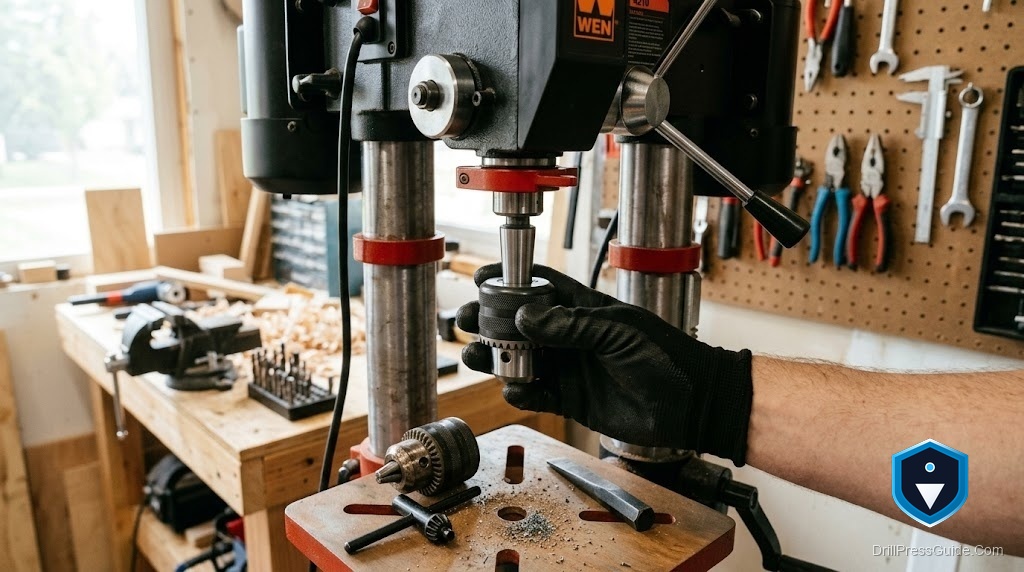
WEN presses are popular first machines, and changing the chuck is one of the most common upgrades owners make, usually to escape a factory keyed chuck that drifts or grips unevenly. The catch is that a chuck swap done carelessly trades one accuracy problem for another, because a taper that is not seated dead square drills just as crooked as the chuck you replaced. Knowing how to change the chuck on a WEN drill press without losing accuracy comes down to protecting and seating the tapers so the new chuck runs as true as the machine allows.
Changing the chuck means removing the old chuck from its arbor and seating a new one. On a WEN the chuck sits on a Jacobs taper arbor, and that arbor seats in the spindle on a Morse taper. Both joints hold by dry friction, so accuracy depends entirely on clean, square seating.
The direct answer: unplug the press, remove any internal retaining screw, pull the old chuck with wedges, then seat the new chuck on clean, dry, undamaged tapers with one firm square push, and verify runout with an indicator. Accuracy is won or lost at the taper, so protect and seat it carefully.
Protect accuracy from the start
With the press unplugged:
- Check for a retaining screw down the bore, often reverse threaded, and remove it first.
- Inspect both tapers for burrs, nicks, or rust that would keep the new chuck from seating square. Dress lightly if needed.
- Keep the tapers bone dry. Oil lets the taper slip and creep, hurting accuracy and grip.
- Plan a square push, never a sideways tap or a twist that cocks the chuck.
Removing the old chuck
- Open the jaws fully.
- Slide drill chuck removal wedges between the chuck and the arbor collar, one each side.
- Tap evenly, alternating sides, until the chuck releases square. Support it.
Seating the new chuck
- Wipe both tapers bone dry.
- Seat the arbor into the spindle with one firm push.
- Rest the chuck nose on a wood block and press straight down with one firm axial push.
- A matched replacement drill chuck with JT33 arbor or a precise keyless drill chuck sized to your taper keeps accuracy high.
- Chuck a straight pin and check runout with a dial indicator.
Where people go wrong
The first mistake is seating the chuck on an oily or burred taper, guaranteeing wobble no matter how good the chuck is. The second is tapping the chuck on sideways or twisting it, cocking it on the taper. The third is skipping the indicator check, so a poor seat goes unnoticed until it drills crooked.
The verdict
Changing a WEN chuck without losing accuracy is all about the taper. Unplug the press, remove any retaining screw, and pull the old chuck with wedges. Clean and inspect both tapers, seat the new chuck bone dry with one firm square push, and confirm the runout with an indicator. Protect and seat the taper carefully and the new chuck runs as true as the press can manage, turning a common upgrade into a real accuracy gain rather than a lateral move.
Three takeaways:
- Accuracy is won or lost at the taper, so keep it clean and dry.
- Seat with one firm square push, never sideways or twisting.
- Confirm the result with an indicator before trusting it.
FAQ
How do I change the chuck on a WEN drill press? Unplug it, remove any internal retaining screw, pull the old chuck with wedges, then seat the new chuck on clean, dry tapers with one firm square push and check runout with an indicator.
Why does my new chuck still wobble? Usually an oily or burred taper or a chuck seated sideways. Clean and inspect both tapers, then reseat bone dry with one straight push.
Should I oil the taper? No. Tapers hold by dry friction. Oil lets the chuck slip and creep, hurting both grip and accuracy. Wipe both tapers bone dry.
Does a WEN chuck have a retaining screw? Many do. Open the jaws fully and look down the bore. A screw at the bottom is a retaining set screw, often reverse threaded, and must come out first.
Keyed or keyless for a WEN? Either works if the taper matches. A quality keyless chuck is a convenient upgrade, and a precise keyed chuck grips hard. Match the taper and seat it square.
How do I check the accuracy after? Chuck a straight pin and turn the spindle by hand against a dial indicator. A few thousandths of runout is normal; visible wobble means reseat.
What taper does a WEN use? Commonly a JT33 Jacobs taper at the chuck and an MT2 Morse taper at the spindle on benchtop models, but confirm yours before buying.
References
- Zoro Resource Hub, Morse vs. Jacobs Tapers. https://www.zoro.com/resourcehub/what-are-the-dimensions-and-angles-of-morse-tapers-and-jacobs-tapers/
- Occupational Safety and Health Administration, Woodworking eTool: Drill Presses. https://www.osha.gov/etools/woodworking/production/machines-tools/drill-press


