
Drill Press Chuck Removal Wedges: The Checks That Prevent a Bad Repair
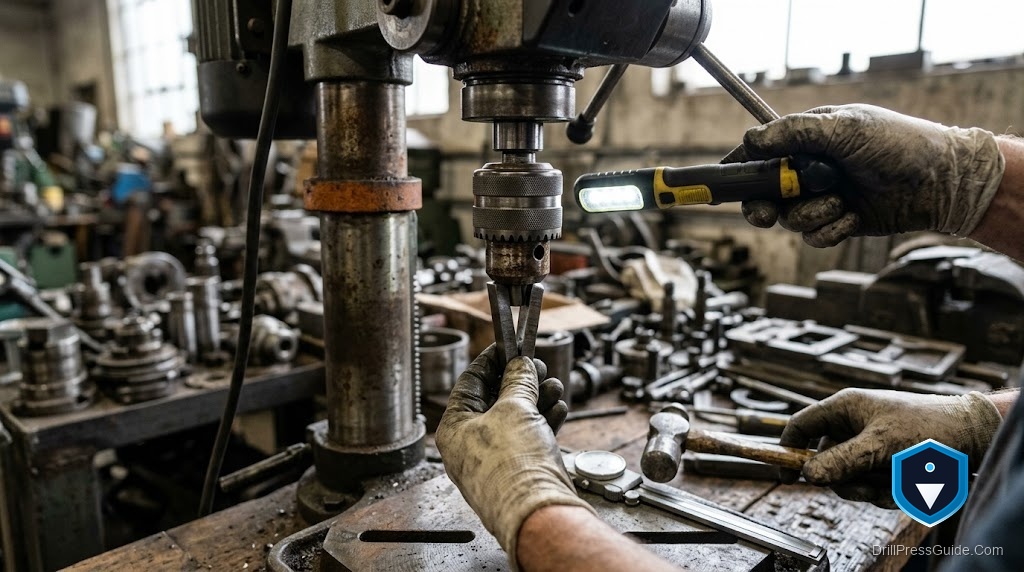
The first time a chuck refuses to come off a spindle, most people reach for a hammer and start swinging, and that is exactly how chucks get dented and arbors get bent. The right tool is a pair of drill press chuck removal wedges, and they turn a frustrating fight into a two minute job. The catch is that wedges only work on one specific joint, so the checks before you drive them decide whether the repair goes cleanly or damages the very parts you are trying to save.
Chuck removal wedges are tapered steel plates that slide into the gap between the chuck body and the arbor collar, then press the chuck off its Jacobs taper as you tap them in. They separate the chuck from the arbor, not the arbor from the spindle, which is a different removal.
The direct answer: use wedges to pop a chuck off its arbor after confirming there is no internal retaining screw holding it, and after choosing wedges over a taper drift for the joint you actually want to break. Tap both wedges evenly and support the chuck so it does not drop.
The checks before you drive the wedges
With the press unplugged:
- Look down the open jaws for a retaining screw. If a screw holds the chuck to the arbor, wedges will fight it. Remove the screw (often reverse threaded) first.
- Decide which joint you are breaking. Wedges separate the chuck from the arbor. To drop the whole arbor out of the spindle, you want a taper drift instead.
- Open the jaws fully. Fully retracted jaws keep the wedge from marring them and give the chuck somewhere to travel.
Using the wedges
- Open the chuck jaws all the way.
- Slide the drill chuck removal wedges into the gap between the chuck top and the arbor collar, one on each side.
- Tap them inward evenly, alternating sides, so the chuck is pushed off square rather than cocked.
- Support the chuck so it does not fall when the taper releases.
If you need the arbor out of the spindle instead, that is a drill press taper drift through the spindle slot, tapped with a soft dead blow mallet.
Wedges versus a taper drift
| Situation | Tool |
|---|---|
| Chuck off the arbor | Chuck removal wedges |
| Whole arbor out of the spindle | Taper drift through the spindle slot |
| Chuck held by an internal screw | Remove the screw first, then wedges |
Where people go wrong
The first mistake is driving wedges against a chuck that is still held by a retaining screw, which damages the chuck and never releases it. The second is using wedges when the real goal was to drop the arbor out of the spindle, which is a drift job. The third is tapping one wedge hard, cocking the chuck so it binds instead of sliding off square.
The verdict
Chuck removal wedges are the right tool for a job people usually attempt with the wrong one. Confirm there is no retaining screw, make sure the chuck to arbor joint is actually the one you want to break, then drive both wedges evenly and support the chuck as it drops. Reach for a taper drift when the arbor itself needs to come out. With the correct tool on the correct joint, the chuck comes free without a mark.
Three takeaways:
- Remove any internal retaining screw before driving wedges.
- Wedges break the chuck to arbor joint, a drift breaks the arbor to spindle joint.
- Tap both wedges evenly so the chuck comes off square.
FAQ
What are drill press chuck removal wedges? Tapered steel plates that slide between the chuck body and the arbor collar and press the chuck off its Jacobs taper as you tap them in evenly.
When should I use wedges instead of a taper drift? Use wedges to separate the chuck from the arbor. Use a taper drift through the spindle slot to knock the whole arbor out of the spindle.
Do I need to remove a screw first? If your chuck has an internal retaining screw, yes. Remove it (it is often reverse threaded) before driving wedges, or the chuck will not release.
Why tap both wedges evenly? Even, alternating taps push the chuck off square. Driving one side hard cocks the chuck so it binds instead of releasing.
Can I use wedges without a retaining screw check? You should always check first. Driving wedges against a screwed on chuck damages the chuck and wastes effort.
Will the chuck fall when it releases? Yes, it lets go suddenly. Support or catch the chuck so it does not drop onto the table or your hand.
Can I make wedges from anything? Purpose made steel wedges are worth having because they are the right taper and thickness. Improvised shims tend to slip or mar the parts.
References
- Zoro Resource Hub, Morse vs. Jacobs Tapers. https://www.zoro.com/resourcehub/what-are-the-dimensions-and-angles-of-morse-tapers-and-jacobs-tapers/
- Occupational Safety and Health Administration, Woodworking eTool: Drill Presses. https://www.osha.gov/etools/woodworking/production/machines-tools/drill-press


