
Harbor Freight Drill Press Chuck Upgrade: A Workshop Troubleshooting Guide
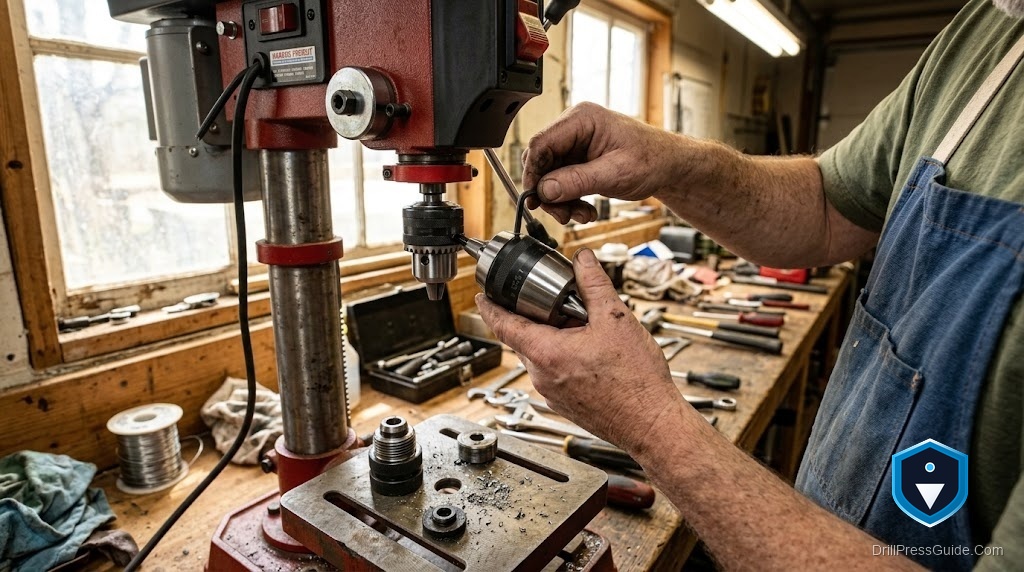
There is a well known move among Harbor Freight tool owners: buy the machine, then quietly upgrade the one or two parts that hold it back. On a Central Machinery or Bauer drill press, the chuck is often exactly that part. The factory chuck can run with more wobble than you want and lose its grip on small bits, while the rest of the press is perfectly serviceable. A Harbor Freight drill press chuck upgrade is one of the most rewarding small changes you can make, turning a rough running press into one that drills clean, straight holes.
A chuck upgrade means replacing the factory chuck with a better one: lower runout, a wider useful grip range, or the convenience of keyless operation. The new chuck mounts to the same Jacobs taper arbor, which seats in the spindle on a Morse taper.
The direct answer: confirm your arbor’s Jacobs taper (often JT33) and the spindle’s Morse taper (often MT2), then choose an upgrade chuck that matches, deciding between a low runout keyed chuck for accuracy and a keyless chuck for convenience. Match the taper first, because no upgrade helps if it will not seat.
Why upgrade instead of just replace
The factory chuck is usually the weakest link on these presses, so this is less a repair than an improvement:
- Lower runout. A better chuck holds the bit more concentric, so holes come out true. This is the single biggest gain on a press that wobbles.
- Wider grip range. A quality chuck holds both tiny bits and larger ones the factory chuck struggled with.
- Keyless convenience. For frequent bit changes on light work, a keyless chuck saves the key hunt entirely.
Match the taper, then choose
Read your arbor’s Jacobs taper and the spindle’s Morse taper from the manual or by measuring. Then decide:
- A low runout keyed drill chuck grips hardest and runs truest, the right pick if accuracy is why you are upgrading.
- A keyless JT33 chuck trades a little grip for fast, tool free bit changes on light to medium work.
- If the factory arbor is also rough, a matched JT33 to MT2 chuck and arbor set upgrades both at once.
Fitting the upgrade
- Unplug the press.
- Open the jaws, remove any internal retaining screw, and drive the old chuck off its taper with chuck removal wedges.
- Wipe both tapers bone dry. No oil on a friction fit.
- Seat the new chuck square with a straight axial push against a wood block.
- Chuck a straight pin and indicate the runout with a dial indicator. A good upgrade chuck should read tighter than the factory one did.
Where people go wrong
The first mistake is buying an upgrade chuck without matching the taper, so it will not seat on the arbor. The second is choosing keyless for heavy drilling, then fighting a bit that slips under load. The third is oiling the taper, which lets even a fine new chuck creep off a light spindle.
The verdict
Upgrading the chuck is the classic Harbor Freight press improvement, and it pays off every time you drill. Match the Jacobs and Morse taper first, then choose a low runout keyed chuck for accuracy or a keyless chuck for convenience on lighter work. Pull the old chuck with wedges, seat the new one dry and straight, and indicate the result. Do that and a press that used to wander drills like a far higher grade machine.
Three takeaways:
- Match the taper before choosing any upgrade chuck.
- Keyed and low runout for accuracy, keyless for convenience.
- Seat dry and straight, then indicate to confirm the gain.
FAQ
Is upgrading the chuck on a Harbor Freight press worth it? Usually yes. The factory chuck is often the weakest link, so a better one lowers runout and improves grip, making the whole press drill truer.
Which chuck should I upgrade to? Match your arbor’s Jacobs taper first, then choose a low runout keyed chuck for accuracy or a keyless chuck for fast bit changes on light work.
How do I know my taper? Read it from the manual or measure the arbor. Harbor Freight presses commonly use a JT33 Jacobs taper at the chuck and an MT2 Morse taper at the spindle, but confirm yours.
Do I need to upgrade the arbor too? Only if the factory arbor is rough or scored. A matched chuck and arbor set upgrades both at once when needed.
Will a keyless chuck slip on heavy work? A keyless chuck gives up a little grip under heavy load, so for large bits and hard drilling a keyed chuck holds better.
How do I remove the old chuck? Unplug the press, remove any internal retaining screw, and drive the chuck off its taper with wedges tapped evenly from both sides.
How much improvement should I see? A good upgrade chuck should indicate tighter runout than the factory chuck, so holes come out visibly straighter and small bits hold better.
References
- Zoro Resource Hub, Morse vs. Jacobs Tapers. https://www.zoro.com/resourcehub/what-are-the-dimensions-and-angles-of-morse-tapers-and-jacobs-tapers/
- Occupational Safety and Health Administration, Woodworking eTool: Drill Presses. https://www.osha.gov/etools/woodworking/production/machines-tools/drill-press


