
Finding the Right Replacement Drill Press Chuck Without Paying for the Wrong Features
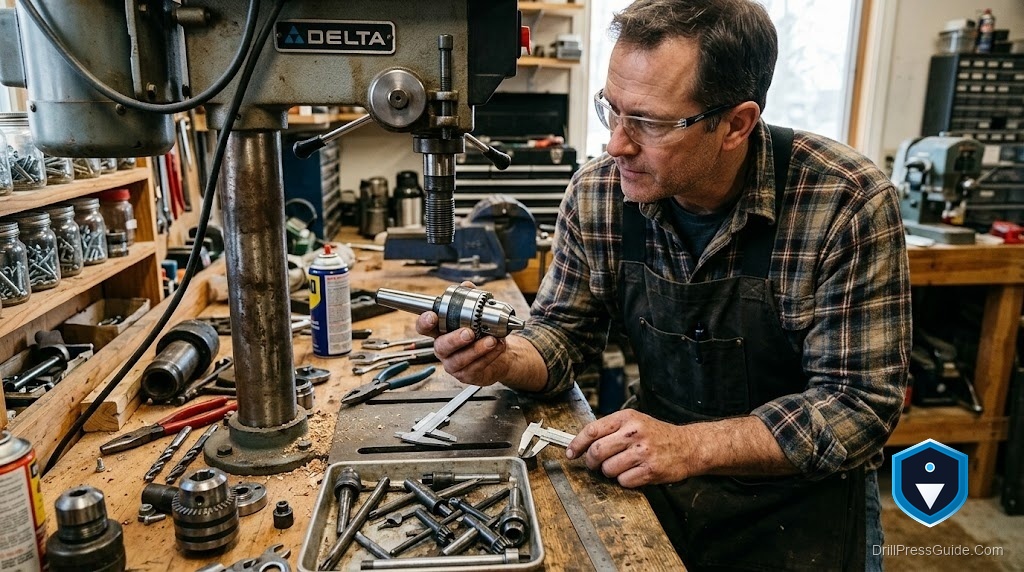
Search for the best replacement drill press chuck and you will drown in options that all claim to be precise, heavy duty, and universal. Most of that is noise. The truth is simpler and more useful: the best chuck for you is the one that matches your arbor, grips the bits you actually drill, and holds accuracy under the loads you put on it. A precision chuck built for a machinist’s tolerances is wasted on a hobby press, and a light import chuck will frustrate someone drilling steel all day. This is a fit and use question, not a leaderboard.
A replacement drill press chuck is the jawed head that clamps your bits, mounted to the spindle through a Jacobs taper arbor. “Best” depends on three things: the taper it must match, whether you want keyed or keyless, and the grip range and quality tier that suit your work.
The direct answer: first match your arbor’s Jacobs taper (often JT33) and, if replacing the arbor, the spindle’s Morse taper (often MT2). Then pick keyed or keyless by how often you change bits, and choose a quality tier that matches how hard you drive the press. Get those three right and the “best” chuck picks itself.
Step one: match the taper, or nothing else matters
No chuck is the best if it will not seat. Confirm your Jacobs taper (the short taper the chuck grips) and your Morse taper (the longer taper in the spindle) before comparing anything. A chuck rated for the wrong Jacobs taper simply will not mount. When in doubt, a matched JT33 to MT2 chuck and arbor set removes the guesswork by pairing a known chuck to a known arbor.
Step two: keyed or keyless
This is the choice that changes daily use the most.
- Keyed chucks bite hardest and hold large bits without slipping, which is why they dominate heavy drilling and metalwork. The tradeoff is the key: you need it, you must remove it before every start, and you can lose it. A solid keyed JT33 drill chuck is the default for anyone who drills big or drills metal.
- Keyless chucks tighten by hand and make constant bit changes fast, which woodworkers and hobbyists love. The tradeoff is a little less grip under heavy load, so they can let a large bit slip when you lean on it. A quality keyless JT33 chuck is ideal for light to medium work with frequent bit swaps.
Step three: match the quality tier to your work
| Tier | Best for | The tradeoff |
|---|---|---|
| Standard import chuck | Hobby and occasional use, small bits | More runout, shorter life under heavy load |
| Mid grade keyed or keyless | Regular shop use, mixed bits | The honest sweet spot for most owners |
| Precision (low runout) chuck | Metalwork, tight tolerance drilling | Overkill for casual wood drilling |
A hobby press that drills pilot holes does not need a precision chuck, and a shop press cutting steel should not run the lightest import. Buying above or below your real use is the most common way people waste effort here.
Grip range matters too
Check the chuck’s capacity against the bits you use. A common range covers up to 1/2 inch, and a 5/8 inch capacity drill chuck suits presses that swing larger bits. A chuck whose minimum jaw opening is too wide will not hold tiny bits, which frustrates fine work, so check both ends of the range, not just the maximum.
Where people go wrong
The first mistake is chasing a precision chuck for a hobby press that will never use the accuracy. The second is picking keyless for heavy metal drilling, then fighting bits that slip under load. The third is ignoring the taper entirely and ordering a highly rated chuck that never seats on the arbor.
The verdict
There is no single best replacement drill press chuck, only the best one for your taper, your bit habits, and your workload. Match the Jacobs and Morse tapers first. Choose keyed for heavy or metal drilling and keyless for fast, frequent changes on lighter work. Then buy the quality tier your real use justifies, no more and no less. A mid grade keyed chuck in the correct taper is the honest default that serves most owners well for years.
Three takeaways:
- Taper match comes before any “best” comparison.
- Keyed for heavy and metal work, keyless for fast light work.
- Match the quality tier to your workload, not to marketing.
FAQ
What is the best replacement drill press chuck? The one that matches your arbor’s taper, fits your keyed or keyless preference, and suits your workload. A mid grade keyed chuck in the correct Jacobs taper is the honest default for most owners.
How do I know which chuck will fit my press? Match the Jacobs taper the chuck grips (often JT33) and, if replacing the arbor, the spindle’s Morse taper (often MT2). No chuck fits if the taper is wrong.
Is a keyless chuck good enough for a drill press? Yes for light to medium work with frequent bit changes. For heavy or metal drilling, a keyed chuck grips better under load.
Do I need a precision low runout chuck? Only for metalwork or tight tolerance drilling. For general woodworking a precision chuck is more than the job needs.
What grip range should I choose? Match it to your bits. Many owners are fine up to 1/2 inch, while presses swinging larger bits want 5/8 inch capacity. Check the minimum opening too, so it still holds small bits.
Can I upgrade from keyed to keyless? Yes, as long as the new chuck matches your arbor’s Jacobs taper. It is a common upgrade for shops that change bits constantly.
Why does a highly rated chuck sometimes not fit? Because fit is about the taper, not the rating. A well reviewed chuck in the wrong Jacobs taper will not seat on your arbor.
References
- Zoro Resource Hub, Morse vs. Jacobs Tapers. https://www.zoro.com/resourcehub/what-are-the-dimensions-and-angles-of-morse-tapers-and-jacobs-tapers/
- Travers Tool, Drill Chuck and Taper Selection Guide. https://www.travers.com


