
Why the Chuck Key Must Come Out Before You Start the Drill Press
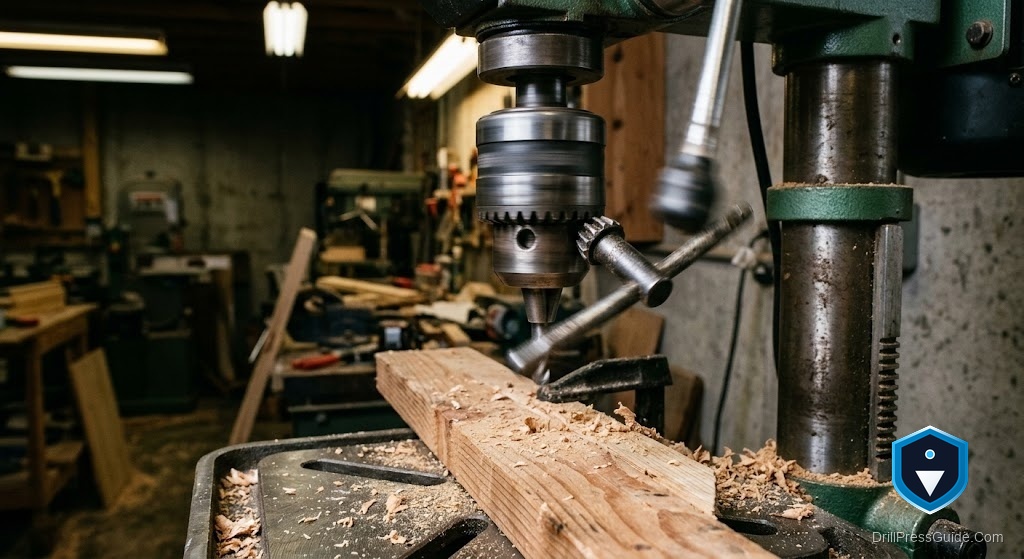
Ask anyone who has spent time in a machine shop about the loudest lesson they ever learned, and a fair number will describe the same thing: a chuck key left in the chuck, the switch flipped, and a chunk of steel launched across the room at head height. It happens in a fraction of a second, it is completely preventable, and it is the reason the first rule taught on any drill press is the same everywhere. Before turning on the drill press, the operator should remove the chuck key. Every time, no exceptions.
The chuck key is the small toothed wrench that tightens and loosens the chuck jaws around a bit. It seats into a hole on the chuck body and stays there only while you turn it. Left in place when the spindle spins, it becomes a projectile thrown by centrifugal force at the full speed of the chuck.
The direct answer: always remove the chuck key immediately after tightening or loosening a bit, and confirm it is out before you touch the power switch. Treat the key as something that lives in your hand, on the tray, or on its holder, never in the chuck when you step back.
Why this one rule leads every safety list
Machine safety authorities do not bury this. OSHA’s woodworking guidance, university environmental health and safety programs, and the Canadian Centre for Occupational Health and Safety all state it plainly: do not leave the chuck key in the drill chuck, make adjustments and remove the key immediately, because a key left in the chuck is thrown out at tremendous speed when the power is turned on.12 The hazard is not theoretical. It is one of the most documented drill press injuries there is.
Build the habit so you never rely on memory
Rules you have to remember fail under pressure. Rules built into a physical habit hold. A few ways shops make this automatic:
- One hand rule. The key never leaves your hand while it is in the chuck. When you set it down, it comes out first.
- A dedicated holder. Mount the key on a spring clip or magnetic holder on the column, so “put it away” and “take it out of the chuck” become the same motion. A drill press chuck key holder makes the safe habit the easy one.
- A self ejecting key. A self ejecting chuck key is spring loaded so it pops out the instant you stop pressing. It cannot be left in, which removes the failure mode entirely. The only tradeoff is a slightly bulkier key, and that is a trade worth making.
The rest of the pre start checklist
Removing the key is first, but a full pre start check takes seconds and prevents most drill press incidents:
- Chuck key out and confirmed.
- Work clamped or held in a vise, never by hand.
- Safety glasses on, sleeves rolled, gloves off, jewelry and loose clothing secured.
- Speed set for the bit and material, with the belt cover closed.
- Table locked at height and the bit clear of the table or over the center hole.
University shop rules put clamping and eye protection right alongside the key rule for good reason.3
Who especially needs to hear this
The experienced operator who has done it ten thousand times is exactly the person who gets complacent, sets the key down in the chuck for one adjustment, and gets surprised. New operators follow the rule because they were just taught it. The rest of us have to keep the habit alive on purpose. If that is you, a self ejecting key or a holder is not babying yourself, it is engineering out the mistake.
The verdict
The chuck key rule is the simplest insurance in the shop: remove the key, every time, before the power goes on. Do not trust memory alone. Give the key a home with a holder, or buy a self ejecting key so the tool cannot betray you. Pair that with clamped work and eye protection, and the single most common drill press injury simply stops being possible in your shop.
Three takeaways:
- The key comes out immediately after every adjustment, before the switch.
- Build the habit into hardware: a holder or a self ejecting key.
- The key rule is step one of a five second pre start check worth doing every time.
FAQ
Why must the chuck key be removed before starting the drill press? Because a key left in the chuck is thrown out at high speed when the spindle spins, and it can cause serious injury. Removing it is the first rule on every drill press safety list.
What should the operator do before turning on the drill press? Remove the chuck key and confirm it is out, clamp the work, wear eye protection with no gloves or loose clothing, set the correct speed, and lock the table. Then start the machine.
Where should I keep the chuck key? In your hand while it is in the chuck, and on a dedicated holder or clip otherwise. A mounted holder makes putting it away and removing it the same motion.
What is a self ejecting chuck key? A spring loaded key that pops out the moment you release pressure, so it cannot be left in the chuck. It removes the most common drill press hazard.
Has anyone really been hurt by a chuck key? Yes. A launched chuck key is one of the most documented drill press injuries, which is why safety authorities emphasize the rule so strongly.
Is it okay to leave the key in for just a second? No. “Just a second” is exactly when the switch gets bumped. Treat the key as never belonging in the chuck when your hand is not turning it.
Do keyless chucks solve this? Yes, because there is no key to leave in. A keyless chuck is a valid way to remove the hazard if it suits your work.
References
- Occupational Safety and Health Administration, Woodworking eTool: Drill Presses. https://www.osha.gov/etools/woodworking/production/machines-tools/drill-press
- Canadian Centre for Occupational Health and Safety, Metalworking Machines: Drill Presses. https://www.ccohs.ca/oshanswers/safety_haz/metalworking/drillpresses.html
- West Virginia University EHS, Drill Press Safety. https://www.ehs.wvu.edu/files/d/468960e4-730d-4a60-98ea-58ee020f4ab8/drill-press-safety.pdf


