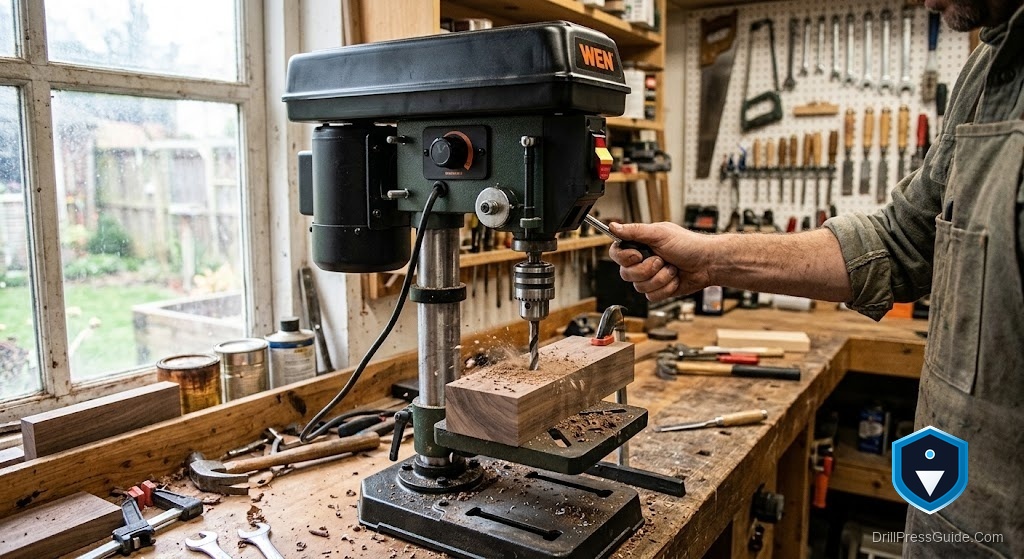
How to Fix a Wobbly Drill Press Chuck, Step by Step

You clamp a straight bit, bring it down to a marked center, and watch the tip trace a little circle instead of sitting on the dot. A wobbly chuck is maddening because it turns a precision tool into a rough one, and it tends to get worse the more you ignore it. The reassuring part: most of the time a wobbly drill press chuck is not a worn out machine at all. It is a dirty taper, a loose seat, or a chuck that was never installed straight, and all three are free or simple to fix.
A wobbly chuck means the chuck runs off center (runout), so the bit’s tip orbits instead of spinning true. The wobble can come from the chuck, the arbor, the spindle bearings, or a bent bit, and telling them apart is the whole job.
The direct answer: find where the wobble lives before you fix anything. Check the bit, then the chuck seat, then the arbor, then the bearings, in that order, simplest first. A dial indicator on a straight test pin tells you the source in five minutes and saves you from replacing the wrong part.
Diagnose in order, simplest first
- Blame the bit first. Swap in a known straight pin or a quality bit. A bent bit fakes a chuck wobble and takes nothing to rule out.
- Check the chuck seat. With the press unplugged, try to rock the chuck on the arbor. Movement means it is not seated or the taper is dirty.
- Isolate chuck versus arbor. Put a dial indicator on the test pin, then on the chuck body, then on the exposed arbor. Where the runout appears tells you the guilty part.
- Check the bearings. Rock the chuck sideways with the quill extended. Play there points at worn spindle bearings, not the chuck.
Fix it based on what you found
Dirty or unseated taper (most common). Unplug the press, drive the chuck off with chuck removal wedges, wipe both tapers bone dry (no oil), and reseat with a straight axial push against a wood block. Nine times out of ten the wobble is gone.
Worn or damaged arbor. If the runout follows the arbor, replace it. A JT33 to MT2 chuck arbor matched to your tapers restores true running.
Worn chuck. If the runout is in the chuck itself and cleaning does not help, the chuck is done. Fit a replacement drill chuck matched to your Jacobs taper.
Worn spindle bearings. If there is side play at the quill, the bearings need replacing, which is a bigger job but the real cure when the wobble is not in the chuck.
Why order matters so much
People buy a new chuck, bolt it onto a bent arbor or worn bearings, and get the same wobble. Then they blame the new chuck. Diagnosing where the runout lives, before spending, is the difference between a five minute cleaning and a wasted purchase. This is the one repair where slowing down at the start saves the most money.
Where people go wrong
The first mistake is skipping the bit swap and chasing a wobble a bent drill bit was causing. The second is oiling the taper on reassembly, which lets the chuck creep and wobble again. The third is replacing the chuck before confirming the runout was even in the chuck.
The verdict
A wobbly drill press chuck is usually good news in disguise: most cases are a dirty taper or an unseated chuck, both free to fix. Work from simplest cause to most involved, rule out the bit, clean and reseat the taper, and only replace parts once an indicator shows where the runout truly is. Fix it in that order and you rarely spend a cent.
Three takeaways:
- Rule out a bent bit before touching the chuck.
- A dirty taper is the most common cause, and it is free to fix.
- Diagnose the runout source before buying any replacement part.
FAQ
Why is my drill press chuck wobbling? Usually a dirty or unseated taper, sometimes a bent bit, a worn arbor, a worn chuck, or worn spindle bearings. Diagnose which before fixing.
How do I fix a wobbly chuck fast? Most often: unplug the press, drive the chuck off with wedges, wipe both tapers dry, and reseat with a straight push. That cures the common dirty taper case.
How do I tell if it is the chuck or the arbor? Run a dial indicator on a straight test pin, then on the chuck, then on the arbor. The part where the runout shows is the source.
Can a bent drill bit look like a wobbly chuck? Yes. Always test with a known straight pin or bit first, because a bent bit mimics chuck runout exactly.
Should I oil the taper when I reseat the chuck? No. Tapers hold by dry friction. Oil lets the chuck creep and wobble again. Clean both surfaces dry.
How much wobble is normal? A few thousandths of an inch is normal on a home machine. A wobble you can see by eye needs fixing.
My chuck still wobbles after a new chuck. What now? The runout is upstream, in the arbor or spindle bearings. Indicate the arbor and check for quill side play to find it.
References
- Zoro Resource Hub, Morse vs. Jacobs Tapers. https://www.zoro.com/resourcehub/what-are-the-dimensions-and-angles-of-morse-tapers-and-jacobs-tapers/
- Occupational Safety and Health Administration, Woodworking eTool: Drill Presses. https://www.osha.gov/etools/woodworking/production/machines-tools/drill-press