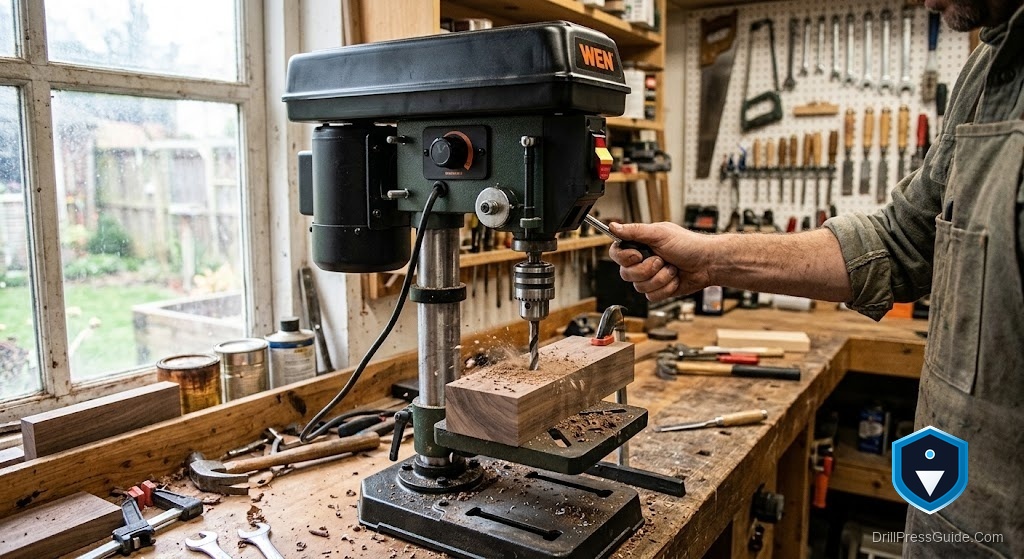
Delta Drill Press Chuck Replacement: A Workshop Troubleshooting Guide
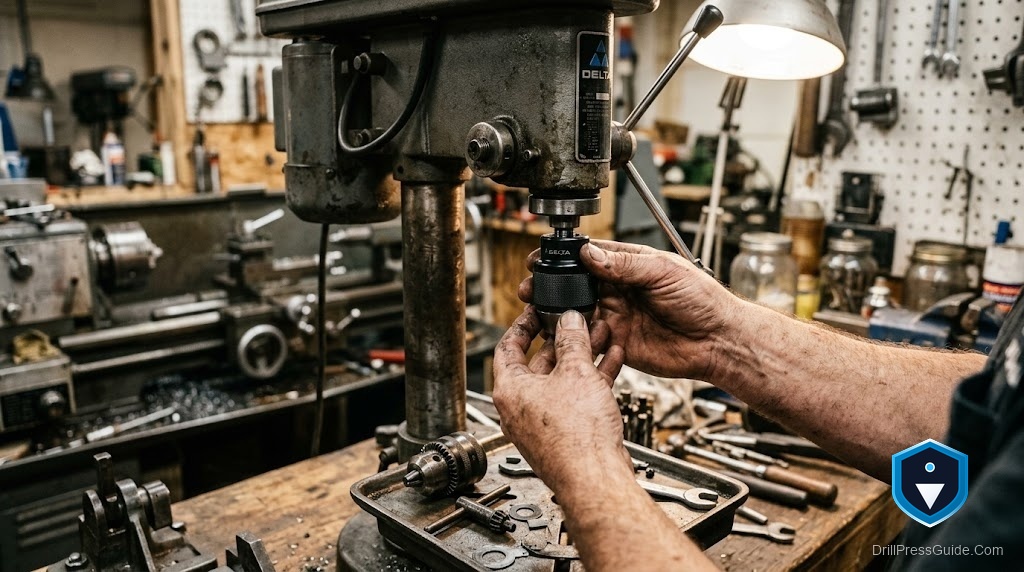
Most people replace a Delta chuck a repair too late. The jaws stopped closing evenly months ago, the bit walks a little on every hole, and the story you tell yourself is that the press is just old. Then a drill bit slips under load and scares you, and suddenly the chuck is a priority. A Delta drill press chuck replacement is straightforward, but the part you buy has to match the arbor, not the sticker on the machine, and that is where good repairs go sideways.
A chuck replacement means removing the worn chuck from its arbor (or removing the whole chuck and arbor from the spindle) and fitting one that matches your taper. On Delta presses the chuck usually mounts to a Jacobs taper arbor, and that arbor sits in the spindle on a Morse taper, commonly MT2 on home sized machines.
The direct answer: confirm your arbor’s Jacobs taper size and your spindle’s Morse taper, then buy a chuck (and arbor if needed) to match those two numbers. A chuck rated for the wrong taper will not seat, and forcing it ruins both parts.
First, is the chuck really the problem?
Before spending, rule out the simpler culprits:
- Bad key or worn teeth. If the jaws will not tighten, the chuck’s internal gear may be rounded. That does mean a new chuck.
- Loose seating. If the chuck itself wobbles on the arbor, it may just need cleaning and reseating, not replacing.
- Arbor or spindle runout. Chuck a straight pin and indicate it. If the runout follows the arbor rather than the chuck, a new chuck alone will not fix the wobble.
Do this diagnosis first. A new chuck bolted onto a bent arbor drills the same crooked holes.
Identify what you are mounting
Two tapers decide the whole purchase:
- Jacobs taper (chuck to arbor). JT33 is common on many Delta chucks. It is the short taper the chuck’s bore grips.
- Morse taper (arbor to spindle). MT2 is common on home Delta presses. It is the longer taper up in the spindle.
If you are replacing only the chuck, match the Jacobs taper. If you are replacing chuck and arbor together, match both. A JT33 to MT2 chuck and arbor set covers the common Delta combination when you want a clean, matched pair.
Removal, then installation
Removing the old chuck from the arbor:
- Unplug the press.
- Lower the quill and lock it, or hold the spindle, so nothing spins.
- Open the jaws fully, then drive the chuck off the taper with a drill chuck wedge set, tapping the chuck removal wedges in from both sides evenly.
Removing the arbor from the spindle (only if replacing the arbor): extend the quill, and use the taper drift through the spindle’s access slot to knock the arbor down and out.
Installing the new chuck:
- Wipe both tapers bone dry. No oil on a friction taper.
- Open the jaws, set the chuck square on the arbor, and seat it with a straight axial push against a wood block, or with the quill pressing the chuck onto a block on the table.
- Indicate the runout with a dial indicator. A few thousandths is fine. A visible wobble means reseat.
Keyed or keyless for the replacement?
Since the chuck is already off, this is the moment to choose. A keyed drill chuck grips large bits harder and suits heavy drilling. A keyless chuck is faster for constant bit changes but gives up a little bite under heavy load, and it is the wrong pick if you run big Forstner bits all day. Match either to your Jacobs taper.
Where people go wrong
The top mistake is buying a chuck by drill press model instead of by taper. The second is skipping the runout check and assuming a new chuck automatically drills straight, when a tired arbor was the real issue. The third is oiling the taper out of habit, which invites the new chuck to slip right back off.
The verdict
Do not limp along on a chuck that will not hold. But do diagnose before you buy, because half the “bad chuck” cases are really a worn arbor or a dirty taper. Match the Jacobs and Morse tapers, seat the new chuck dry and straight, and indicate it once. If big bit grip matters, stay keyed. If speed matters more, go keyless and accept the small tradeoff.
Three takeaways:
- Tapers decide the part, not the model badge.
- Diagnose the arbor and runout before blaming the chuck.
- Seat dry, seat straight, and indicate before you trust it.
FAQ
How do I know which replacement chuck fits my Delta drill press? Match the Jacobs taper on the arbor (often JT33) and, if replacing the arbor too, the spindle’s Morse taper (often MT2). Buy to those tapers, not to the drill press model.
How do I remove the old chuck? Unplug the press, open the jaws fully, and drive the chuck off its taper using a wedge set tapped in evenly from both sides. To remove the arbor, use a taper drift through the spindle slot.
Should I replace the arbor along with the chuck? Only if the arbor’s taper is scored, bent, or causing runout. A healthy arbor can be reused with a new chuck.
Why do my holes still wander after a new chuck? The runout likely comes from the arbor or spindle bearings, not the chuck. Indicate a straight pin to find where the wobble originates.
Keyed or keyless for a Delta replacement? Keyed grips large bits better for heavy work. Keyless is faster for frequent bit changes but bites a little less under load. Match either to your Jacobs taper.
Do I oil the taper when installing the new chuck? No. Tapers hold by dry friction. Oil can let the chuck slip or drop.
Can I convert my Delta to a keyless chuck? Yes, as long as the keyless chuck matches your arbor’s Jacobs taper. It is a common upgrade for shops that change bits constantly.
References
- Zoro Resource Hub, Morse vs. Jacobs Tapers. https://www.zoro.com/resourcehub/what-are-the-dimensions-and-angles-of-morse-tapers-and-jacobs-tapers/
- Occupational Safety and Health Administration, Woodworking eTool: Drill Presses. https://www.osha.gov/etools/woodworking/production/machines-tools/drill-press