Replacement Chuck Key for Drill Press: The Checks That Prevent a Bad Repair
Every workshop has a coffee can of orphaned chuck keys. None of them fit the tool you need right now. So you pick the closest one, crank it into the pinion hole, and feel that gritty half turn where the teeth are not quite meshing. That sound is money leaving your chuck. Buying a replacement chuck key for a drill press is easy. Buying the right one, and not wrecking the chuck with a near miss in the meantime, takes about two measurements.
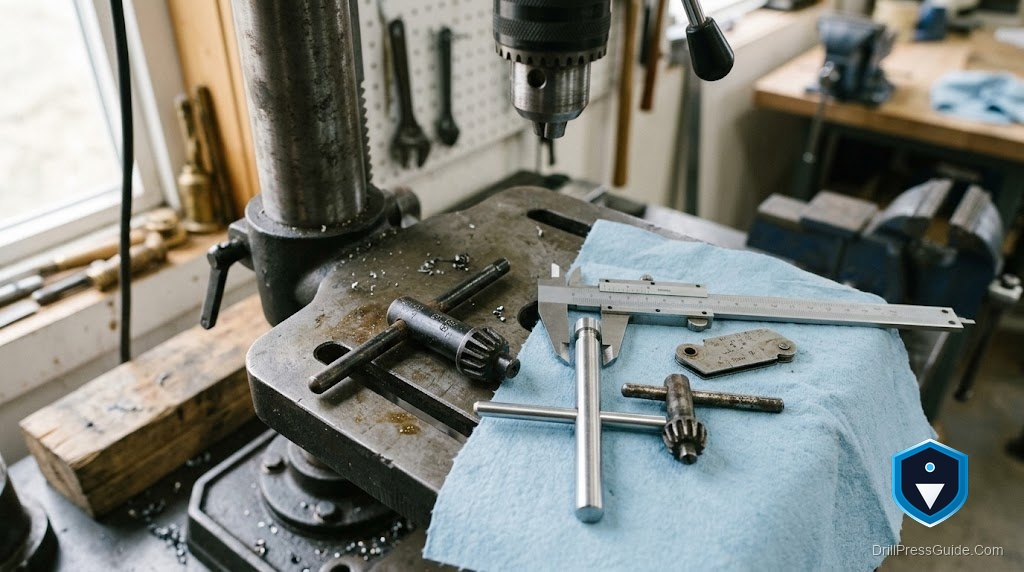
A chuck key is the toothed handle that opens and closes the chuck jaws. Its business ends are the pilot (the smooth post that centers it) and the gear teeth that engage the chuck’s bevel ring. A key fits when the pilot matches the hole diameter and the teeth match the pitch cut into the chuck. Everything else, brand, color, handle shape, is noise.
The direct answer: measure the pilot hole diameter on your chuck and note the chuck’s capacity, then buy a key to those numbers. Do not buy by drill press brand, and do not force a key that binds, because a mismatched key rounds the teeth and turns a lost key into a lost chuck.
The two measurements that matter
- Pilot hole diameter. Set a caliper across the round hole the key drops into. Common sizes cluster around 1/4, 5/16, and 3/8 inch on home machines, and the difference between them is small enough to fool the eye. Measure, do not guess.
- Chuck capacity and tooth pitch. A 1/2 inch chuck and a 5/8 inch chuck often take different keys, and the gear teeth must match the chuck’s pitch. If you can read a Jacobs code stamped near the hole, that pins down the key precisely.
Write both on a scrap of tape and take it shopping. That habit alone prevents most bad buys.
Pick the format that fits how you work
A single sized key is right when you have one press and a healthy chuck. Match the pilot and capacity and you are done. Search drill press chuck keys by the diameter you measured rather than by tool brand.
A multi size set earns its place fast if you own several drills or you lose keys on a schedule. A universal chuck key set covers the common pilot sizes so the next disappearance is a non event. The honest downside: the keys in lighter sets can feel lighter in the hand, and you will collect sizes you never use.
A self ejecting key adds a spring that pushes the key out when you release it. If you have ever caught your hand on the switch with the key still in the chuck, a self ejecting chuck key buys real confidence. It is slightly bulkier, and that is the whole tradeoff.
Comparison at a glance
| Format | Who it suits | Weak spot |
|---|---|---|
| Single sized key | One press, one healthy chuck | Useless if you buy the wrong pilot size |
| Multi size set | Multiple tools, frequent losers | Lighter keys, unused sizes |
| Self ejecting key | Anyone who forgets the key | A little bulkier at the chuck |
The safety reason this is not just convenience
A chuck key is the classic drill press hazard. Machine shop safety rules from OSHA and university programs say the same thing in plain language: remove the key the moment you finish an adjustment, because a key left in the chuck is thrown out at high speed when the power comes on. That is the case for a self ejecting key, and the case for never treating “just for a second” as acceptable.
Do not let a worn chuck fool you
If a correctly sized new key still slips or will not hold the jaws tight, stop blaming the key. Rounded teeth inside the chuck, or a pinion that has lost its edge, will defeat any key you buy. Look into the pinion hole for chewed teeth. If they are rounded, you are shopping for a chuck, and a new key alone is throwing good money after bad.
The verdict
A replacement chuck key is a two dollar decision that people manage to get wrong by shopping the drill press instead of the chuck. Measure the pilot hole, note the capacity, and buy to those numbers. Get a set if you are a repeat offender, get a self ejecting key if you value the safety reminder, and never grind a near fit into a good chuck. That is the whole game.
Three things to remember:
- The chuck sets the key size, so measure the pilot hole.
- A set is smart insurance if you lose keys often.
- If a correct key still slips, the chuck is worn, not the key.
FAQ
How do I find the right replacement chuck key? Measure the pilot hole diameter on the chuck and note the chuck’s capacity. Buy a key that matches both. Ignore the drill press brand, since the key is matched to the chuck.
What are the common drill press chuck key sizes? Home machines cluster around 1/4, 5/16, and 3/8 inch pilot diameters, paired with 1/2 inch or 5/8 inch chucks. Your exact size is set by your chuck, so measure it.
Are chuck keys universal across brands? Effectively yes, because the key matches the chuck, not the tool. Any brand’s key with the same pilot diameter and tooth pitch fits, which is why universal sets are common.
Why does my new chuck key grind instead of turning smoothly? The pilot or tooth pitch does not match, or the chuck teeth are worn. Recheck your pilot measurement first, then inspect the chuck for rounded teeth.
Is a self ejecting chuck key worth it? If you have ever reached for the switch with the key still in, yes. It removes the most common drill press hazard for a small size penalty.
Can I use a hand drill chuck key on a drill press? Only if the pilot diameter and pitch match. Many do not, so measure before assuming.
My key fits but the jaws still will not tighten. Why? The chuck’s internal gear is likely worn. A key can only turn teeth that still have shape, so a tired chuck needs replacing.
References
- Occupational Safety and Health Administration, Woodworking eTool: Drill Presses. https://www.osha.gov/etools/woodworking/production/machines-tools/drill-press
- Emory University EHS, Drill Press Safety Rules. https://ehso.emory.edu/sso/documents/content-guidelines/drillpresssafetyrules.pdf