Delta Drill Press Chuck Key Replacement: Diagnose the Fit Before Replacing Anything
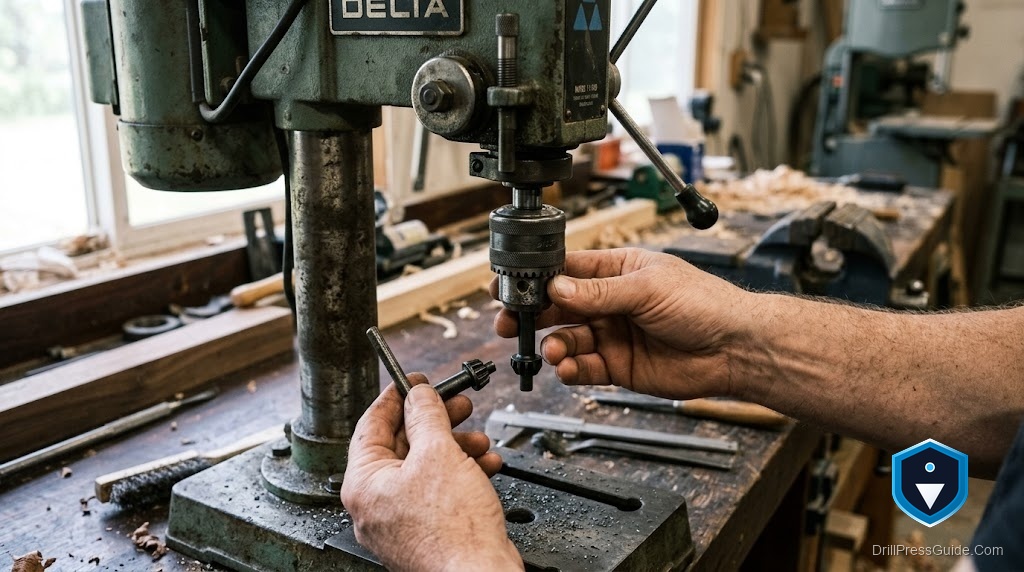
A missing chuck key has a way of turning up the same week you finally have time to build something. You dig through three drawers, find four keys from tools you no longer own, and not one of them seats right in the Delta. The temptation is to grab the closest match and force it. Do that and you will round off the pinion teeth on the chuck, and then a five minute errand becomes a chuck replacement. A good Delta drill press chuck key replacement starts with one question: what does your chuck actually take?
A drill press chuck key is the small toothed wrench that tightens and loosens the chuck jaws. It has a pilot (the round post that centers it in the hole on the chuck body) and a ring of gear teeth that mesh with the chuck’s bevel gear. Get the pilot diameter and the tooth pitch right and the key drops in and turns with no slop. Get either one wrong and it either will not seat or it chews the teeth.
So the short answer: match the key to the chuck, not to the drill press model. Two Delta presses from different years can wear different chucks, and a chuck from a repair or an upgrade may not match anything in the manual. Read the chuck first.
Read the chuck before you order
Look at the chuck body near one of the key holes. Most Jacobs style chucks carry a stamped code, something like a number followed by letters. On many older Delta units you will see a marking such as RJ33 or a similar Jacobs designation. That code tells you the chuck family and, with it, the key that fits.
If there is no readable stamp, measure. Two numbers decide the fit:
- Pilot hole diameter. Put a caliper across the round hole the key post drops into. This is the measurement people get wrong most often, because they eyeball it.
- Chuck capacity. A 1/2 inch chuck and a 5/8 inch chuck often use different keys even on the same brand.
Write both down before you shop. A key sold as “fits Delta” without a pilot size is a coin flip.
Your three real options
Buy the matching key. If the chuck is healthy, a single correct key is the cleanest fix. Delta keys have carried part numbers over the years, and some of the older ones are discontinued, which is why so many owners end up cross referencing by pilot size instead of chasing a number that no longer ships. Browsing replacement drill press chuck keys by pilot diameter usually turns up a match faster than hunting the exact Delta part.
Buy a multi size set. If you own more than one drill or you expect to misplace the next key too (most of us do), a universal chuck key set covers the common pilot sizes in one purchase. The tradeoff is honest: the sets are a little bulky, and the smaller keys in a set can feel less substantial than a single forged OEM key. But when one goes missing you are not dead in the water.
Skip the key entirely. If losing keys is a recurring theme, a keyless drill chuck that matches your spindle taper removes the problem at the source. This is the move for someone who values convenience over the last bit of clamping grip. It is not for the person chucking large Forstner bits all day, where a keyed chuck still holds better under load.
A quick comparison
| Option | Best for | The catch |
|---|---|---|
| Single matching key | A healthy chuck, one drill press | Older Delta part numbers may be discontinued |
| Multi size key set | Multiple tools, frequent losers | Individual keys feel lighter than a forged OEM key |
| Keyless chuck swap | Bit changes all day, hate keys | Less grip on big bits, and you must match the taper |
Do not skip the safety habit
Whatever key you end up with, build the reflex of pulling it the instant you finish tightening. Safety guidance from OSHA and university machine shops is blunt about this: a key left in the chuck becomes a projectile the moment the spindle spins.12 Some replacement keys include a spring loaded ejector that pops the key out on its own, which is worth seeking out if you have ever caught yourself reaching for the switch with the key still in.
When the key is not the real problem
If a correct, well fitting key still will not hold the jaws tight, the chuck itself may be worn. Rounded gear teeth inside the chuck, or jaws that no longer close evenly, will defeat any key. At that point you are looking at a chuck replacement rather than a key, and it is worth checking runout before you spend more on keys that a tired chuck cannot use.
The verdict
Do not let a lost key push you into buying the wrong thing twice. Measure the pilot hole, note the chuck capacity, and then decide. If the chuck is sound, match the key or grab a multi size set so the next disappearance is a non event. If you are tired of keys altogether and you mostly run smaller bits, convert to keyless and move on. The one path to avoid is forcing a near fit into a good chuck, because that is how a lost key turns into a ruined tool.
Three takeaways to leave with:
- The chuck decides the key, not the Delta model number.
- Pilot hole diameter is the measurement that actually matters, so measure it.
- Pull the key every single time, and let a self ejecting key help you remember.
FAQ
What size chuck key does a Delta drill press use? It depends on the chuck, not the press. Most Delta benchtop and floor models run 1/2 inch or 5/8 inch chucks, and the key is matched by pilot hole diameter. Measure the hole with a caliper before buying.
How do I know which key fits my chuck? Look for a stamped code near the key hole, often a Jacobs style marking. If it is unreadable, measure the pilot hole diameter and note the chuck’s capacity. Those two numbers identify the key.
Are Delta chuck keys interchangeable with other brands? Sometimes. Chuck keys are matched to the chuck, so any brand’s key with the same pilot diameter and tooth pitch will work. That is why universal key sets are popular for mixed workshops.
My Delta chuck key part number is discontinued. Now what? Cross reference by pilot hole size instead of the part number. Plenty of currently available keys fit the older Delta chucks once you know the pilot diameter.
Can I replace a keyed chuck with a keyless one? Yes, as long as the new chuck matches your spindle’s arbor and taper. Keyless is convenient for frequent bit changes but grips large bits less firmly under heavy load.
Why does my key keep slipping out of the teeth? Usually a pilot that is slightly undersized or worn chuck teeth. If a correctly sized key still slips, inspect the chuck’s bevel gear for rounding.
Is it safe to leave the key in for a second while I set up? No. Treat the key as something that lives in your hand or on the tray, never in the chuck when you step away, because it will be thrown when the spindle starts.
References
- Occupational Safety and Health Administration, Woodworking eTool: Drill Presses. https://www.osha.gov/etools/woodworking/production/machines-tools/drill-press
- Canadian Centre for Occupational Health and Safety, Metalworking Machines: Drill Presses. https://www.ccohs.ca/oshanswers/safety_haz/metalworking/drillpresses.html