
WEN 4-Inch Drill Press Vise: Specs, Capacity, Parts, and Owner Notes
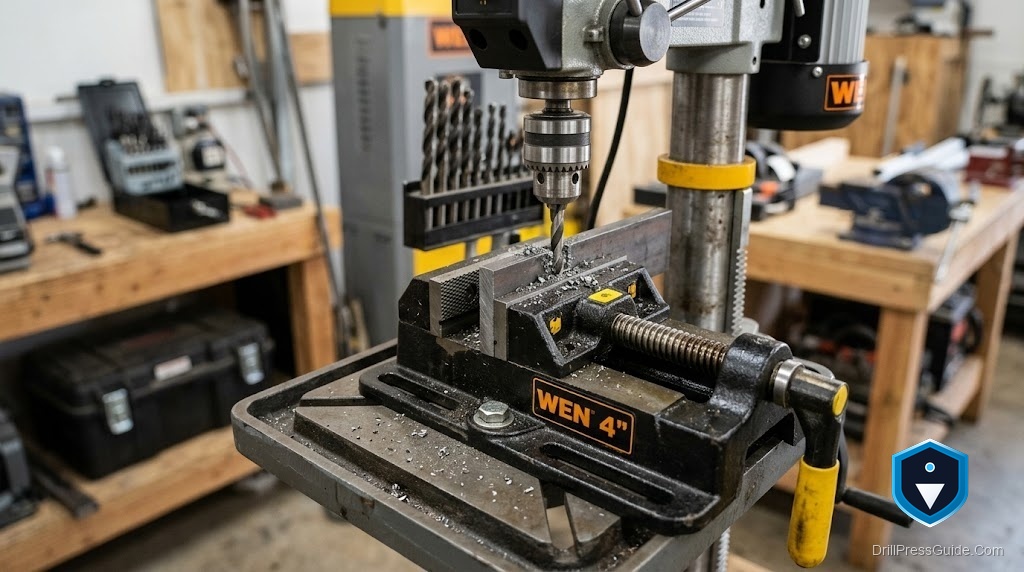
If the 3-inch drill press vise is the small-parts default, the WEN 4-inch model is the one you reach for when your work gets a little bigger. It is the same cast-iron idea with more jaw, holding wider stock securely while keeping your hands clear of the bit. This is a specs, capacity, and owner-notes reference for the WEN 4-inch drill press vise, so you know exactly what it holds and whether it is the right size for your bench.
The WEN 4-inch drill press vise (model DPA424) is a cast-iron clamp with 4-inch jaws that open to about 4 inches, a 1-inch throat depth, and four onboard mounting slots to bolt it to a drill press table. It measures roughly 9 by 7.7 by 2.7 inches and weighs around 7 pounds. Its universal base fits most drill press tables. It is a current WEN product backed by WEN’s warranty and support.
Straight answer: the 4-inch vise is right if you want to hold wider or heavier parts than a 3-inch vise allows while still keeping the affordable cast-iron simplicity. It is the wrong choice if your work is tiny (a 3-inch vise is lighter and cheaper) or if you need tilting or cross-slide positioning, which this flat, fixed vise does not offer.
Specs and what they mean
The defining numbers are the 4-inch jaw width, the roughly 4-inch opening, and the 1-inch throat. The wider jaws grip stock that would overhang a 3-inch vise, and the extra mass, around 7 pounds of cast iron, adds stability and damps vibration for cleaner holes. The four mounting slots let you bolt the WEN 4-inch drill press vise solidly to your table, which is what turns a heavy clamp into a safe one.
What the 1-inch throat means in practice is how far in from the edge you can clamp; it is modest, so plan your clamping so the bit clears the jaws and enters open space or a backing board.
Capacity, honestly
The 4-inch vise handles small-to-medium parts: wider boards, brackets, and metal stock that a 3-inch vise cannot span. It is a genuine step up in what you can hold securely. What it is not is a large-capacity or precision-positioning vise: the 4-inch opening still caps part width, the 1-inch throat limits clamping depth, and it neither tilts nor slides. For most benchtop and light-shop drilling, that capacity is plenty; for wide panels or angled metalwork, you would want a larger or specialized vise.
Setup and everyday use
Setup mirrors any drill press vise, and one step is non-negotiable:
- Position the vise and line up the workpiece under the bit.
- Bolt it down through the four mounting slots. Always secure the vise to the table before drilling; an unbolted vise can spin.
- Clamp the part against the fixed jaw and tighten the movable jaw firmly.
- Check clearance so the bit passes into the open center or a backing board, not the vise body.
With the heavier 4-inch vise, bolting down matters even more, because its extra mass makes an unsecured spin more dangerous, not less.
Parts and upkeep
As a current WEN product, the 4-inch vise is backed by WEN’s warranty and support, and upkeep is minimal. Keep the jaws and slide clean, oil the screw occasionally for smooth action, and avoid overtightening onto fragile parts. When clamping finished material, place a scrap of wood or soft padding between the jaws and the part to prevent marks. There are no belts, motors, or electrical parts, so the vise essentially maintains itself. If you also need to hold small parts, pairing it with the WEN 3-inch vise covers both ranges.
The honest flaws
Two honest notes. First, like most affordable cast-iron vises, the jaws can mark soft or finished workpieces, so use soft pads when appearance matters. Second, the 1-inch throat and 4-inch opening are still modest, and the vise does not tilt or swivel, so it is a general-purpose holder rather than a precision metalworking fixture. Within those bounds, it is a solid, dependable clamp.
Who should buy it, and who should skip it
Buy the WEN 4-inch vise if you drill small-to-medium parts and want more jaw and mass than a 3-inch vise, with the same affordable cast-iron simplicity. It is a versatile default for a home or light-shop bench.
Skip it if your work is consistently tiny (the 3-inch vise is lighter and cheaper) or if you need tilting or cross-slide positioning for angled or precise metalwork (choose a tilting or compound vise). Do not buy the 4-inch expecting large-panel capacity; size up to a bigger vise for that.
Conclusion: the versatile mid-size clamp
The WEN 4-inch drill press vise is the practical middle ground, more capacity than a 3-inch vise, still simple and affordable.
- Cast-iron 4-inch jaws opening to about 4 inches, 1-inch throat, four mounting slots, about 7 pounds.
- Holds small-to-medium parts securely; always bolt it to the table before drilling.
- Limits are the modest throat and opening, and no tilt or swivel.
- Current WEN product with warranty support and almost no upkeep.
FAQ
What size does the WEN 4-inch vise hold? Its 4-inch jaws open to about 4 inches with a 1-inch throat depth, suited to small-to-medium parts.
How is it different from the 3-inch vise? Wider jaws, a larger opening, and more mass, so it holds wider or heavier stock than the 3-inch model.
Does it fit my drill press? It has a universal base with four mounting slots that fits most drill press tables. Check your table against the base dimensions.
Do I need to bolt it down? Yes, always. Its extra mass makes an unsecured spin more dangerous, so fasten it to the table before drilling.
Will it mark my workpiece? The cast-iron jaws can mark soft or finished material. Use soft padding between the jaws and the part.
Can it tilt or swivel? No. It is a flat, fixed vise. For angled or precise positioning, use a tilting or compound vise.
Should I choose the 4-inch or 3-inch? Choose the 4-inch for small-to-medium parts, the 3-inch for consistently tiny work. Many owners keep both.
References
- WEN DPA424 4-inch Drill Press Vise, WEN Products: https://wenproducts.com/products/wen-dpa424-4-in-drill-press-vise
- WEN 4-inch Cast Iron Drill Press Vise DPA424, Lowe’s: https://www.lowes.com/pd/WEN-4-in-Cast-Iron-Drill-Press-Vise/5013582121
- WEN 4 in. Drill Press Vise DPA424, The Home Depot: https://www.homedepot.com/p/WEN-4-in-Drill-Press-Vise-DPA424/319983558


