
Understanding the WEN 3-Inch Drill Press Vise: Setup, Limits, and Support
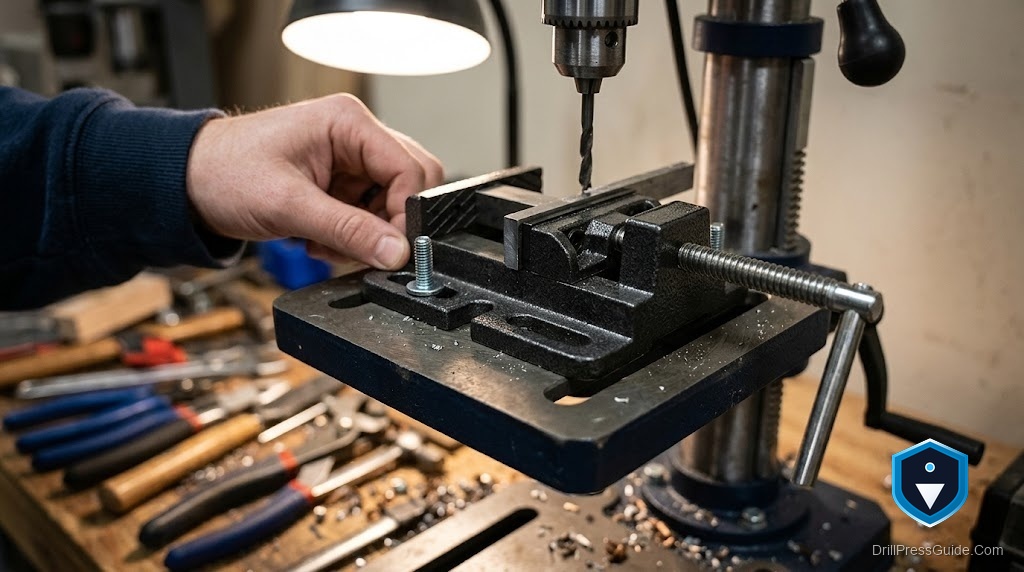
The most common way people get hurt on a drill press, or ruin a part, is by holding the workpiece with their hands. A bit grabs, the piece spins, and a small job turns into a bad day. A drill press vise fixes that, and the WEN 3-inch model is one of the most popular affordable answers. Understanding the WEN 3-inch drill press vise, how to set it up, where its limits are, and how it is supported, tells you whether this small cast-iron clamp is the right accessory for your bench.
The WEN 3-inch drill press vise (model DPA423) is a cast-iron clamp with 3-inch jaws that open to about 3-1/10 inches, a 1-inch throat depth, and four onboard mounting slots to bolt it to a drill press table. Its universal base design fits most drill press tables. It is a current WEN product backed by WEN’s warranty and support.
Straight answer: the WEN 3-inch vise is right if you drill small parts and want to hold them securely and squarely without your fingers near the bit. It is the wrong choice if you need to clamp wide stock or want a vise that pivots and tilts, because the 3-inch jaws and 1-inch throat are modest by design.
Why a vise matters
A drill press vise does two jobs at once: it keeps your hands clear of the bit, and it holds the workpiece square so the hole goes where you intend. Freehand drilling risks both a spinning part (dangerous) and a wandering or angled hole (frustrating). The WEN 3-inch drill press vise clamps small parts firmly in cast iron, which resists the twisting force a bit applies as it breaks through. For the small work most benchtop presses do, that security is exactly what you want.
The cast-iron body also adds mass, which damps vibration and keeps the part from chattering, improving both safety and hole quality.
Setup, step by step
Setting up the vise is quick:
- Position it: Place the vise on the drill press table and line up your workpiece under the bit.
- Bolt it down: Use the four onboard mounting slots to fasten the vise to the table with bolts or clamps. This is the step people skip, and it is the most important, an unbolted vise can spin just like an unheld part.
- Set the work: Open the jaws, seat the workpiece against the fixed jaw, and tighten the movable jaw until the part is firmly held.
- Check clearance: Confirm the bit will pass through the part into the open center or a backing board, not into the vise body.
Always bolt or clamp the vise to the table before drilling; that single habit is what makes it safe.
Limits, stated plainly
The honest limits are size. The 3-inch jaws and roughly 3-1/10-inch opening hold small parts, not wide stock. The 1-inch throat depth limits how deep into a part you can clamp. And this is a flat, fixed vise: it does not tilt or swivel, so angled drilling needs a tilting table or a different vise. None of that is a flaw; it is the definition of a compact 3-inch vise, and it only matters if your parts are larger than the jaws allow.
Support and upkeep
As a current WEN product, the 3-inch vise is backed by WEN’s warranty and customer support, and there is very little to maintain. Keep the jaws and slide clean, add a drop of oil to the screw occasionally so it turns smoothly, and do not overtighten to the point of cracking a fragile workpiece. The replaceable-quality steel jaw faces grip well; if you clamp finished parts, a scrap of wood or soft material between jaw and part prevents marring. There are no belts or electrical parts to fail.
The honest flaws
Beyond its size, two honest notes. First, like most affordable cast-iron vises, the jaws can leave marks on soft or finished material, so use soft pads when appearance matters. Second, the modest throat and opening mean it is genuinely a small-parts tool; buyers who need to clamp 4-inch-plus stock should size up. Used within its range and bolted down, it does its one job well.
Who should buy it, and who should skip it
Buy the WEN 3-inch vise if you drill small parts on a benchtop press and want safe, square, repeatable holds at a modest size. For most hobby and light-shop work, it is exactly enough.
Skip it if you routinely clamp wide stock (choose a 4-inch or larger vise), or if you need tilting or cross-slide positioning for angled and precise metalwork (choose a tilting or compound vise). Do not try to hold oversized parts in a 3-inch vise; get the right size instead.
Conclusion: a small vise that earns its place
The WEN 3-inch drill press vise is a simple, affordable safety and accuracy upgrade for small work.
- Cast-iron 3-inch jaws opening to about 3-1/10 inches, 1-inch throat, four mounting slots.
- It keeps hands clear and holds parts square; always bolt it to the table before drilling.
- Limits are size: small parts only, no tilt or swivel.
- Current WEN product with warranty support and almost no upkeep.
FAQ
What size does the WEN 3-inch vise hold? Its 3-inch jaws open to about 3-1/10 inches with a 1-inch throat depth, sized for small parts.
Does it fit my drill press? It has a universal base with four mounting slots that fits most drill press tables. Check your table against the base dimensions.
Do I have to bolt it down? Yes. Fasten the vise to the table through its slots before drilling; an unsecured vise can spin like an unheld workpiece.
Will it mark my workpiece? The cast-iron jaws can mark soft or finished material. Use a scrap of wood or soft padding between the jaws and the part.
Can it tilt for angled holes? No. It is a flat, fixed vise. For angled drilling, use a tilting table or a tilting/compound vise.
How do I maintain it? Keep the jaws and slide clean, oil the screw occasionally, and avoid overtightening. There is nothing else to service.
Should I get the 3-inch or a larger vise? Choose the 3-inch for small parts. If you regularly clamp wider stock, step up to a 4-inch or larger vise.
References
- WEN DPA423 3-inch Drill Press Vise, WEN Products: https://wenproducts.com/products/wen-dpa423-3-in-drill-press-vise
- WEN 3-inch Cast Iron Drill Press Vise DPA423, Lowe’s: https://www.lowes.com/pd/WEN-3-in-Cast-Iron-Drill-Press-Vise/5013699687
- WEN Drill Press Vise 3-inch specifications, Northern Tool: https://www.northerntool.com/products/wen-drill-press-vise-3in-jaw-width-3-1in-jaw-capacity-cast-iron-model-dpa423-5733481


