
How to Make a Drill Press Vise Without Losing Accuracy
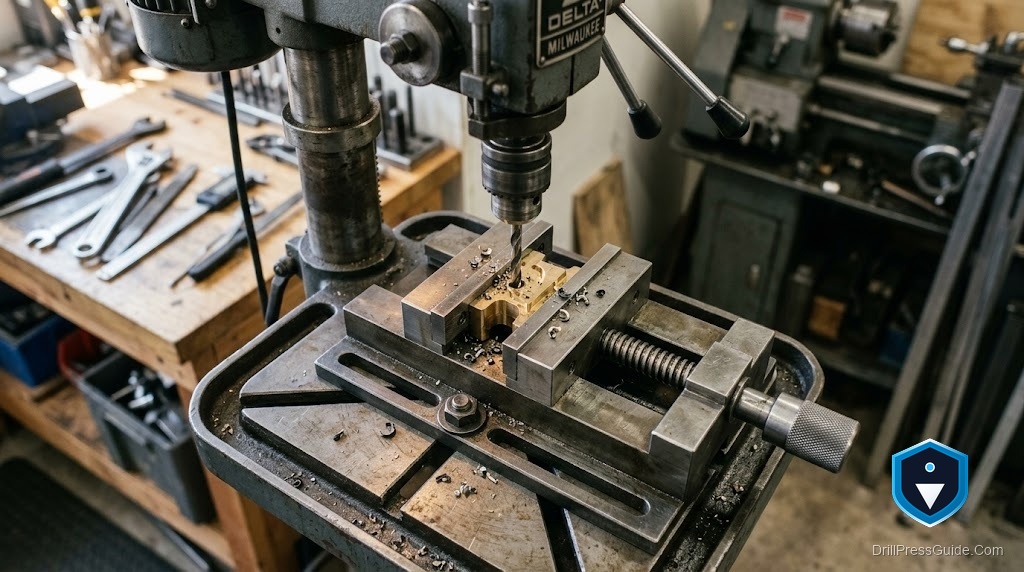
Holding a workpiece by hand under a spinning drill bit is how fingers get hurt and holes get ruined. A drill press vise solves both problems by gripping the work firmly and letting you clamp it to the table, and making your own is a genuinely useful project when you want a vise sized exactly to your work. The one thing that separates a good shop-made vise from a frustrating one is that it must hold the workpiece square and immovable, because a vise that lets the work shift defeats its entire purpose.
A drill press vise is a clamping device that grips a workpiece between two jaws and can itself be secured to the drill press table, holding the work steady, square, and safe while you drill. Making one means building a fixed jaw and a moving jaw driven by a screw, keeping the jaws parallel and square, and providing a way to bolt or clamp the vise to the table.
Short answer: build a solid fixed jaw and a screw-driven moving jaw that stay parallel and square as they close, mount both to a rigid base, and give the base holes or a lip so it can be clamped to the drill press table. Accuracy comes from jaws that grip square without racking and a vise that is itself locked to the table, so the workpiece cannot move.
Get the jaws parallel and square
The heart of a vise is two jaws that close on the work while staying parallel and perpendicular to the base, because jaws that tilt or rack grip the work crooked and let it shift. Build a fixed jaw solidly anchored to the base and a moving jaw guided so it travels straight toward the fixed one without twisting. In a wooden vise, guide the moving jaw with runners or rods; in a metal one, a machined slide. Face the jaws flat and true. Test by clamping a square block and checking it sits square and does not rock. Parallel, square, non-racking jaws are the single most important thing, since they are what actually hold the work accurately.
Drive it with a solid screw
The moving jaw is closed by a screw, and that screw and its nut must be solid and aligned so clamping force pushes the jaw straight in, not at an angle. Use a stout threaded rod or acme screw with a matching nut captured in the fixed jaw or base, and fit a handle to turn it. Make sure the screw pushes through the center of the moving jaw’s travel so it does not tilt the jaw as it tightens. A sloppy or off-center screw lets the jaw rack under load, which loosens the grip exactly when drilling forces are highest. A well-aligned screw delivers even, square clamping force, which is what keeps the work locked.
Mount the vise to the table
A vise that grips the work but can itself slide on the table is only half a vise, because a large bit can grab the work and spin the whole vise. So build the base with bolt holes or slots, or a lip, that let you clamp or bolt the vise to the drill press table. This is what turns hand-holding into true securing: the work is locked in the jaws, and the jaws are locked to the table. Plan the mounting to line up with your table’s slots or holes. Being able to fix the vise to the table is essential to both accuracy and safety, so build it in rather than treating it as an afterthought.
Use it safely and keep it true
Once built, clamp the workpiece firmly in the jaws and then secure the vise to the table before drilling, every time, so nothing can spin. Support the work on the jaws or a backing piece so the bit does not drill into the vise, and use a sacrificial backing to prevent tearout on through-holes. Keep the bit and chuck guarded and your hands clear. Check periodically that the jaws still close square and the screw runs smoothly, since wear or a bent screw reintroduces racking. Used this way, a shop-made vise holds the work as securely as a bought one and keeps both your holes accurate and your fingers away from the bit.
Conclusion
Making a drill press vise is worthwhile when you build it to do the one thing a vise must: hold the workpiece square and immovable. Get the jaws parallel, square, and non-racking, drive the moving jaw with a solid, centered screw, and build the base so the whole vise clamps to the drill press table. Then always clamp the work and secure the vise before drilling, back up through-holes, and keep hands clear. Check that the jaws stay square over time. Done right, a homemade vise matches a bought one for holding power and turns dangerous hand-holding into safe, accurate, repeatable drilling.
Frequently asked questions
Why make a drill press vise instead of holding the work? Because holding work by hand under a spinning bit is dangerous and inaccurate. A vise grips the work square and clamps to the table, keeping holes accurate and hands away from the bit.
What is the most important thing for accuracy? Jaws that stay parallel and square as they close, without racking. Tilting or twisting jaws grip the work crooked and let it shift, which is exactly what a vise must prevent.
How should the moving jaw be driven? By a solid, well-aligned screw pushing through the center of the jaw’s travel, with a captured nut, so clamping force closes the jaw straight rather than tilting it under load.
Does the vise need to attach to the table? Yes. A vise that grips the work but can slide on the table is unsafe, since a bit can grab the work and spin the whole vise. Build in holes, slots, or a lip to clamp it down.
How do I avoid drilling into the vise? Support the work so the bit exits into a gap or a sacrificial backing piece rather than the vise body. The backing also prevents tearout on through-holes.
How do I keep a homemade vise accurate over time? Check periodically that the jaws still close square and the screw runs smoothly. Wear, a bent screw, or a loose nut reintroduces racking, so correct those to keep the grip true.
References
- OSHA, Machine Guarding eTool: Drill Presses, osha.gov
- Forest Products Laboratory, wood machining references, fpl.fs.usda.gov


