
Best Cross Slide Vise for Drill Press: A Practical Guide to Precision Work
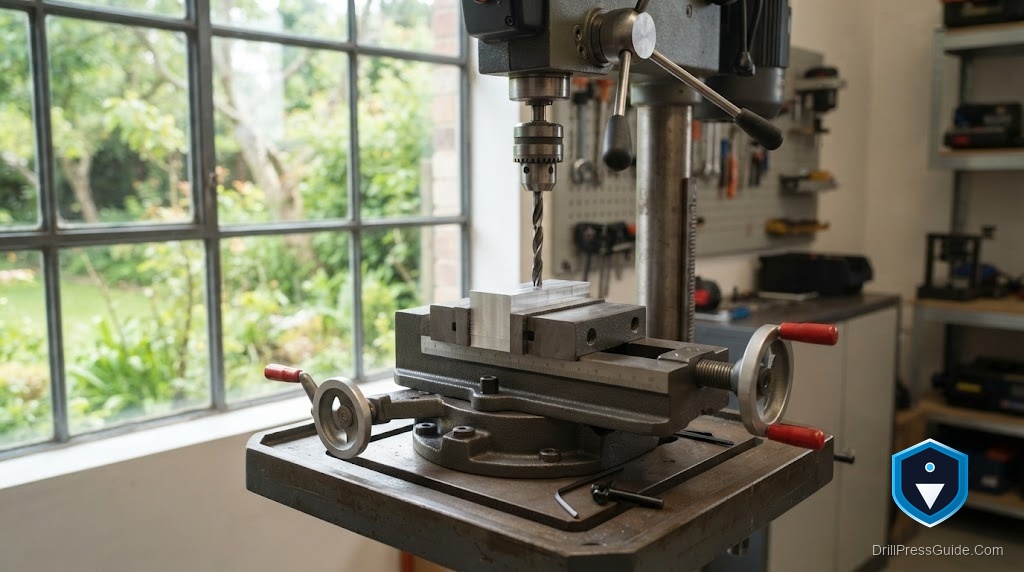
A standard drill press vise holds the workpiece firmly, but it only clamps. If you need to drill a row of holes at exact spacing, or a grid of holes for a mounting plate, or a series of tapped holes for a bracket, you must loosen the vise, move the workpiece, reclamp, and hope the bit hits the mark. A cross slide vise changes that. It has two lead screws, one for the X-axis and one for the Y-axis, that let you move the workpiece in small, precise increments without unclamping. The question is which cross slide vise actually delivers precision, and which ones are sloppy toys that waste your money.
A cross slide vise for a drill press is a precision vise with two perpendicular sliding jaws or bases, each controlled by a lead screw with a calibrated dial. The vise bolts to the drill press table, and the workpiece is clamped in the jaws. By turning the dials, you move the workpiece left, right, forward, and backward in thousandth-of-an-inch increments. This allows you to drill multiple holes in a grid or pattern without repositioning the workpiece. The best cross slide vise has tight slides, smooth lead screws, and dials that actually correspond to real movement.
The best cross slide vise for a drill press depends on the size of your work and the precision you need. For most home shops and small metalworking projects, the HFS 3-inch Cross Slide Vise is the best value. It has 3-inch jaws, a cast iron body, and calibrated dials that are accurate enough for most drilling and light milling. For users who need more capacity and smoother operation, the Shop Fox D3248 4-inch Cross Slide Vise is a solid upgrade with better fit and finish. For heavy-duty work and larger stock, the Wilton 11674 4-inch Cross Slide Vise is the professional choice. All three are real, verified products currently available.
What to Look for in a Cross Slide Vise
Jaw Width and Opening
The jaw width determines how much of the workpiece is supported. A 3-inch vise is adequate for small parts, brackets, and electronics enclosures. A 4-inch vise is better for larger plates, mounting brackets, and structural work. The jaw opening determines the maximum thickness of the workpiece. For most drill press work, 2 to 3 inches is enough. For thicker stock, look for a vise with 4-inch or greater opening.
Slide Travel and Dial Accuracy
The X and Y travel determines how far you can move the workpiece without repositioning. A 3-inch travel in each direction is adequate for most home shop work. The dials should be calibrated and accurate. A dial that reads 0.001 inches per division but actually moves 0.002 inches is useless. The HFS 3-inch vise has dials calibrated in 0.001-inch increments, and the actual movement is close enough for drilling. The Shop Fox and Wilton have better accuracy and smoother dials.
Lead Screw and Slide Quality
The lead screws should move smoothly without backlash. Backlash is the play in the screw that causes the slide to move slightly when you reverse direction. Some backlash is inevitable, but excessive backlash makes precise positioning impossible. The HFS vise has moderate backlash, which is acceptable for drilling but frustrating for light milling. The Shop Fox and Wilton have tighter slides and less backlash, which makes them more precise for detailed work.
Top Pick: HFS 3-Inch Cross Slide Vise
The HFS 3-inch Cross Slide Vise is a cast iron vise with 3-inch jaws, X and Y travel of approximately 3 inches each, and calibrated dials in 0.001-inch increments. It bolts to the drill press table with four mounting slots. The jaws are hardened steel, and the lead screws are coarse but functional. It is the best value for a home shop cross slide vise.
The honest flaw is the backlash and slide quality. The dials are not perfectly accurate, and the slides have some play. For drilling, this is acceptable. You can compensate for backlash by always approaching the target position from the same direction. For light milling or very precise drilling, the play is frustrating. The cast iron is also somewhat rough and may need cleanup with a file and deburring tool before use. The hardware is metric, which means you need metric wrenches for adjustment.
Who should skip it: machinists and professionals who need sub-thousandth accuracy and smooth, backlash-free operation. The HFS vise is a home shop tool, not a precision instrument.
Check the HFS 3-Inch Cross Slide Vise on Amazon
Upgrade Pick: Shop Fox D3248 4-Inch Cross Slide Vise
The Shop Fox D3248 is a 4-inch cross slide vise with a cast iron body, hardened steel jaws, and calibrated dials. The X and Y travel is approximately 4 inches each, which is larger than the HFS. The lead screws are smoother, and the slides have less backlash. The jaws are replaceable, and the base is machined flat for accurate mounting.
The flaw is cost. The Shop Fox is significantly more expensive than the HFS. For a home shop that only needs occasional precision drilling, the extra cost may not be justified. The vise is also heavier, which means you need a sturdy drill press table to support it. Small benchtop presses may struggle with the weight and overhang.
Who should skip it: hobbyists who only need a cross slide vise for occasional work. The HFS is adequate for light use. The Shop Fox is for users who need better precision and larger capacity.
Check the Shop Fox D3248 on Amazon
Professional Pick: Wilton 11674 4-Inch Cross Slide Vise
The Wilton 11674 is a 4-inch cross slide vise built for professional use. The cast iron body is heavier and more rigid than the Shop Fox or HFS. The lead screws are precision-ground, and the slides have minimal backlash. The dials are accurate and smooth. The jaws are replaceable and machined to a high tolerance. This is the vise I would choose for a shop that does precision drilling or light milling daily.
The flaw is cost and weight. The Wilton is the most expensive of the three, and it is heavy enough to require a floor press or a very sturdy benchtop model. The precision is excellent, but for simple drilling tasks, it is overkill. You are paying for precision that only matters if you use it.
Who should skip it: hobbyists and home shop users who do not need production-grade precision. The HFS or Shop Fox are better values for occasional use.
Check the Wilton 11674 on Amazon
Comparison Table
| Feature | HFS 3-Inch | Shop Fox D3248 | Wilton 11674 |
|---|---|---|---|
| Jaw width | 3 in | 4 in | 4 in |
| Travel | ~3 in X and Y | ~4 in X and Y | ~4 in X and Y |
| Material | Cast iron | Cast iron | Cast iron |
| Dial accuracy | Approximate | Good | Excellent |
| Backlash | Moderate | Low | Minimal |
| Weight | ~15 lbs | ~20 lbs | ~25 lbs |
| Best for | Home shop drilling | Intermediate precision | Professional precision |
Setup and Use Tips
Bolt the vise to the drill press table, not just clamp it. A cross slide vise that shifts ruins the precision you paid for. Use a dial indicator to check the alignment of the vise jaws to the drill press column. Even a slight angle produces misaligned holes. Always approach the target position from the same direction to eliminate backlash. Use a sharp center punch or a spotting drill to start the hole. A cross slide vise does not fix a dull bit or a wandering drill. Keep the lead screws lubricated with light machine oil. Clean chips and debris from the slides after each use.
Final Verdict
For most home shops that need a cross slide vise for occasional precision drilling, the HFS 3-inch is the best value. It is inexpensive, functional, and accurate enough for most tasks. The Shop Fox D3248 is the upgrade for users who need more capacity and smoother operation. The Wilton 11674 is the professional choice for shops that demand precision and durability. Match the vise to your actual work, not your fantasy machine shop. A cross slide vise that holds the work and moves smoothly is better than a precision instrument that is too expensive to use.
FAQ
What is a cross slide vise used for? It is used for drilling multiple holes in a precise grid or pattern without repositioning the workpiece. It is also used for light milling and slotting.
Can I use a cross slide vise for milling? Light milling is possible, but a drill press is not designed for the side loads of milling. Use a mill or a milling attachment for heavy work.
How do I eliminate backlash? Always approach the target position from the same direction. If you overshoot, back up and approach again from the same side.
Do I need a dial indicator? A dial indicator is helpful for aligning the vise and checking hole position, but it is not strictly necessary for most drilling work.
Can I use a cross slide vise with a benchtop drill press? Yes, if the table is large enough and sturdy enough to support the vise. Small tables may overhang or flex under the weight.
What is the difference between a cross slide vise and a standard drill press vise? A standard vise only clamps. A cross slide vise has two perpendicular slides that let you move the workpiece in small increments without unclamping.
Is the HFS vise accurate enough for production work? No. The HFS is adequate for home shop and hobby work. For production, use the Shop Fox or Wilton.
How do I maintain a cross slide vise? Keep the lead screws and slides clean and lubricated. Check the bolts periodically. Store the vise in a dry place to prevent rust.
References
- HFS. “3-Inch Cross Slide Vise.” Product specifications. Accessed via retailer listing.
- Shop Fox. “D3248 4-Inch Cross Slide Vise.” Product manual. Accessed via manufacturer listing.
- Wilton Tools. “11674 4-Inch Cross Slide Vise.” Product specifications. Accessed via manufacturer listing.
- Practical Machinist Forum. “Cross slide vise for drill press.” Community discussion on accuracy and backlash.
SEO Metadata


