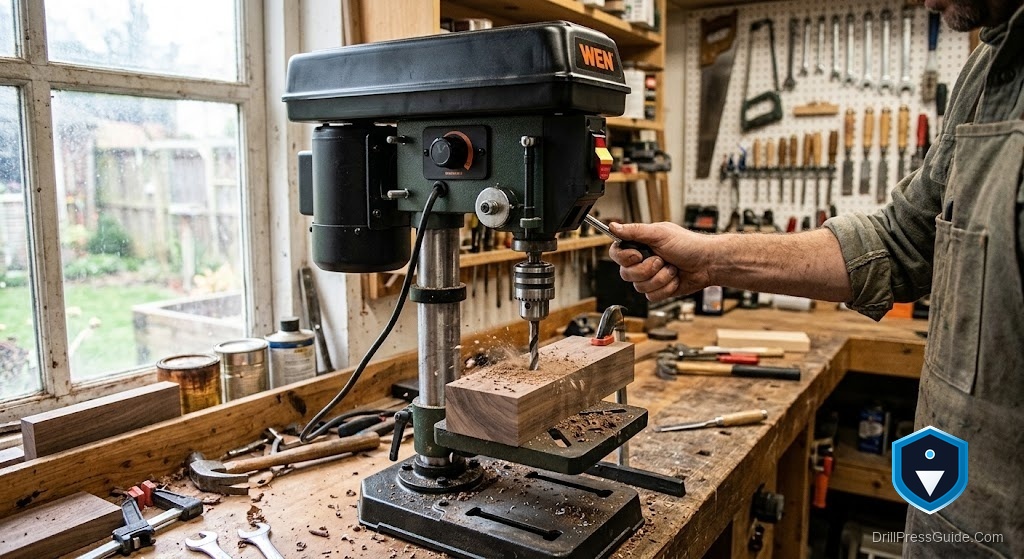
Best Drill Press Vise for Woodworking: A Practical Guide to Holding Your Work
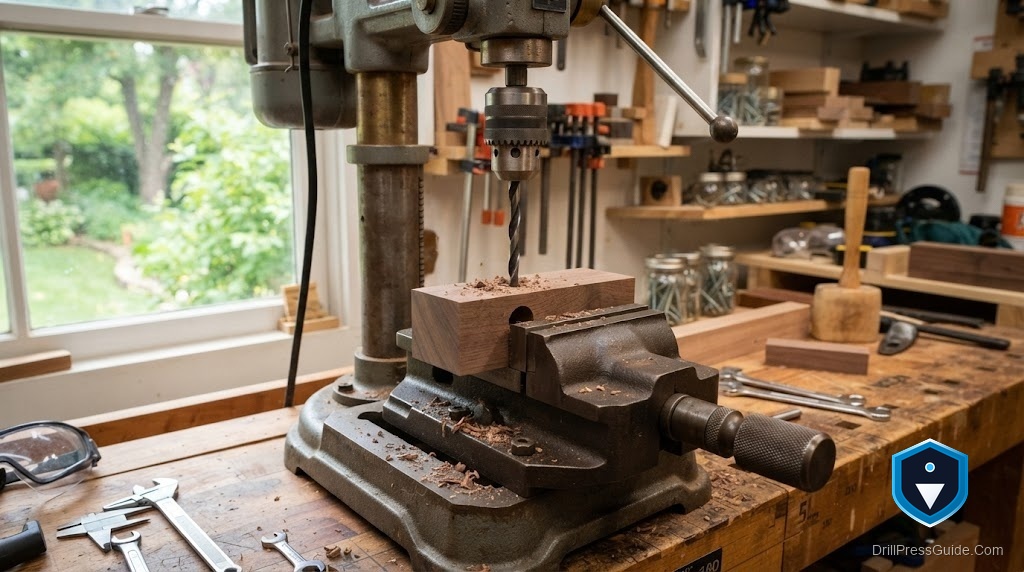
Wood moves, compresses, and splinters. A metal vise with serrated jaws will crush a finished edge, leave bite marks, and split thin stock. A hand screw vise is slow and imprecise. A C-clamp distorts the workpiece and blocks the bit. A woodworking drill press vise needs flat, smooth jaws that spread clamping force evenly, a low profile that keeps the work close to the table, and a quick action that does not waste your time.
A woodworking drill press vise is a small, precision vise with smooth or padded jaws, a flat base, and a screw or quick-slide mechanism. It is designed to hold wood without marring the surface, to bolt or clamp to the drill press table, and to allow vertical drilling without the vise body interfering with the quill. The jaws are usually 3 to 6 inches wide, with faces that are either machined flat, lined with leather or plastic, or replaceable with softer inserts.
The best drill press vise for woodworking depends on the size of your stock and the finish you need. For most home shop woodworkers who need a versatile, non-marring vise, the Shop Fox D4088 is the best choice. It has 6-inch aluminum jaws that are smooth and wide, a quick-release mechanism, and a flat base. For users who need a smaller vise for delicate work, the Yost LV-4 with jaw liners is a good alternative. For heavy-duty woodworking and larger stock, the Wilton 11800 is a professional-grade vise with a 6-inch jaw width and a cast iron body.
What to Look for in a Woodworking Drill Press Vise
Jaw Width and Material
Jaw width determines how much of the workpiece is supported. A 3-inch vise is fine for small parts, but a 6-inch vise supports a full cabinet stile without overhang. Woodworking jaws should be smooth. Serrated or hardened steel jaws, which are standard on metal vises, will crush wood fibers. Aluminum or cast iron jaws with a smooth finish are standard for woodworking. Some vises have replaceable jaw liners made of leather, cork, or plastic. These protect finished surfaces but can compress under heavy clamping, which reduces accuracy.
Opening and Throat Depth
The opening is the maximum distance between the jaws. For most furniture work, 2 to 3 inches is enough. For thicker stock or laminated pieces, 4 inches is better. The throat depth is the distance from the top of the jaw to the screw or slide. A deep throat lets you hold thicker stock vertically. A shallow throat limits you to thinner pieces. The Shop Fox D4088 has a 3-inch jaw opening and a generous throat depth for a bench vise.
Base and Mounting
The base must be flat and parallel to the jaw faces. A concave base rocks on the table, which tilts the workpiece. Look for a base with mounting slots or holes that line up with the T-slots or slots on your drill press table. The Shop Fox D4088 has a flat base with mounting slots. The Wilton 11800 has a bolt-down base. The Yost LV-4 can be adapted with jaw liners.
Quick-Release and Screw Mechanism
Woodworking involves more frequent changes than metal work. A quick-release mechanism lets you slide the jaw open by hand, then engage the screw for the final clamp. This is a significant time-saver when you are drilling repetitive holes in cabinet parts. The Shop Fox D4088 has a quick-release trigger. The Yost LV-4 also has a quick-release. The Wilton 11800 uses a standard screw, which is slower but more precise for heavy clamping.
Top Pick: Shop Fox D4088 6-Inch Aluminum Drill Press Vise
The Shop Fox D4088 is a 6-inch drill press vise with smooth aluminum jaws, a quick-release mechanism, and a flat base. The jaws are 6 inches wide, which supports large stock without overhang. The aluminum construction is light but rigid, and the smooth jaws do not mar wood. The quick-release trigger lets you open the jaws instantly for fast changes. The base has mounting slots for bolting to the drill press table.
The honest flaw is the quick-release trigger. It is made of plastic and can wear out after heavy use. Some owners replace the trigger with a metal part or simply use the screw manually. The aluminum jaws are also softer than steel, which means they can dent if you clamp a metal object or drop a tool on them. This is a woodworking vise, not a metalworking vise, and it should be treated accordingly.
Who should skip it: anyone who needs to clamp metal or who needs a vise that will survive heavy abuse. The D4088 is a woodworking tool, and it should be used for wood only.
[Check the Shop Fox D4088 on Amazon](Check on Amazon