Best Drill Press Vise for Metal: A Practical Guide to Holding Your Work
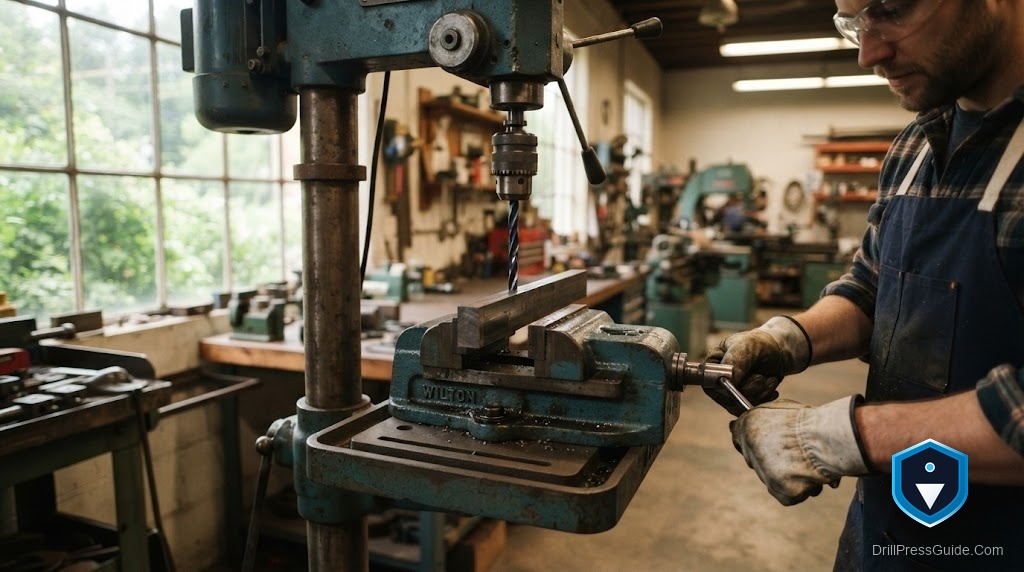
Drilling a precise hole in metal requires the workpiece to stay exactly where you place it. Unlike wood, metal does not compress under a vise jaw, and it is unforgiving when the bit grabs and spins. A hand vise, a C-clamp, or even a woodworking vise will not work. You need a drill press vise designed for metal: hardened steel jaws, precise screw movement, and a low profile that keeps the work close to the table without interfering with the quill.
A drill press vise for metal is a small, precision vise with hardened steel jaws, a flat base, and a lead screw or quick-slide mechanism. It is designed to bolt to the drill press table or sit on it and be clamped from the sides. The jaws are flat, parallel, and strong enough to hold steel, aluminum, or brass without deforming. The base is machined flat so it sits level on the table. The screw is coarse enough to tighten quickly but fine enough to hold with pressure without backing off.
The best drill press vise for metal depends on the size of your work and how often you change setups. For most home shops and small professional shops, the WEN 414BV is the best combination of accuracy, capacity, and price. It has a 4-inch jaw width, 1-1/2 inch jaw opening, and a flat base with four mounting slots. For users who need a quick-release mechanism for faster changes, the Yost LV-4 is a solid alternative with a similar footprint. For heavier work and larger stock, the Wilton 11104 is a professional-grade vise with a 4-inch jaw width and a deeper throat.
What to Look for in a Metal Drill Press Vise
Jaw Width and Opening
The jaw width determines how much of the workpiece is supported. A 3-inch vise is adequate for small parts, but it leaves larger work unsupported at the ends, which lets the piece lift when the bit exits. A 4-inch vise is the standard for most metal work. A 5-inch or 6-inch vise is better for structural stock, flat bar, and angle iron. The jaw opening is the maximum distance between the jaws. For flat stock, 2 inches is usually enough. For odd shapes or large brackets, 3 inches or more is better.
Jaw Material and Replaceability
Hardened steel jaws are standard for metal vises. They grip hard material without deforming. Some vises have replaceable jaws, which is useful because over time the grip surface becomes smooth and loses purchase. Plastic or aluminum jaw liners are sold to protect finished surfaces, but they reduce grip and are not suitable for heavy drilling. The WEN 414BV has hardened steel jaws that are not replaceable but are durable. The Yost LV-4 has replaceable jaws. The Wilton 11104 has machined steel jaws with a serrated grip surface.
Base and Mounting
The base must be flat and parallel to the jaw faces. If the base is concave or warped, the vise rocks on the table, which makes the hole wander. Look for a base with mounting slots or bolt holes that line up with the T-slots or slots on your drill press table. The WEN 414BV has four mounting slots. The Yost LV-4 has a base designed to sit in T-slots. The Wilton 11104 has a flat base with a bolt-down pattern.
Screw and Slide Mechanism
The screw should move smoothly without slop. A coarse thread tightens quickly but can back off under vibration. A fine thread holds better but takes longer to open and close. The quick-release mechanism on the Yost LV-4 is a useful feature: you pull a pin and slide the jaw open by hand, then engage the screw for the final clamp. This saves time when you are changing parts frequently.
Top Pick: WEN 414BV 4-Inch Drill Press Vise
The WEN 414BV is a 4-inch drill press vise with a 1-1/2 inch jaw opening and a flat base with four mounting slots. It is made from cast iron with hardened steel jaws. The screw handle is removable, which helps when the vise is mounted close to the drill press column. It is inexpensive, widely available, and accurate enough for most metal work.
The honest flaw is the finish. The paint is thin, and the screw threads are not as polished as on more expensive vises. After a year of heavy use, the screw may show some galling if not lubricated. The jaws are not replaceable, so once they are worn smooth, the whole vise needs replacement. At this price, that is expected, but it is a reason to keep the jaws clean and avoid gripping dirty or oily parts.
Who should skip it: machinists who need sub-thousandth runout and a vise that will last a decade of daily use. The WEN 414BV is a home shop tool, not a professional machinist’s vise.
Quick-Release Alternative: Yost LV-4 4-Inch Drill Press Vise
The Yost LV-4 is a 4-inch drill press vise with a quick-release slide mechanism. The jaw opens to 2-1/2 inches, which is wider than the WEN. The jaws are replaceable, and the base is designed to drop into standard drill press table slots. The screw is smooth, and the quick-release pin works reliably.
The flaw is the base size. It is slightly larger than the WEN, which means it can overhang small drill press tables. If your table is 7 inches or less in diameter, measure before buying. The jaws are also slightly softer than the Wilton, which means they will wear faster in heavy use.
Who should skip it: anyone with a very small drill press table or who needs a low-profile vise. The Yost is taller than the WEN.
Professional Pick: Wilton 11104 4-Inch Drill Press Vise
The Wilton 11104 is a 4-inch drill press vise built for heavier work. The jaws are 4 inches wide, the opening is 2 inches, and the body is cast iron with a machined steel slide. The screw is a single start acme thread that holds under vibration without backing off. The base is flat, with a bolt-down pattern that fits standard drill press tables. It is the vise I would choose for a shop that drills metal daily.
The flaw is cost and weight. At nearly twice the price of the WEN, it is an investment. It is also heavier, which matters if you remove the vise frequently. For occasional use, the extra cost is hard to justify. For daily use, it pays for itself in accuracy and longevity.
Who should skip it: hobbyists and occasional users. The WEN is good enough for light and moderate use.
Check the Wilton 11104 on Amazon
Comparison Table
| Feature | WEN 414BV | Yost LV-4 | Wilton 11104 |
|---|---|---|---|
| Jaw width | 4 in | 4 in | 4 in |
| Jaw opening | 1.5 in | 2.5 in | 2 in |
| Material | Cast iron, steel jaws | Cast iron, replaceable jaws | Cast iron, steel slide |
| Quick release | No | Yes | No |
| Mounting | Four slots | T-slot base | Bolt-down |
| Weight | ~10 lbs | ~12 lbs | ~15 lbs |
| Best for | Home shop, budget | Frequent changes | Professional, daily |
Setup Tips for Metal Work
Bolt the vise to the table or clamp it from both sides. A vise that shifts when the bit grabs is dangerous. Use layout fluid or a permanent marker to mark the hole location. Center punch before drilling. Use a cutting oil appropriate for the metal. Aluminum needs a different lubricant than steel. Do not over-tighten the vise. The goal is to hold the work, not deform it. For round stock, use a V-block under the work in the vise to prevent the piece from rotating.
Final Verdict
For most home shops that drill metal occasionally, the WEN 414BV is the best value. It holds the work accurately, mounts securely, and costs less than a professional vise. For users who change setups frequently, the Yost LV-4 quick-release saves time. For professional shops and daily use, the Wilton 11104 is the tool that lasts. Match the vise to your work frequency, not your fantasy project list.
FAQ
Can I use a woodworking vise for metal? No. Woodworking vises have softer jaws, wider openings, and are not designed for the vibration and side loads of metal drilling.
Do I need to bolt the vise to the table? Yes, for metal work. Clamping from the sides is acceptable only for very light work. Bolted is safer and more accurate.
What jaw width do I need? 4 inches is the standard for most metal work. 3 inches is acceptable for small parts. 5 inches or more is needed for structural stock.
Can I use a drill press vise on a milling machine? Some drill press vises are accurate enough for light milling, but they are not designed for the side loads of milling. Use a proper mill vise for that.
How do I prevent the bit from grabbing the work? Use a center punch, a pilot hole, and the correct speed. Clamping the work securely in a proper vise is the first and most important step.
What is the difference between a drill press vise and a machinist vise? A drill press vise is smaller, lower, and designed to bolt to a drill press table. A machinist vise is larger, heavier, and designed for a milling machine or workbench.
References
- WEN Products. “414BV 4-Inch Drill Press Vise.” Product manual. Accessed via manufacturer listing.
- Yost Vises. “LV-4 4-Inch Drill Press Vise.” Product specifications. Accessed via manufacturer listing.
- Wilton Tools. “11104 4-Inch Drill Press Vise.” Product specifications. Accessed via manufacturer listing.
SEO Metadata