
What Size Chuck Key for a Drill Press? How to Find the Right Fit Every Time
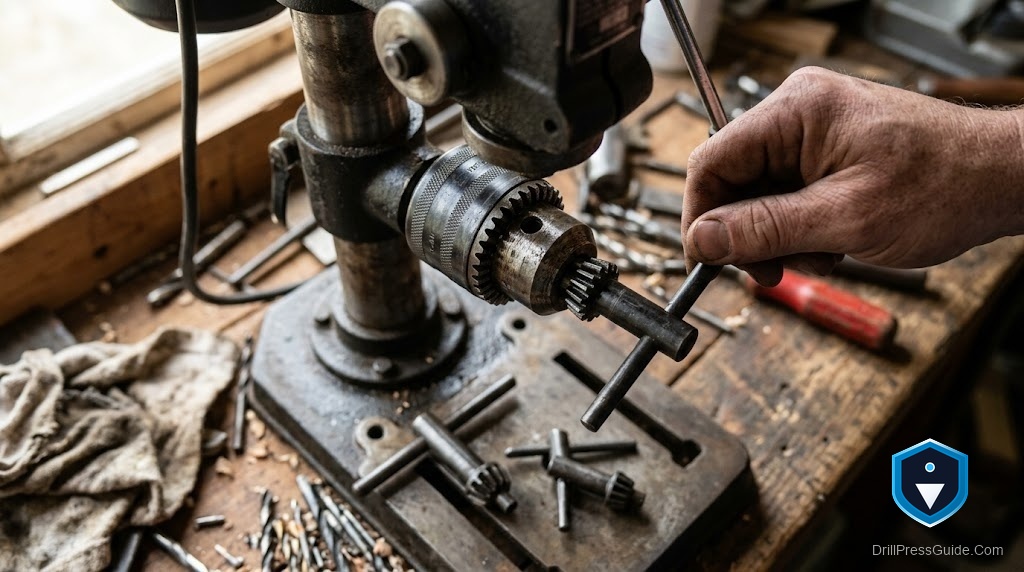
Lose the little key that came with your drill press and you hit a wall fast: the chuck will not tighten or release, the machine is useless, and you are staring at a wall of chuck keys online with no idea which one fits. The good news is that the right size is not a guess. It is stamped, measurable, and matchable in a couple of minutes, and if you would rather not decode it, a multi-size key covers almost every hobby press. This is about reading your chuck rather than gambling on a replacement.
The chuck key size for a drill press is determined by the chuck’s pilot hole diameter and gear teeth, not by the machine’s brand alone. Find it by checking the numbers stamped on the chuck, measuring the pilot hole, or matching the chuck’s capacity, and when in doubt a multi-size replacement key fits most common drill presses.
Why brand alone does not tell you
People search by brand, chuck key for a Craftsman, Ryobi, or Delta press, but the brand is only a rough hint, because the same maker uses different chucks across models. What actually decides the key is the chuck itself: the diameter of the pilot hole the key pin fits into, and the gear teeth the key must mesh with. Two presses from one brand can take different keys, and two different brands can share one. So identify the chuck, not just the machine.
Three ways to find your size
1. Read the stampings. Look on the body of the chuck for stamped markings. Many chucks carry a code or a capacity, and taper designations such as a Jacobs taper number. Those markings often point directly to the key that fits, which is why references like the eReplacementParts chuck guide start with identifying the chuck’s own markings.
2. Measure the pilot hole. The pilot hole is the small hole on the side of the chuck the key’s pin seats into. Measure its diameter with calipers. Common pilot sizes cluster around a quarter inch or a bit larger, and matching the pin diameter plus the gear is what makes a key work.
3. Match the chuck capacity. Note the chuck’s maximum opening, often stamped as a range like zero to one-half inch. Capacity narrows the field of likely key sizes, especially combined with the pilot measurement.
The chuck-key sizing quick guide
| To find the size | Do this | Note |
|---|---|---|
| Fastest | Read stamped code or taper on the chuck | Often names the key directly |
| Most reliable | Measure the pilot hole with calipers | Pin must match this diameter |
| Backup | Match the chuck’s capacity range | Narrows the choices |
| When unsure | Use a multi-size key | Covers most common presses |
The simple fallback: a multi-size key
If decoding markings feels fiddly, or you want a spare that fits more than one tool, a multi-size chuck key is the practical answer. A replacement chuck key with several sizes carries a range of pin sizes on one tool and fits most common keyed drill presses and power tools, so you match it to your chuck by trying the sizes rather than ordering a single exact part. Keeping one on the shop wall also means the next lost key is a shrug instead of a stopped project.
Keep from losing it again
The whole problem starts with a wandering key, so fix that too. Many presses have onboard key storage, a clip or holder, so use it. A short retractable lanyard or a magnet near the switch keeps the key at the machine. Some people fit a self-ejecting key that cannot be left in the chuck, which also removes the danger of a key launching at startup. Storing it in one dedicated spot beats searching the bench every time.
A safety note while you are at it
Whatever key you use, never leave it in the chuck when you start the machine. A key left seated becomes a projectile the instant the motor spins, a hazard both OSHA and CCOHS call out. Remove it before every start, and a self-ejecting key enforces the habit for you.
The verdict
The right chuck key size is set by your chuck’s pilot hole and gear, not the machine’s brand, so identify the chuck by its stamped markings, a pilot-hole measurement, or its capacity, and match the key to that. When decoding is more trouble than it is worth, a multi-size replacement key fits most common presses and makes a good spare. Three takeaways: read the chuck, not the brand badge, measure the pilot hole for the most reliable match, and keep a multi-size key plus dedicated storage so a lost key never stops you again. And never, ever start the machine with the key still in the chuck.
Frequently asked questions
What size chuck key do I need for my drill press? The size set by your chuck’s pilot hole diameter and gear teeth, not the machine brand. Read the chuck’s stamped markings, measure the pilot hole, or match its capacity to find it.
How do I find my drill press chuck key size? Check for a stamped code or taper number on the chuck, measure the pilot hole with calipers, and note the chuck’s maximum capacity. Together these identify the correct key.
Does the brand of my drill press tell me the key size? Only loosely. The same brand uses different chucks across models, and different brands can share a chuck. Identify the chuck itself rather than relying on the brand.
Will a universal or multi-size chuck key fit my press? Usually. A multi-size key carries several pin sizes on one tool and fits most common keyed drill presses and power tools, so you match it by trying the sizes.
What is the pilot hole on a chuck? The small hole on the side of the chuck that the key’s pin seats into. Its diameter must match the key’s pin, so measuring it is the most reliable sizing method.
How do I stop losing my chuck key? Use the onboard storage clip, add a retractable lanyard or a magnet at the machine, or fit a self-ejecting key. Keeping it in one dedicated spot prevents the search.
Is it dangerous to leave the chuck key in? Yes. A key left in the chuck launches like a projectile when the motor starts. Always remove it before starting, or use a self-ejecting key that cannot stay in.
References
- eReplacementParts, How to Remove and Reinstall a Drill Press Chuck. https://www.ereplacementparts.com/repair/how-to-remove-and-reinstall-a-drill-press-chuck/
- OSHA, Woodworking eTool: Drill Press. https://www.osha.gov/etools/woodworking/production/machines-tools/drill-press
- CCOHS, Metalworking Machines: Drill Presses. https://www.ccohs.ca/oshanswers/safety_haz/metalworking/drillpresses.html


