
Understanding the Delta 14 070 Drill Press: Setup, Limits, and Support
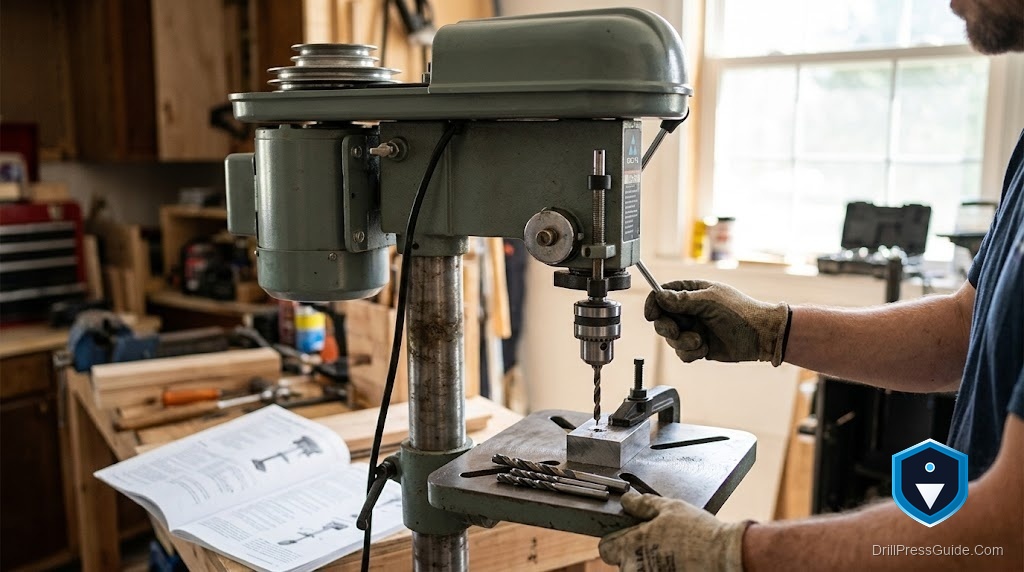
The Delta 14-070 drill press is a 14-inch floor-standing machine that Delta sold as an entry-level floor press, and it has a devoted following alongside a fair share of honest criticism. Owners who use it for hole-saw work and general drilling keep them running for decades; owners who tried to push it through large bits in dense material found its limits fast. If you own a 14-070, are looking at one used, or are trying to source the notoriously tricky belts, here is the complete picture: setup, real limits, and where support comes from.
The Delta 14-070 drill press is a 14-inch floor-standing drilling machine featuring a 1/2-HP induction motor at 115V (1,720 RPM, 8 amps), 12 spindle speeds from 250 to 3,000 RPM via a belt-and-pulley system, a 3-inch quill feed (stroke), an 11-1/2-by-11-1/2-inch tilting cast-iron table with 360-degree rotation, a 7-inch throat, and a weight around 250 pounds, positioned as an entry-level floor press for wood and light metal.
Short answer: the Delta 14-070 is an entry-level 14-inch floor press with a 1/2-HP motor, 12 belt-driven speeds (250 to 3,000 RPM), a 3-inch stroke, and an 11-1/2-inch tilting table. It is a capable general-purpose machine for wood and light metal, but it is underpowered for large bits in dense material, and the original drive belts have been discontinued (a common owner headache). Support comes through Delta and generic parts sourcing. Here is the detail.
The specs confirmed
- Motor: 1/2 HP induction, 115V (convertible to 220-240V), 1,720 RPM, 8 amps.
- Swing: 14 inches (7-inch throat, bit to column).
- Speeds: 12, from 250 to 3,000 RPM via belt and pulley.
- Quill feed (stroke): 3 inches.
- Table: 11-1/2 by 11-1/2 inches, cast iron, tilting, with 360-degree rotation and adjustable height on the column.
- Configuration: floor-standing.
- Weight: approximately 250 pounds.
- Overall height: about 65 inches.
What it can do
- General woodworking: holes in wood, joinery, dowels, and hole-saw work (a use many owners rely on).
- Light metal drilling with small-to-medium bits at the slower speeds.
- 12 speeds from 250 to 3,000 RPM give a good range for matching RPM to bit and material, with 250 RPM low enough for larger bits and metal.
- Angled drilling via the tilting table.
- Floor-press height clearance for taller workpieces.
The real limits
Underpowered for large bits in dense material. This is the most common owner criticism. The 1/2-HP motor bogs when pushing large-diameter bits through hardwood or thicker metal. Owners who need to drill large holes in dense material regularly wish they had bought a 3/4-HP or 1-HP press. For hole-saw work, joinery, and general drilling, the 1/2 HP is adequate; for heavy work, it is not.
Discontinued drive belts. Delta obsoleted the two drive belts used for speed adjustment on the 14-070. Owners report difficulty finding direct replacements. The workaround: record the belt numbers from a machine with good belts, or find a Gates (or equivalent) belt of matching dimensions. This is the single most-cited parts headache for the 14-070.
Quill play. Some owners report play in the quill developing over time. It can often be reduced by adjusting the quill fit and checking the bearings.
Chuck key fit. Some machines shipped with a poorly fitting chuck key from the factory; a correct-fitting replacement key solves it.
Setting one up
- Level and stabilize the floor machine; bolt it down if possible for a 250-pound press.
- Inspect and address the belts first. If the original belts are cracked, source matching-dimension replacements (Gates or equivalent) since Delta’s originals are discontinued.
- Square the table two directions with a rod and square.
- Set the belt speed using the 12-speed chart in the manual for your bit and material.
- Adjust the spindle return spring so the quill returns cleanly.
- Check the chuck for runout; reseat or replace if needed, and confirm the chuck key fits properly.
- Set the depth stop for repeatable holes.
- Use a grounded outlet; the motor can be converted to 220-240V per the manual if desired.
Parts and support
- Delta’s parts network (deltamachinery.com) by model number 14-070 covers many components, though the drive belts are discontinued.
- Generic substitutes: V-belts of matching dimensions (the key workaround for the discontinued originals), keyed chucks on the standard taper, switches, and return springs.
- The owner’s manual is available as a PDF (mikestools.com and other archives) with the parts diagram and speed chart.
- VintageMachinery.org and owner forums (LumberJocks, SawmillCreek) have addressed the 14-070’s belt and quill issues in detail.
The honest flaws recap
1/2-HP motor is the ceiling. Fine for general work, underpowered for large bits in dense material.
Discontinued belts. Plan to source generic matching-dimension replacements.
Belt-change speeds. Twelve speeds, all via moving the belt.
Entry-level positioning. This was Delta’s budget floor press, not an industrial machine.
Who should buy it, and who should skip it
Buy it (used) if you want a Delta cast-iron floor press for general woodworking and hole-saw work at an entry-level price, and you are prepared to source generic belts.
Skip it if you regularly drill large bits in hardwood or metal (get a 3/4-HP or 1-HP press), or you want variable speed and a warranty. In that case, a RIKON 30-230 floor press offers more power and a five-year warranty, or the variable-speed WEN 4214T 12-inch benchtop offers modern features if a benchtop suits your space.
How it compares
Against a Delta 17-900 floor press, the 14-070 is the smaller, lighter, entry-level machine; the 17-900 offers more swing and capacity. Against a Craftsman 15-inch floor press, the 14-070 is a comparable entry-to-mid floor press with the same belt-drive, cast-iron format. Against a RIKON 30-230, the 14-070 loses on power, warranty, and modern features but wins on used-market price. For a woodworker who wants a Delta cast-iron floor press for general and hole-saw work and accepts the belt-sourcing quirk, the 14-070 is a solid used buy.
The verdict
The Delta 14-070 drill press is an entry-level 14-inch floor press: a 1/2-HP motor, 12 belt-driven speeds from 250 to 3,000 RPM, a 3-inch stroke, an 11-1/2-inch tilting cast-iron table, and roughly 250 pounds of floor-standing mass. It is a capable general-purpose machine for wood, joinery, hole-saw work, and light metal, with two honest limits every owner should know: it is underpowered for large bits in dense material, and the original drive belts are discontinued (source generic matching-dimension replacements). Support comes through Delta and generic parts. If you need more power or a warranty, step to a RIKON or a larger Delta; if you want a solid Delta cast-iron floor press for general work at a used-market price, the 14-070 does the job well.
Frequently asked questions
What are the specs of the Delta 14-070 drill press? A 14-inch swing, a 1/2-HP induction motor at 115V (1,720 RPM, 8 amps), 12 spindle speeds from 250 to 3,000 RPM, a 3-inch quill feed, an 11-1/2-by-11-1/2-inch tilting cast-iron table with 360-degree rotation, a 7-inch throat, and about 250 pounds, floor-standing at roughly 65 inches tall.
Is the Delta 14-070 drill press underpowered? For general woodworking, joinery, and hole-saw work, the 1/2-HP motor is adequate. For large-diameter bits in hardwood or thicker metal, owners consistently report it bogs down. If you drill large holes in dense material regularly, a 3/4-HP or 1-HP press is a better choice.
Where do I get belts for a Delta 14-070 drill press? Delta discontinued the original drive belts. The workaround owners use is to source V-belts of matching dimensions (Gates or equivalent) by measuring the originals or recording the belt numbers. This is the most-cited parts issue for the 14-070.
How many speeds does the Delta 14-070 have? 12 belt-driven speeds from 250 to 3,000 RPM, set by moving the belt between pulley positions per the speed chart in the manual.
Where do I get parts for a Delta 14-070 drill press? Through Delta’s parts network (deltamachinery.com) by model number for most components, plus generic substitutes for belts (the discontinued originals), keyed chucks, switches, and return springs. The manual PDF and owner forums help with specifics.
Can the Delta 14-070 drill metal? Yes, light metal with small-to-medium bits at the slower speeds (250 RPM low end). Center punch first and use cutting fluid on steel. The 1/2-HP motor limits heavy metal drilling.
What is the table size on the Delta 14-070? An 11-1/2-by-11-1/2-inch cast-iron tilting table with 360-degree rotation and adjustable height on the column.
References
- Delta 14-070 owner’s manual (archived PDF): https://www.mikestools.com
- Delta Machinery, 14-070 parts and model support: https://www.deltamachinery.com
- SawmillCreek and LumberJocks, Delta 14-070 owner discussions on belts and quill: https://sawmillcreek.org


