
Understanding Drill Press Purpose Before You Buy or Set One Up
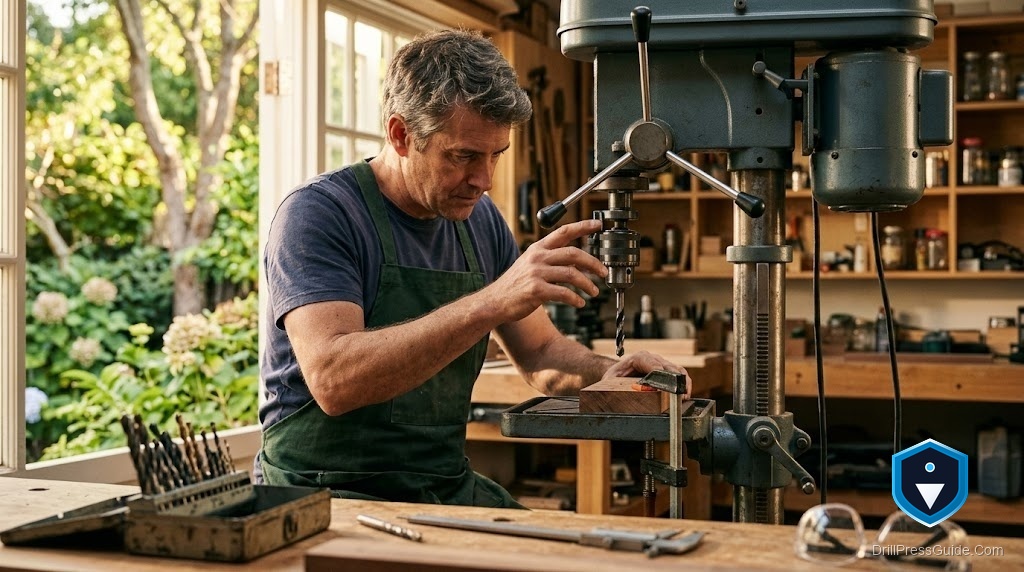
The first time you clamp a workpiece under a drill press and pull the feed handle, you feel it instantly: the bit goes exactly where you aimed, straight down, every time. That single trait is the whole reason the machine exists, and it is why a handheld drill can never quite replace one.
A drill press is a fixed, powered machine that holds a rotating cutting tool in a chuck and drives it straight down into a clamped workpiece along a controlled path. Its purpose is accuracy and repeatability: square holes to the surface, consistent depth, and enough steady force to cut metal, wood, and plastic without the wandering and tilting you get freehand. Everything about the machine, from the heavy base to the quill that guides the spindle, serves that one goal.
Here is the direct answer to why you would own one. A drill press gives you three things a hand drill cannot. First, it drills perpendicular holes without guesswork, because the quill travels in a straight line the factory set for you. Second, it repeats a hole at the same depth and position again and again, thanks to the depth stop and a table you can lock. Third, it applies controlled downward force through the feed handle, so hard materials cut cleanly instead of skating. Add a drill vise or hold-down fixture and the work stays put, which is a safety feature as much as an accuracy one, since a spinning part is one of the real hazards at the point of operation.
What the drill press is actually built to do
Strip away the marketing and a drill press does a short list of jobs extremely well. It bores accurate holes to a set depth. It drills a grid of holes that all match. It runs sanding drums, and with care it handles light reaming and countersinking. The reason it does these better than a handheld tool is structural: the column, the head, and the quill hold the spindle centerline fixed while the table holds the work fixed, so the only motion is the one you want.
A solid starter machine shows the idea clearly. The WEN 4212T variable speed drill press gives a ten inch swing, two inches of quill travel, and a speed range you set for the material, which is exactly the controlled-motion package the tool is meant to provide. Pair it with a drill press vise and you have covered the machine’s core purpose: held work, guided tool, repeatable result.
Purpose changes with the accessory
People ask about a multi-purpose or all-purpose drill press as if it were a separate machine. It is not. The base machine gets its extra jobs from what you mount. A depth stop turns it into a repeatable counterbore tool. A vise turns it into a metalworking station. A sanding drum turns it into a spindle sander. The purpose of each part stacks onto the whole, which is why the chuck, the depth stop, and the vise all show up in any honest parts list.
That said, be clear about limits. A drill press is built to push straight down, not sideways. The spindle bearings take axial load, not the side load of milling. Using it as a mill is where people get hurt and where accuracy falls apart, so keep its purpose in the lane it was designed for.
Comparison: drill press versus hand drill
A hand drill wins on portability and reach. You take it to the work, up a ladder, inside a cabinet. It will never match a press for square, repeatable holes.
A drill press wins on accuracy, depth control, and force. You bring the work to it. It cannot leave the bench, but within its swing it is far more precise.
My verdict: if your work is holes that must be straight, deep to a set point, or identical across many parts, the drill press is the right tool and nothing else comes close. If you mostly drive screws and drill the odd hole around the house, a hand drill is enough. Most shops end up owning both for exactly these reasons.
Conclusion
The purpose of a drill press is simple to state and hard to beat: it turns a rotating bit into a guided, repeatable, powerful straight-down cut. Understand that before you buy, and you will size the swing, travel, and speed range to the holes you actually make instead of the ones you imagine.
Key takeaways:
- A drill press exists for square, repeatable, controlled-depth holes.
- Its accuracy comes from a fixed spindle path and a lockable table, not from your steady hand.
- Accessories extend its purpose, but it is built to push down, not sideways.
FAQ
What is the main purpose of a drill press? To drill accurate, perpendicular, repeatable holes with controlled depth and steady force.
What is the purpose of the depth stop? It sets a repeatable maximum depth so every hole in a run matches.
What is the purpose of a drill press vise? It clamps the workpiece so it cannot spin or shift, which protects both accuracy and your hands.
Can one drill press be all-purpose? The base machine plus the right accessories covers most drilling jobs, but no drill press is built for sideways milling loads.
Do I need a drill press if I own a hand drill? If you need square or repeatable holes, yes. For casual holes and driving screws, a hand drill is enough.
What materials can it handle? Wood, metal, and plastic, as long as you set the right speed for the material.
Why does the chuck matter to the machine’s purpose? The chuck grips the tool on the spindle centerline, which is what keeps holes true.
References
- Occupational Safety and Health Administration, Woodworking eTool: Drill Presses (osha.gov)
- WEN Products, drill press specifications and owner documentation (wenproducts.com)


