
Can You Use an End Mill in a Drill Press? What You Need to Know First
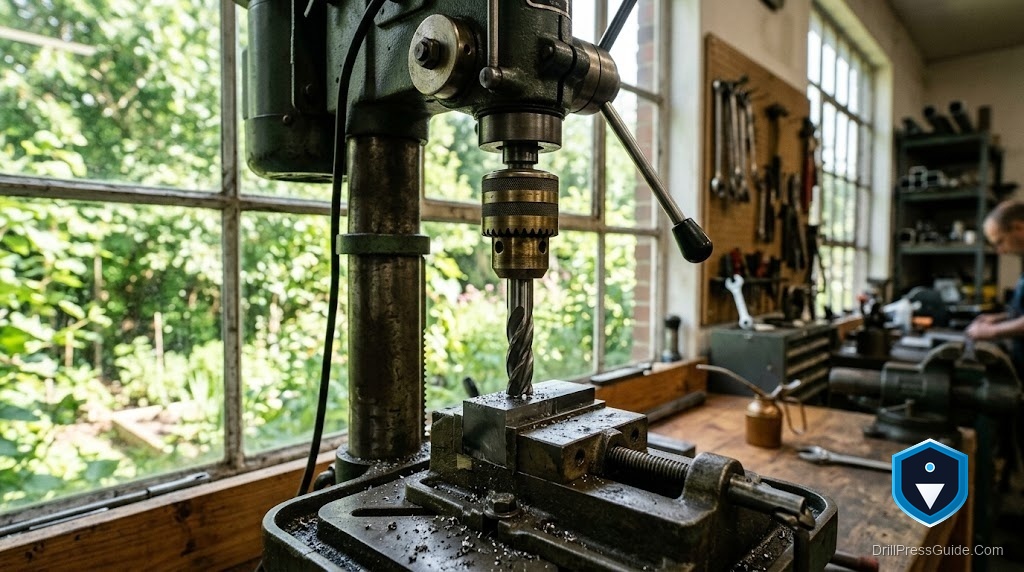
You have an end mill in your hand and a drill press on the bench, and the end mill drops right into the chuck. Physically, nothing stops you. That is exactly why this question is dangerous: the setup looks fine and works for about thirty seconds before the reasons it is a bad idea show up. An end mill is built to cut sideways, a drill press is built to cut down, and putting the two together tests the one weakness a drill press has. Here is what to know before you switch it on.
The short answer
You can chuck an end mill in a drill press and take a very light plunge cut, but you should not use it for side milling, and even plunge cuts strain the machine. The two real problems are that a drill chuck can release the end mill under sideways force, which is dangerous, and that drill press bearings are built for downward load, not the radial load an end mill creates when it cuts on its flanks. So the honest answer is: for a tiny straight-down plunge, with caution, maybe; for real milling, no.
Why an end mill and a drill press disagree
An end mill is designed to cut on both its tip and its sides, which means milling pushes the cutter sideways. A drill press has two features that cannot handle that:
- The chuck grips on a friction taper. That taper is meant to resist downward pull. A side load can walk the arbor loose and drop the spinning cutter, or spin the chuck off. This is the headline safety risk.
- The bearings take thrust, not radial load. Side cutting loads the spindle bearings in the direction they are weakest, wearing them and introducing runout that then degrades your ordinary drilling.
There is also a fit issue: many end mills have larger or flatted shanks that a drill chuck grips poorly, which makes slipping even more likely.
If you only need a light plunge cut
Some people use a center-cutting end mill in a drill press purely to plunge a flat-bottomed hole straight down, and that is the one use with a reasonable safety margin, because the load stays mostly axial. If you do this: use a center-cutting end mill (not all end mills can plunge), seat the chuck firmly on a clean taper, hold the work in a solid vise, take a shallow cut, and do not sweep the table sideways under load. The moment you move the work laterally into the cutter, you are side milling and inviting the cutter to pull loose. Keep it straight down, light, and brief.
End mill in a drill press versus the right setup
The comparison makes the limits clear. Using an end mill in a drill press gives you, at best, a flat-bottomed plunge and nothing more, with real risk if you drift sideways. A proper milling machine holds the end mill in a collet locked by a drawbar, so it cannot pull free, and rides on bearings and a rigid table built for side cutting, so it slots and profiles safely and accurately. Even for flat-bottom holes alone, a milling machine or a purpose-made counterbore does the job with none of the loose-cutter risk. The drill press can imitate the plunge; it cannot safely do the sideways work that is the whole point of an end mill.
My verdict
Can you use an end mill in a drill press? For a light, center-cutting plunge straight down, with a firmly seated chuck and a clamped workpiece, cautiously yes. For side milling, no, because the chuck can release the cutter and the bearings are not built for the load. If you find yourself wanting to move the work sideways into an end mill, that is the signal you need a milling machine, not a workaround. Keep the drill press doing what it does safely and accurately: drilling holes.
Frequently asked questions
Can you put an end mill in a drill press? Physically yes, and you can take a light straight-down plunge with a center-cutting end mill. But you should not side mill with it, because the chuck can release the cutter under sideways force.
Why is side milling with an end mill in a drill press dangerous? The drill chuck grips on a taper made to resist downward pull. Sideways cutting force can walk the arbor or chuck loose and drop the spinning end mill.
Can I plunge a flat-bottom hole with an end mill in a drill press? Yes, with a center-cutting end mill, a firmly seated chuck, and a clamped workpiece. Keep the cut shallow and straight down, and do not move the work sideways under load.
Will an end mill fit a drill press chuck? Sometimes. Many end mills have larger or flatted shanks that a drill chuck grips poorly, which increases the risk of slipping. Check that your chuck actually holds the shank securely.
Does using an end mill damage a drill press? Side cutting wears the spindle bearings, which are built for downward load, and that wear shows up later as runout in your drilling. Even plunge cuts add strain.
What should I use for real milling instead? A milling machine or mill-drill. It holds the end mill in a drawbar-locked collet and has bearings and a table built for side cutting, so it mills safely and accurately.
References
- Hobby-Machinist forum, Using my drill press as a mill: https://www.hobby-machinist.com/threads/using-my-drill-press-as-a-mill.9375/
- Home Improvement Stack Exchange, drill press as a milling machine: https://diy.stackexchange.com/questions/86209/is-it-possible-to-use-a-drill-press-as-a-milling-machine-with-the-proper-bit
- OSHA Woodworking eTool, Drill Presses: https://www.osha.gov/etools/woodworking/production/machines-tools/drill-press


