
Can You Use a Drill Press as a Milling Machine? An Honest Look
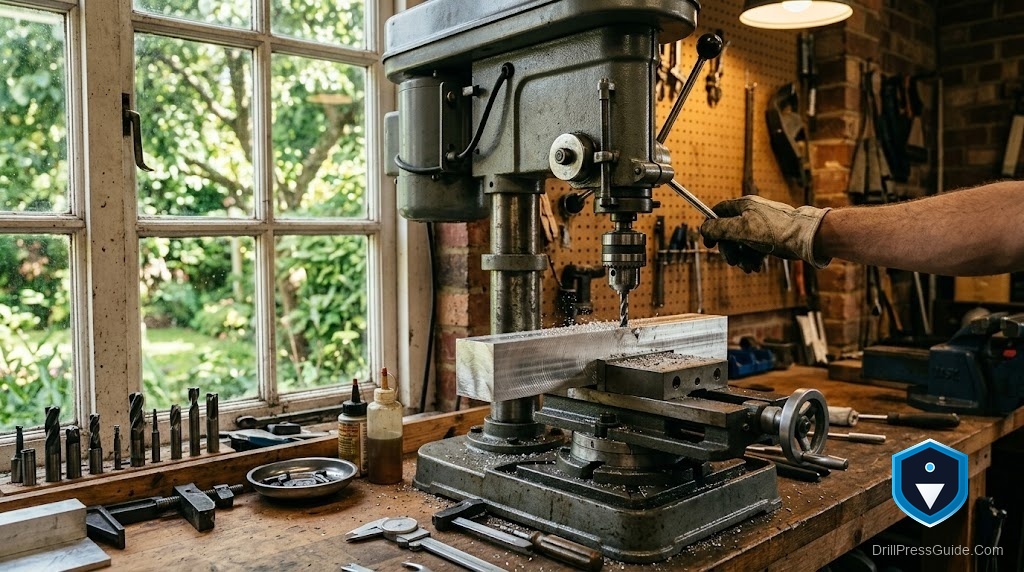
It is one of the most-asked questions in home shops, and the honest answer disappoints a lot of people who were hoping to skip buying a mill. A drill press spins a cutter and lowers it into metal, so it looks like it should mill. But looking the part and being built for the job are different things, and milling asks a drill press to do exactly what its design refuses to do well. Here is the straight answer, with the reasons, so you can decide without wrecking your machine.
The short answer
No, not for real milling. You can take tiny, occasional cuts on a drill press, but it is not built to be a milling machine and using it as one wears the spindle bearings and produces inaccurate, chattery results. The reason is force direction: a drill press is engineered for axial load (pushing a bit straight down), while milling applies radial load (pushing the cutter sideways). That single mismatch drives everything that goes wrong.
So you can coax light cuts out of it in a pinch, but you cannot rely on it to mill accurately or safely as a habit.
Why the design fights milling
Three parts of a drill press make it a poor mill:
- Bearings built for thrust, not side load. The spindle bearings handle downward drilling force. Sideways milling force wears them quickly, and worn bearings mean runout, which ruins accuracy on every job afterward, not just the milling.
- A chuck that can let go. A drill chuck grips on a friction taper meant for downward loads. Side load can walk an end mill loose, which is dangerous. Real mills use a drawbar to lock the cutter in.
- A table and column that flex. The table hangs off a round column that can rotate and deflect. Milling forces make it chatter, leaving a wavy surface instead of a clean cut.
Experienced machinists on the hobby forums say the same thing: a drill press can survive a few thousandths of a light cut, but it is borrowing against its bearings to do it.
If you must take a light cut
If you genuinely need to shave a whisker off a soft part once, hold the work in a solid cross-slide vise (never by hand), keep the cut to a few thousandths, feed slowly, and stop the moment the spindle sounds or feels rough. Treat it as a one-time emergency, not a technique. And never chuck a large end mill and expect the taper to hold under side load; that is how cutters come loose. Anything beyond a tiny cleanup cut belongs on a real mill.
Drill press versus a mill-drill or benchtop mill
The comparison settles the question. A drill press is superb at what it is for, straight, accurate holes, and terrible at side-load cutting. A mill-drill or benchtop mill is built the opposite way: a drawbar holds the cutter against side load, the bearings and spindle take radial force, and a rigid, geared head and heavy table resist chatter so the machine holds a dimension. If your work needs slots, flats, or profiles, the mill-drill does it accurately and safely while the drill press cannot. Buying the right machine is not extravagance; it is the only way to mill accurately and keep your drill press healthy for the drilling it does best.
My verdict
Can you use a drill press as a milling machine? For a tiny, one-off cut, barely, and while wearing the bearings. For anything real, no. The force mismatch between axial drilling and radial milling is baked into the machine and no accessory removes it. Keep the drill press for precise holes, add a cross-slide vise only to improve your drilling, and buy a mill-drill or benchtop mill when you truly need to mill. That answer protects your accuracy, your safety, and the machine you already own.
Frequently asked questions
Can a drill press be used as a milling machine? Not for real milling. It can take tiny occasional cuts, but it is built for downward drilling force, not the sideways force of milling, so accuracy and bearing life suffer.
Why can’t a drill press mill properly? Its bearings are made for thrust, not side load; its chuck can release a cutter under side force; and its table and column flex and chatter. All three fight accurate milling.
Will milling damage my drill press? Yes, over time. Side loads wear the spindle bearings, which then causes runout that degrades your drilling accuracy afterward. Even light cuts spend bearing life.
Is it dangerous to put an end mill in a drill press? It can be. A drill chuck grips on a taper meant for downward loads, and side force can walk the cutter loose. Real mills use a drawbar to prevent this.
What is the smallest safe milling I can do on a drill press? At most a few thousandths on a soft part held in a solid cross-slide vise, treated as a one-time emergency. Stop if the spindle sounds rough. It is never a reliable method.
What should I use instead? A mill-drill or benchtop milling machine. They are designed for side loads, use a drawbar, and have rigid tables, so they mill accurately and safely where a drill press cannot.
References
- Hobby-Machinist forum, Using my drill press as a mill: https://www.hobby-machinist.com/threads/using-my-drill-press-as-a-mill.9375/
- Home Improvement Stack Exchange, drill press as a milling machine: https://diy.stackexchange.com/questions/86209/is-it-possible-to-use-a-drill-press-as-a-milling-machine-with-the-proper-bit
- OSHA Woodworking eTool, Drill Presses: https://www.osha.gov/etools/woodworking/production/machines-tools/drill-press


