
A Plain-English Guide to the Quill Travel on a Drill Press
You are comparing two drill presses and one lists “3-1/8 inch quill travel” while the other says “2 inch.” Does it matter? For a lot of jobs, yes, and it is the kind of spec people ignore until the quill bottoms out halfway through a hole and they are stuck cranking the table. Quill travel is a simple idea with real consequences, so here it is in plain English, no machinist decoder ring required.
What quill travel is
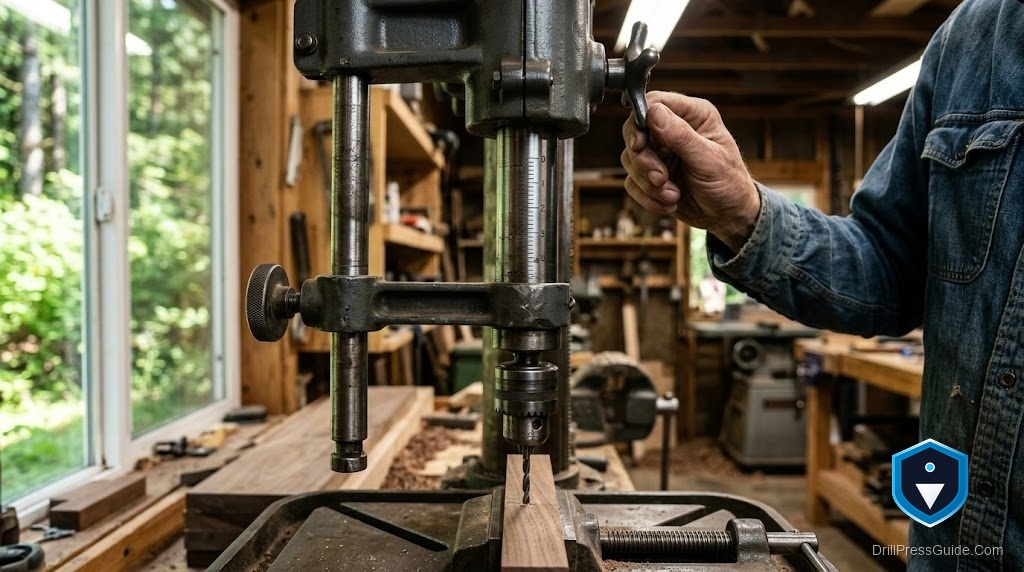
Quill travel is how far the quill (the sleeve holding the spindle) slides down when you pull the feed handle. Since the chuck and bit ride on the quill, quill travel is exactly how far the bit moves down in one stroke, from fully raised to fully lowered. On benchtop machines that is commonly two to three inches; floor machines often offer more. You will also see it called spindle travel or stroke; they mean the same movement.
The direct answer: quill travel is your maximum drilling depth in a single pull. Simple as that.
Why quill travel matters
Here is where the number shows up in real work:
- It caps single-pass depth. Two inches of travel means you can drill two inches deep before the quill runs out. A deeper hole means stopping, retracting, raising the table, and continuing, which costs time and a little accuracy.
- It helps with chip clearing. Longer travel lets you peck-drill, plunging and retracting to clear chips without losing position, which matters most for deep holes in metal.
- It defines useful capacity with tall work. Drilling into the end of a long workpiece or a thick block leans on every bit of travel you have.
- It is separate from power and speed. No motor upgrade or speed change adds travel. It is a fixed mechanical limit of the machine.
The practical takeaway: if you drill deep, travel is one of the first specs to check. If your holes are shallow, a modest travel is perfectly fine.
Getting the most from the travel you have
Quill travel is only useful if you do not waste it. Set the table (or raise the work on a block) so the bit sits just above the surface at the top of its stroke, so the whole travel goes into the hole rather than into empty air. Use the depth stop for repeatable depths, and for deep holes plan to peck. A machine such as the WEN 4212T 10-inch drill press offers around two inches of travel, which handles typical dowels, shelf pins, and joinery comfortably once the table is set right. The habit of starting the bit close to the work is what separates people who “run out of travel” from people who never think about it.
Long travel versus short travel
When you compare two machines, the travel difference is a genuine trade, not just a bigger-is-better number. A longer quill travel lets you drill deeper in one pass and peck-drill deep holes cleanly, which a metalworker or anyone drilling thick stock will value. A shorter travel is common on compact benchtop machines and is completely adequate for shallow woodworking, where holes rarely approach two inches. The longer-travel machine is usually larger and heavier, so you trade bench space and mass for depth capacity. Buy the longer travel if you drill deep; do not pay in size and weight for depth you will never use.
My verdict
Quill travel is the plain, honest answer to “how deep can I drill in one pull,” and it is worth a look before you buy because nothing but a different machine can add to it. Two to three inches suits most home shops; reach for more only if deep holes are routine. Then, whatever you own, set the table so the bit starts just above the work and you will use all the travel you have. Understand this one spec and the “stuck halfway through a hole” problem simply stops happening.
Frequently asked questions
What is quill travel on a drill press? It is how far the quill and bit descend in one stroke of the feed handle, from fully up to fully down. It sets the deepest hole you can drill in a single pass.
Is quill travel the same as spindle travel? Yes. Quill travel, spindle travel, and stroke all describe the same downward movement, so listings use the terms interchangeably.
How much quill travel do I need? Two to three inches covers most woodworking and light metal work. Choose more only if you regularly drill deep holes in thick material.
Can I drill deeper than the quill travel? Yes, but not in one pass. Drill to the limit, retract, raise the table or work, and continue. Expect a slight accuracy loss where the two passes meet.
Why does my drill press run out of travel too soon? Usually the table is set too low, so travel is spent above the work. Raise the table so the bit starts just above the surface, or the hole is simply deeper than the machine’s stroke.
Does more quill travel mean a better machine? Only if you drill deep. For shallow work it adds nothing. Match travel to the depths you actually drill instead of chasing the largest number.
References
- OSHA Woodworking eTool, Drill Presses: https://www.osha.gov/etools/woodworking/production/machines-tools/drill-press
- WEN 4212T product page: https://wenproducts.com/products/wen-4212t-10-in-variable-speed-drill-press
- Woodcraft, Drill Press Table shop guide: https://www.woodcraft.com/blogs/shop-knowledge-guides/drill-press-table


