How Does a Drill Press Work: What It Is, Where It Fits, and What to Check
Pull the lever, the bit comes down, a hole appears. That is what you see. What you do not see is a small chain of mechanisms working together to keep that bit spinning at the right speed and traveling in a perfectly straight line. Understanding that chain is the difference between a person who operates a drill press and a person who can set one up, fix a wandering hole, and know instantly when something is wrong.
What a drill press is
A drill press is a stationary machine that spins a bit and feeds it straight down into clamped work along a fixed vertical axis. A motor drives the spinning; a lever drives the feed; a rigid frame keeps the two aligned. That rigid alignment is the entire reason the machine drills straighter than your hand ever could.
How does a drill press work, step by step
Here is the direct answer, following the power from the wall to the hole:
- The motor spins. An electric motor in the head produces the rotation.
- A belt-and-pulley system sets the speed. The motor drives the spindle through belts running on stepped pulleys, or through a variable-speed mechanism. Moving the belt (or turning a dial) changes the ratio, which changes spindle RPM. This is how you match speed to the bit and material.
- The spindle turns the chuck. The spindle carries the chuck, which grips the bit and centers it on the spindle axis.
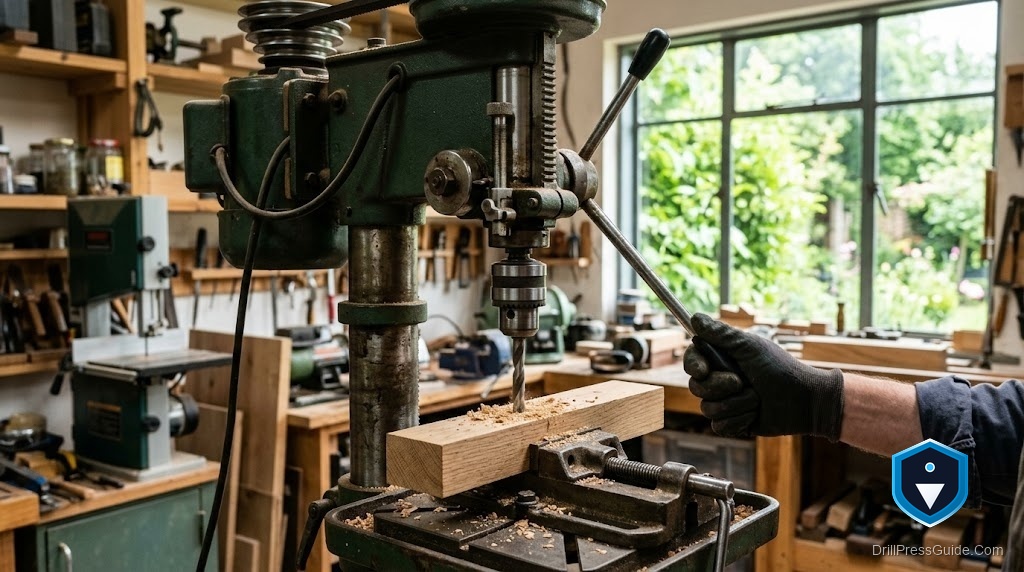
- The quill lets it move down without wobble. The spinning spindle rides inside the quill, a sleeve that slides up and down in the head. The quill is what keeps the descent straight.
- The feed handle presses the quill down. Pulling the lever rotates a pinion against a rack on the quill, lowering the spinning bit into the work. A return spring lifts it back up when you let go.
- The depth stop limits travel. An adjustable stop sets how far the quill can descend, so repeated holes reach the same depth.
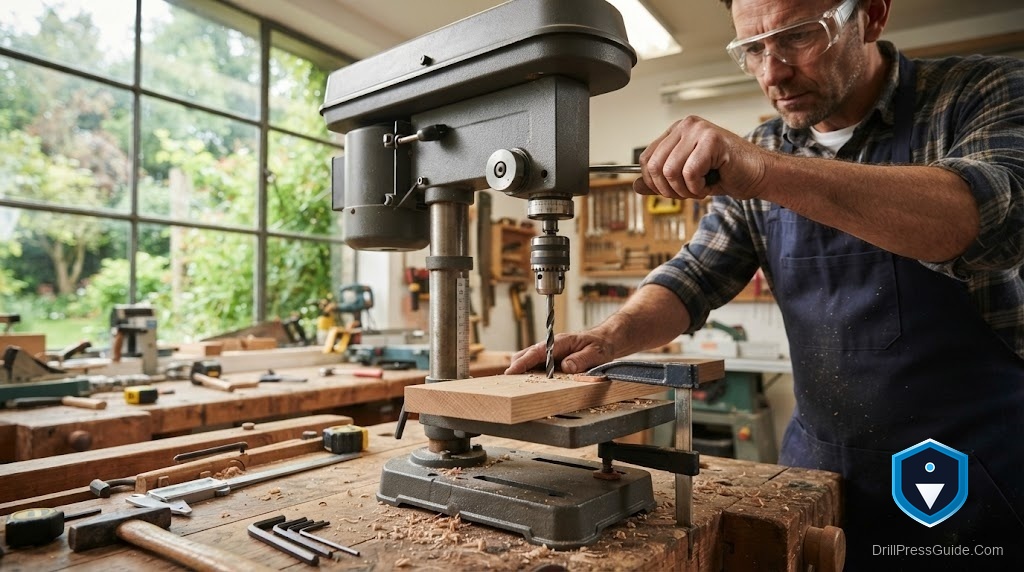
- The table and base hold the work. The clamped workpiece sits on the table, aligned under the bit, and the base anchors the whole machine.
That chain (motor, pulleys, spindle, quill, feed) is the entire working principle. Everything else is a convenience built around it.
Where speed control fits in
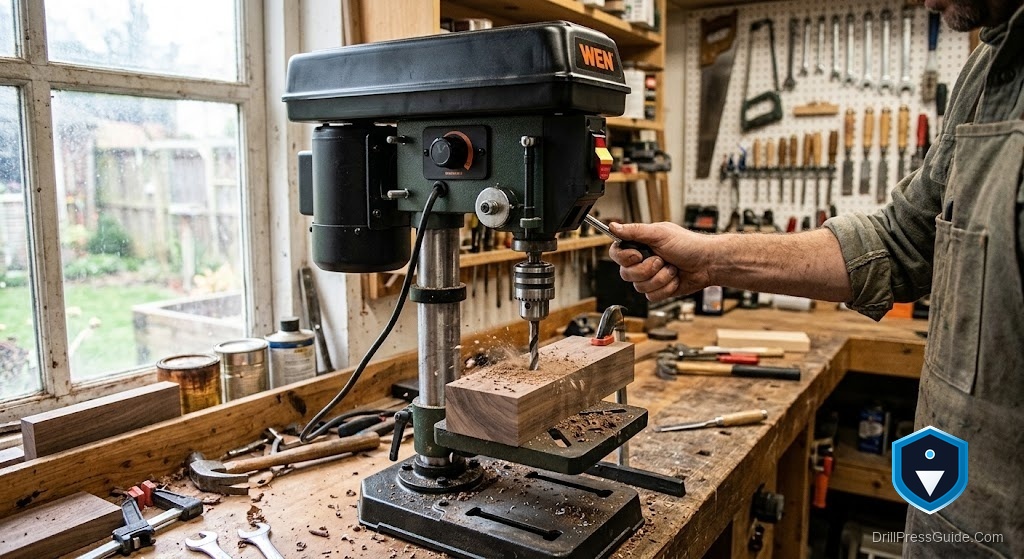
The part that confuses people most is speed, so it is worth isolating. The motor spins at a roughly fixed rate, but the bit does not have to. By running the belt on different pulley diameters, or by using a variable-speed drive, the machine trades speed for turning force. Small pulley on the motor driving a large pulley on the spindle means slow spindle speed and more torque, which is what big bits and metal need. The reverse gives high speed for small bits in wood. A machine like the WEN 4212T 10-inch variable-speed drill press does this with a handle so you can change speed without moving a belt, but the underlying mechanism is the same pulley-ratio idea.
Belt-drive versus variable-speed: how the mechanism differs
The two common speed systems reach the same goal by different means. A belt-and-step-pulley drive is simple, rugged, and easy to maintain, but you change speed by opening the head and moving the belt by hand, which takes a minute. A mechanical or electronic variable-speed drive changes the ratio while the motor runs, so you turn a dial and read the new speed off the machine, which is faster and more convenient but adds parts that can eventually need service. For a shop that changes speed constantly, the variable-speed mechanism earns its complexity. For a shop that sets a speed and leaves it, the belt drive is one less thing to ever repair. Both work by changing the drive ratio; they only differ in how easily you do it.
My verdict
A drill press works by spinning a bit through a belt-or-dial speed system, holding it straight in a quill, and feeding it down with a lever against a return spring, all inside a rigid frame that keeps the line true. Once you can trace that chain, the machine stops being mysterious: a wandering hole points at the quill or table, a burning bit points at speed, and a bit that will not reach points at travel. Knowing how it works is what turns operating into troubleshooting.
Frequently asked questions
How does a drill press make holes straight? The spinning spindle rides in a quill that slides only up and down inside a rigid frame. That fixed vertical path keeps the bit square to the table no matter how you feed it.
How does the speed control on a drill press work? Belts run on stepped pulleys, or a variable-speed drive changes the ratio between motor and spindle. Changing the ratio trades speed for torque, so big bits run slow and small bits run fast.
What does the quill do on a drill press? The quill is a sleeve that lets the spinning spindle travel up and down without wobbling. It is the part that keeps the bit’s descent straight and controls hole depth.
How does the feed handle work? Pulling the lever turns a pinion gear against a rack on the quill, lowering the bit into the work. A return spring raises the quill when you release the lever.
How does a variable-speed drill press work? Instead of moving a belt, a dial adjusts the drive ratio while the motor runs, changing spindle speed on the fly. The principle is the same pulley-ratio trade of speed for torque.
Why does my drill press bog down in metal? Usually the speed is too high for the bit size, so there is not enough torque. Drop to a slower speed to give the bit the turning force it needs in metal.
References
- OSHA Woodworking eTool, Drill Presses: https://www.osha.gov/etools/woodworking/production/machines-tools/drill-press
- WEN 4212T product page: https://wenproducts.com/products/wen-4212t-10-in-variable-speed-drill-press
- Woodcraft, Drill Press Table shop guide: https://www.woodcraft.com/blogs/shop-knowledge-guides/drill-press-table