
Drill Press Safety Rules: The List That Actually Keeps You Safe
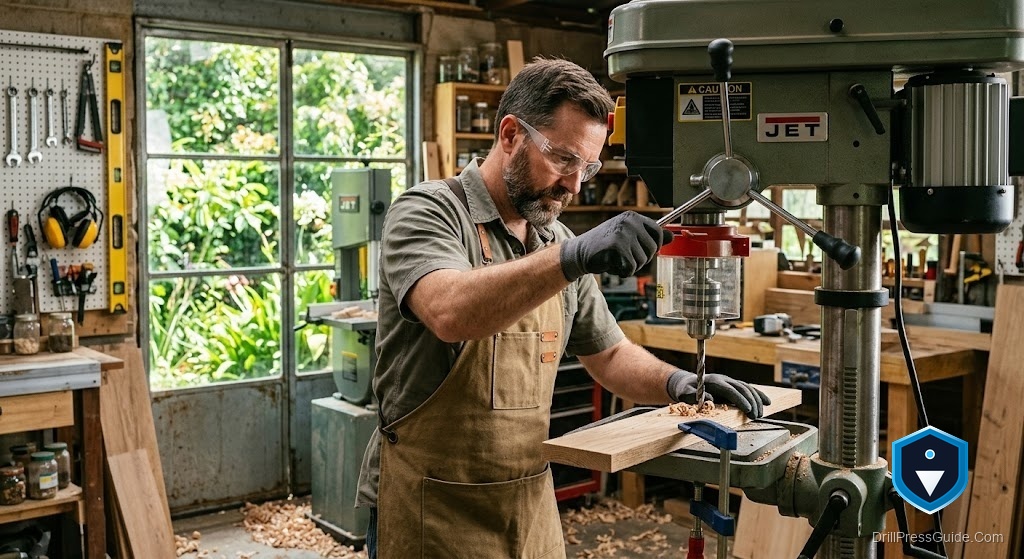
Every shop has a laminated list of drill press rules taped to the wall, and most of them read like they were written to satisfy a clipboard, not to keep a person whole. You skim past “observe all safety precautions” and learn nothing. The rules that matter are specific, they explain the hazard behind them, and they change what your hands do. Here is that list, ordered by how often the rule prevents a real injury.
Why drill press rules exist
A drill press has three ways to hurt you: the spinning bit at the point of operation, the workpiece if it catches and whips around, and the hot chips it throws. OSHA points out that the single most common cause of drill press accidents is poor judgment, usually hand-holding stock that the bit then grabs and spins. So the rules are not bureaucratic. Each one closes off one of those three hazards.
That is the direct answer to why you follow them: not to pass an inspection, but because each rule maps to a specific way people get hurt.
The drill press safety rules, in priority order
- Remove the chuck key before you switch on. A key left in the chuck is flung across the shop the instant the motor starts. Pull it every time, and store it where you have to reach for it.
- Clamp the workpiece; never hand-hold it. A vise or a clamp against a fence stops the part from spinning if the bit grabs. This is the rule that prevents the most serious injuries.
- Wear eye protection, and a face shield for metal. Chips leave the bit fast and hot. Your eyes are the least replaceable thing in the shop.
- No loose clothing, jewelry, gloves, or untied hair. Anything that can wrap the spindle will pull your hand in with it. Gloves are specifically dangerous near rotating tooling.
- Set speed to match the bit and material. Big bits and metal run slow; small bits and wood run fast. Wrong speed throws chips harder and increases grab.
- Make all adjustments with the motor off. Change speed, table height, and clamps only when the spindle is stopped, and unplug it to change belts.
- Support long or round work against a fence or stop. This stops the piece from rotating with the bit or climbing it.
- Ease off at breakthrough. As the bit exits the back of the work, reduce feed pressure so it does not grab and lurch.
- Clear chips with a brush, never fingers. Swarf is sharp and hot enough to burn.
- Keep the guard in place and add a chip shield. Belt guards stay closed; a point-of-operation shield protects your face.
Those ten are the working set. Notice how many are about your hands and setup rather than the machine itself.
Habits versus hardware
Safety rules split into two kinds, and both are needed. Habit rules (pull the key, clamp the work, dress right, ease off at breakthrough) take no extra gear and prevent the grab and the projectile before they start. Hardware rules (keep the belt guard closed, add a chip shield, use a vise) put a physical barrier between you and the hazard for the moments your attention slips. Relying only on habits leaves your eyes exposed the one time a chip flies wrong; relying only on hardware leaves you exposed the one time you forget the key. A clamp-on point-of-operation shield like an ATS drill press safety guard covers the hardware side at the bit, but it does not replace pulling the key or clamping the work. The two layers guard different mistakes, so you keep both.
My verdict
The only drill press rules worth memorizing are the ones tied to a specific hazard: pull the chuck key, clamp the work, protect your eyes, dress for the machine, match the speed, and adjust with the power off. Learn those as reflexes and the laminated wall list becomes a formality instead of your only defense. The machine is forgiving when you respect the rules and quietly dangerous the moment you treat them as decoration.
Frequently asked questions
What are the most important drill press safety rules? Remove the chuck key before starting, clamp the workpiece instead of hand-holding it, wear eye protection, avoid loose clothing and gloves, and adjust the machine only when it is off.
Why can’t you wear gloves at a drill press? Gloves can catch on the rotating bit or chuck and pull your hand into the tooling. Bare hands with the work clamped are safer near any spinning spindle.
What are five basic drill press safety rules? Pull the chuck key, clamp the work, wear eye protection, tie back loose clothing and hair, and set the correct speed for the bit and material.
Does OSHA have drill press safety rules? OSHA’s machine-guarding standard (29 CFR 1910.212) requires guarding against rotating parts and flying chips, and its woodworking eTool details drill press hazards and solutions.
Why should you never hand-hold a workpiece? If the bit grabs, it can spin an unclamped part into a whirling blade instantly. Clamping keeps the piece still and your hands out of the danger zone.
When should you make adjustments to a drill press? Only with the motor stopped, and unplugged when changing belts. Setting speed, table height, or clamps on a running machine is how hands reach the spinning parts.
References
- OSHA Woodworking eTool, Drill Presses: https://www.osha.gov/etools/woodworking/production/machines-tools/drill-press
- OSHA 1910.212, General requirements for all machines: https://www.osha.gov/laws-regs/regulations/standardnumber/1910/1910.212
- OSHA Drill Press train-the-trainer script: https://www.osha.gov/sites/default/files/2021-04/Drill%20Press%20-%20Trainer%20Script.pdf


