
Drill Press Definition: A Practical Guide for the Workshop
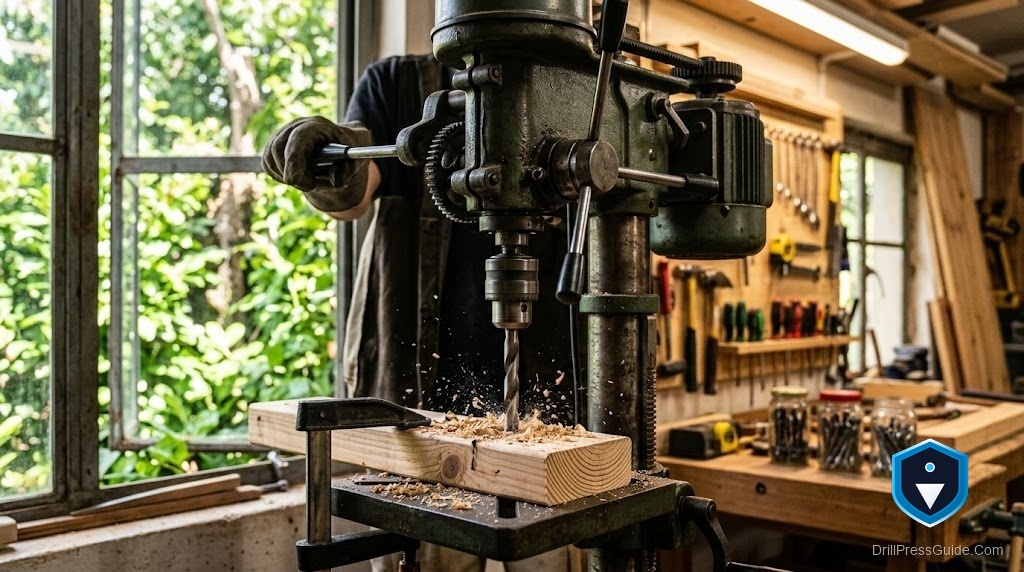
Look up “drill press” and you get a dictionary line that technically answers the question and teaches you nothing useful. A machine tool for drilling holes. True, and completely unhelpful the moment you stand in front of one and wonder why it has a lever, a column, and a table that tilts. A real definition should tell you what the machine is, what its parts do, and why it exists. That is what this one does.
Drill press definition
A drill press is a stationary powered machine that drills holes by feeding a rotating bit straight down into a workpiece along a fixed vertical axis. A motor spins a spindle, the spindle carries a chuck, the chuck grips the bit, and a feed lever lowers the whole assembly (the quill) into work that sits clamped on a table below. Because the head, column, and table stay locked in alignment, the hole is straight, square to the table, and repeatable.
The short version: a drill press is a drill held perfectly steady by a frame, fed by a lever, so accuracy comes from the machine instead of your hand. That single trait separates it from every handheld drill.
The parts that make the definition make sense
A definition is easier to hold onto when you know the pieces it names:
- Base and column. The base anchors the machine; the round steel column carries everything and sets the vertical line.
- Head. Houses the motor, the speed-change system (belt-and-pulley or variable-speed), and the spindle.
- Spindle and chuck. The spindle spins; the chuck clamps the bit and centers it on the spindle axis.
- Quill. The sleeve that lets the spinning spindle move up and down without wobbling. Its travel sets your maximum hole depth per stroke.
- Feed handle. The lever you pull to lower the bit into the work.
- Table. Supports and, on most machines, tilts and raises to position the work.
- Depth stop. Limits travel so repeated holes reach the same depth.
Name those seven and the definition stops being abstract. Each part exists to serve the one goal: a controlled, repeatable, vertical hole.
Why the definition centers on accuracy
Here is the direct answer to why the definition matters. Every phrase in it (fixed vertical axis, clamped work, feed lever) points at the same purpose: removing human wobble. A handheld drill’s accuracy lives in your wrist. A drill press moves that accuracy into the frame, so a beginner’s first hole can be as square as an expert’s. That is the reason the machine earns a permanent spot on the bench, and it is why the definition is not “a tool that drills holes” but “a tool that drills controlled, repeatable holes.”
A benchtop machine like the WEN 4212T 10-inch variable-speed drill press is the definition in physical form: fixed column, spindle in a quill, tilting table, and a lever you feed. Understand it and you understand the category.
Drill press versus drill: the definitions compared
People blur “drill” and “drill press,” but the definitions split cleanly. A drill is a handheld powered tool that spins a bit; its accuracy depends on the operator holding it steady and square. A drill press is a stationary machine that spins a bit along a fixed vertical axis; its accuracy is built into the frame. The drill is defined by portability, the drill press by precision. That is why the drill press definition always includes words like “stationary,” “fixed axis,” and “table,” and the drill definition never does. They are related tools with genuinely different definitions, because they solve different problems.
My verdict
The useful definition of a drill press is not the dictionary’s “machine for drilling holes.” It is a stationary machine that feeds a rotating bit down a fixed vertical axis into clamped work, so holes come out straight, square, and repeatable no matter whose hand is on the lever. Learn the seven core parts and you can look at any drill press, from a small benchtop unit to a tall floor model, and know exactly what you are seeing and why every piece is there.
Frequently asked questions
What is the simplest definition of a drill press? A stationary machine that drills holes by feeding a spinning bit straight down along a fixed vertical axis into clamped work, giving straight, repeatable holes.
What is the difference between a drill press and a drill? A drill is handheld and its accuracy depends on your wrist. A drill press is stationary and its accuracy is built into the frame, so holes stay square and repeatable.
What is a bench drill press? A drill press small enough to sit on a workbench rather than stand on the floor. The definition is the same; only the size and mounting differ.
What is the quill in the drill press definition? The quill is the sleeve that lets the spinning spindle move up and down without wobbling. Its travel sets the maximum hole depth per stroke.
Is a pedestal drill the same as a drill press? Yes. “Pedestal drill” is another name for a floor-standing drill press. The definition is identical; the pedestal refers to the floor-mounted column.
Why is a drill press defined as stationary? Because it is fixed in place to keep the bit on a constant vertical line. That fixed alignment is the source of its accuracy and the heart of the definition.
References
- OSHA Woodworking eTool, Drill Presses: https://www.osha.gov/etools/woodworking/production/machines-tools/drill-press
- WEN 4212T product page: https://wenproducts.com/products/wen-4212t-10-in-variable-speed-drill-press
- Woodcraft, Drill Press Table shop guide: https://www.woodcraft.com/blogs/shop-knowledge-guides/drill-press-table


