
Drill Press Safety: Understanding It Before You Buy or Set One Up
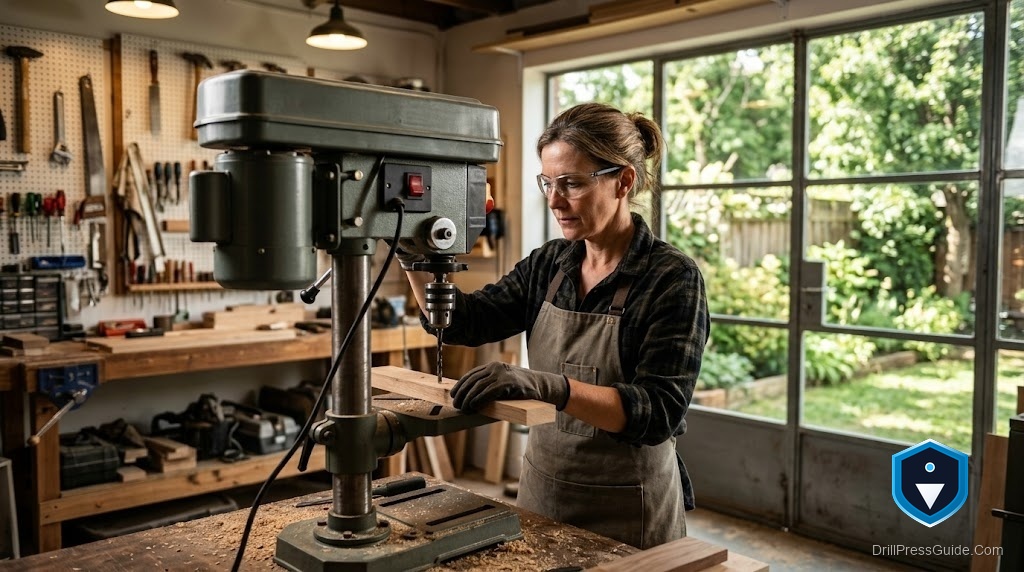
The drill press has a reputation as one of the safest machines in the shop, and that reputation is exactly what gets people hurt. It looks calm. The bit spins in one place, there is no whirling blade, and the motion is slow and deliberate. Then someone hand-holds a piece of steel, the bit grabs, and the workpiece becomes a spinning propeller. Drill press injuries are almost never about the machine failing. They are about setup and habits, which is good news, because those are things you control completely.
What drill press safety actually protects against
Drill press safety is the set of habits and guards that keep you clear of three hazards: the rotating bit at the point of operation, the workpiece if it catches and spins, and the hot chips (swarf) the bit throws. OSHA notes that the point of operation on a drill press is rarely fully guarded and that hand-holding stock is one of the most common causes of accidents. So safety is less about the machine and more about how you feed it work.
That framing matters. You are not defending against a machine that lunges at you. You are defending against a workpiece that spins and chips that fly.
Drill press safety rules that matter most
Here is the direct answer, in priority order:
- Remove the chuck key before starting. A key left in the chuck becomes a projectile the instant the motor spins. Make pulling the key a reflex.
- Clamp the work. Use a vise or a clamp against a fence. Never hand-hold metal, small parts, or anything a large bit will grab.
- Wear eye and face protection. Chips come off fast and hot. Safety glasses are the minimum; a face shield is better for metal.
- Tie back loose clothing, hair, and jewelry. Anything that can wrap around the spindle will.
- Match the speed to the bit and material. Wrong speed throws chips harder, dulls bits, and increases grab.
- Use a chip shield or guard. A quill-mounted shield keeps chips out of your face at the point of operation.
- Clear chips with a brush, never your hand. Swarf is sharp and hot.
- Keep the work area clear and the machine off when you set up. Adjust height, speed, and clamps with the motor stopped.
Those eight cover the overwhelming majority of drill press incidents. None of them require skill, only discipline.
Guards and shields worth adding
Most home drill presses ship with a belt-cover guard and nothing at the point of operation. In workplaces, OSHA’s general machine-guarding rule (29 CFR 1910.212) requires guarding to protect operators from rotating parts and flying chips, and a point-of-operation chip shield is the common way to meet it. A clamp-on shield such as an ATS drill press safety guard mounts to the column and drops a clear flip-up shield in front of the bit, catching chips before they reach your face while still letting you see the work. For a shop that drills much metal, or any shared or teaching space, that shield is the single most worthwhile safety upgrade.
Guarding versus good habits
It is tempting to treat a guard as the answer, or to treat habits as enough on their own. Neither is complete. A chip shield does nothing about a chuck key left in place or an unclamped workpiece, and perfect habits still leave your eyes exposed to a stray chip on a bad day. The two layers cover different failures: habits prevent the grab and the projectile, the guard catches what gets past them. A shop that relies only on habits is one lapse from an eye injury, and a shop that relies only on the guard is one grab away from a spinning workpiece. Use both, because they protect against different mistakes.
My verdict
A drill press is safe the way a calm river is safe: right up until you stop respecting it. Pull the chuck key, clamp the work, protect your eyes, dress for the machine, and add a point-of-operation shield if you drill metal or share the shop. Do those and the drill press lives up to its gentle reputation. Skip them and its calm appearance is exactly what makes it dangerous.
Frequently asked questions
What is the most important drill press safety rule? Remove the chuck key before starting the machine, and never hand-hold the workpiece. A flung key and a spinning unclamped part cause the most common injuries.
Does OSHA require a guard on a drill press? In workplaces, OSHA’s machine-guarding rule (29 CFR 1910.212) requires guarding against rotating parts and flying chips. A point-of-operation chip shield is the usual way to comply.
Why should you never hand-hold work on a drill press? If the bit grabs, it can spin the workpiece into a blade faster than you can react. Clamping keeps the part still and your hands clear.
What protective gear do I need for a drill press? Safety glasses at minimum, a face shield for metal, no loose clothing or jewelry, and tied-back hair. Hearing protection helps on longer sessions.
Is a drill press safer than a handheld drill? It can be, because the work is clamped and the bit is controlled, but only with correct setup. Poor habits make it more dangerous, not less.
How do I keep chips from hitting my face? Run the correct speed, add a quill-mounted or clamp-on chip shield, and clear swarf with a brush. Never wipe chips away with your hand.
References
- OSHA Woodworking eTool, Drill Presses: https://www.osha.gov/etools/woodworking/production/machines-tools/drill-press
- OSHA 1910.212, General requirements for all machines: https://www.osha.gov/laws-regs/regulations/standardnumber/1910/1910.212
- OSHA Drill Press train-the-trainer script: https://www.osha.gov/sites/default/files/2021-04/Drill%20Press%20-%20Trainer%20Script.pdf


