
What Is the Purpose of a Drill Press, and When Is It the Right Tool?
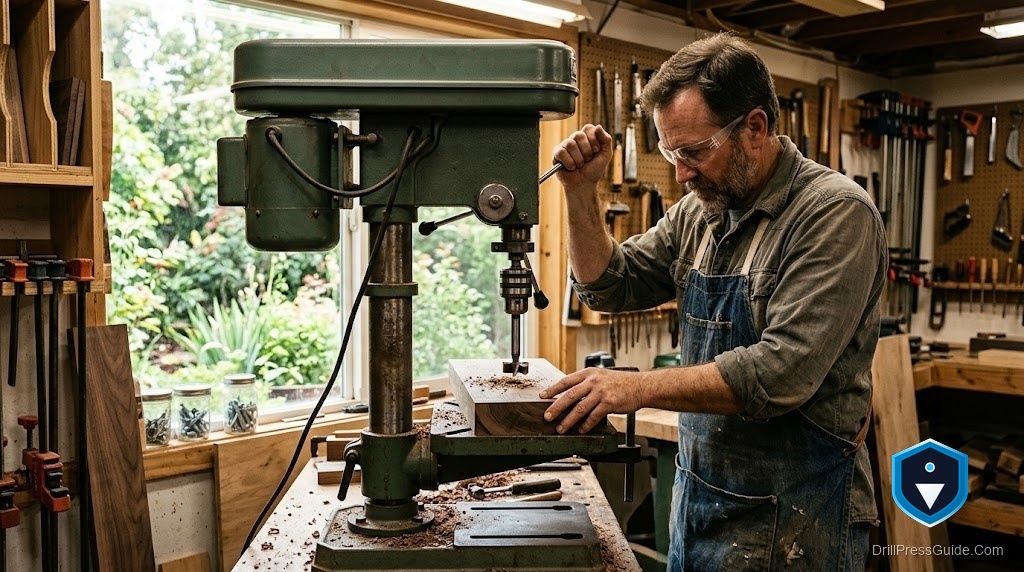
A handheld drill makes holes. A drill press also makes holes. So people reasonably ask what the second machine is even for. The honest answer is that a drill press does not exist to make holes faster. It exists to make them accurate, repeatable, and controlled, and that single purpose reshapes what you can build.
The purpose in one sentence
The purpose of a drill press is to hold a spinning bit in a fixed vertical line so every hole goes straight down, to the depth you set, in the spot you chose, as many times as you need. A motor turns a spindle, the spindle turns a chuck, and you feed the bit into clamped work with a lever. Because the head, column, and table stay in alignment, your accuracy no longer depends on a steady wrist.
That is the whole reason the machine earns bench space. It converts a hand skill into a machine setting.
What is the purpose of a drill press, in practice
Here is the direct answer, broken into the jobs the purpose actually enables:
- Square holes to the surface. The bit travels perpendicular to the table, so holes come out plumb without you fighting drift.
- Controlled depth. A depth stop lets you drill blind holes and pockets that all stop at the same point.
- Repeatability. With a fence and a stop block, every part gets an identical hole in an identical place.
- Control of large bits. Forstner bits, hole saws, and spade bits grab hard. The machine holds the work and resists the twist that would wrench a handheld drill from your hands.
- Safe metal drilling. At the right slow speed, with the work clamped, it bores clean holes in steel and aluminum.
- Light secondary tasks. With a drum sander it becomes a spindle sander; with a mortising attachment it cuts square mortises.
Every one of those is a variation on the core purpose: remove human wobble and add repeatable control.
When it is the right tool, and when it is not
A drill press is the right tool when the hole has to be right: matched shelf-pin holes, a bolt pattern that must line up, a deep pocket that cannot blow through the back, a big bit that would be dangerous freehand. It is the wrong tool when you need to drill in place (a wall, a ceiling, a fence post) or when a rough hole is good enough and walking to the bench is a waste of time.
Think of purpose as a filter. If the job needs accuracy, depth, or repetition, the drill press is the answer. If it needs reach and speed, the handheld drill is.
Drill press purpose versus handheld drill purpose
These two tools are often compared as rivals, but their purposes barely overlap. The handheld drill exists to bring drilling to the work, anywhere, quickly, with no setup. The drill press exists to bring precision to the drilling, on the bench, with setup that pays off in accuracy and repetition. One is a mobile generalist; the other is a stationary specialist. A benchtop machine like the WEN 4212T 10-inch variable-speed drill press shows the specialist purpose clearly: it does not go anywhere, but on the bench it drills straighter and repeats better than any handheld tool. Neither replaces the other, because they were built for different jobs.
My verdict
The purpose of a drill press is precision drilling you can repeat: straight holes, matched depth, and identical placement, plus the muscle to run big bits and metal safely. If your work needs holes that fit together, that purpose is worth a permanent spot on the bench. If your work is mostly rough or on-site, a handheld drill already serves the purpose you have. Buy the machine whose purpose matches your work, not the one with the most impressive frame.
Frequently asked questions
What is the main purpose of a drill press? To drill accurate, repeatable holes at a controlled depth by holding the bit in a fixed vertical line. Accuracy and repetition, not speed, are the point.
What is the purpose of a drill press over a hand drill? The drill press removes human wobble. It keeps holes square, controls depth precisely, and repeats identical holes, which a handheld drill cannot do reliably.
What is the purpose of the drill press chuck? The chuck grips the bit and centers it on the spindle axis. Its job is to hold the bit tight and true so the hole follows the intended line.
Can a drill press serve more than one purpose? Yes. With accessories it works as a spindle sander and a mortiser. Its core purpose stays the same: controlled, repeatable vertical work.
What is the purpose of the depth stop? To limit how far the bit travels so you can drill blind holes and pockets to a consistent depth across many parts.
Is a drill press worth it for occasional use? If your occasional work still needs accuracy and repetition, yes. If it is rough or on-site drilling, a handheld drill already serves that purpose.
References
- OSHA Woodworking eTool, Drill Presses: https://www.osha.gov/etools/woodworking/production/machines-tools/drill-press
- WEN 4212T product page: https://wenproducts.com/products/wen-4212t-10-in-variable-speed-drill-press
- Woodcraft, Drill Press Table shop guide: https://www.woodcraft.com/blogs/shop-knowledge-guides/drill-press-table


