
How Much Is a Drill Press Worth? A Condition-and-Value Checklist
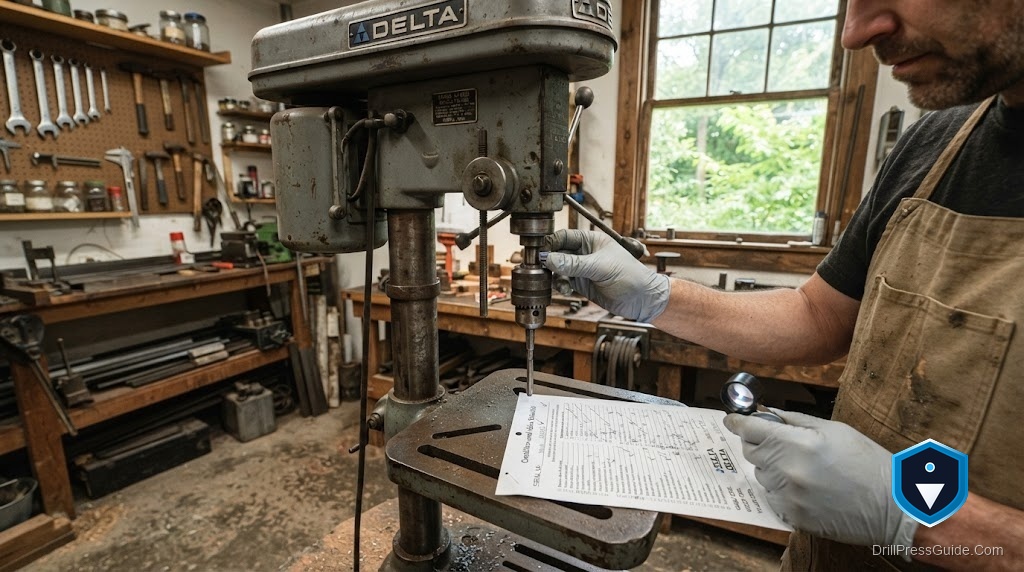
Most people typing “how much is a drill press” are really asking one of two things: is this used machine on the listing any good, or how much drill press do I actually need? Both are better questions than a single number could ever answer, because a heavy old machine in rough shape can be a poor pick while a modest one in clean condition can serve for decades. So instead of chasing a figure, let us answer what really matters: how to judge whether a drill press is worth having.
What “worth” means for a drill press
The worth of a drill press is set by three things: how accurately it drills, how sound its mechanical parts are, and how well its capacity matches your work. A machine can look impressive and still drill crooked holes if its spindle is worn. A plain benchtop machine can be worth its bench space for years if its bearings are tight and its table is flat. Judge the machine, not the badge.
That is the mindset this checklist is built on. You are grading condition and fit, not reading a sticker.
How much drill press do you actually need
Here is the direct answer to the second version of the question. Match three specs to your work and you have found “enough”:
- Swing. Twice the throat distance, this sets the widest workpiece you can center a hole in. Ten to twelve inches suits most home shops.
- Spindle travel. How far the bit plunges per stroke, usually two to three inches on benchtop machines. More travel means deeper holes without repositioning.
- Speed range. A wide range with a low minimum lets you run big bits and metal slow and small bits fast.
- Motor power. Enough to keep the bit turning under load without bogging. Bigger bits and steel demand more.
More machine than your work needs is spare capacity you paid to store. Less than you need shows up as bogging, chatter, and shallow holes. “Enough” is the honest target.
The used drill press inspection checklist
If you are looking at a secondhand machine, this is where worth is won or lost. Check these before you commit:
- Spindle runout. Chuck a straight rod and spin it by hand while watching the tip. Visible wobble means a worn spindle, bearings, or chuck, and that drives accuracy.
- Quill play. Extend the quill fully and try to rock it side to side. Slop here means worn bearings and wandering holes.
- Bearings. Spin the spindle by hand. Grinding, roughness, or noise on power-up points to bearings that need replacing.
- Table condition. Look for a flat, un-cracked table that raises, lowers, and tilts smoothly. A seized crank or cracked casting is a real problem.
- Motor and switch. It should start promptly, run without smell or excessive hum, and stop cleanly. Test the switch and any speed control.
- Chuck. Jaws should close concentrically and grip a bit without slipping. A tired chuck is replaceable, so weigh it lightly.
- Belts and pulleys. Cracked belts and chewed pulleys are minor fixes but tell you how the machine was treated.
A machine that passes these is sound regardless of age. One that fails runout or bearing checks is a project, not a tool, no matter how solid it looks.
New versus used
The honest comparison is condition certainty against character. A new benchtop machine like the WEN 4212T 10-inch variable-speed drill press arrives with known specs, a warranty, and zero wear, so you know exactly what you are getting. A used machine, especially an older cast-iron one, can offer more mass and rigidity, but only if it passes the inspection above. Buy new when you want certainty and a warranty; buy used when you can inspect the machine in person and confirm the spindle and bearings are tight. A used machine you cannot test is a gamble, and mass alone does not make a worn machine accurate.
My verdict
Stop asking how much a drill press is and start asking whether this drill press is sound and sized for your work. Match swing, travel, speed range, and power to what you build, then grade any used machine on runout, quill play, bearings, and table condition. A sound machine that fits your work is worth having. A worn one is worth passing on, and no spec sheet changes that.
Frequently asked questions
How much drill press do I need for home use? A 10-inch to 12-inch swing, two to three inches of travel, a wide speed range, and enough power to avoid bogging covers almost all home woodworking and light metal work.
How do I tell if a used drill press is any good? Check spindle runout with a rod, test quill play, listen to the bearings, confirm the table is flat and moves smoothly, and make sure the motor and switch work. Those decide soundness.
Does a heavier drill press mean a better one? Mass helps rigidity and damps vibration, but a heavy machine with worn bearings still drills crooked. Condition beats weight every time.
How much does a drill press weigh? Benchtop models commonly run from roughly 40 to 90 pounds; floor models are far heavier. Weight tracks with size, rigidity, and capacity.
How much horsepower does a drill press need? Enough to keep the bit turning under load. Light benchtop work is fine with a fractional-horsepower motor; large bits in steel want more.
Is a used drill press a smart pick? Yes, if you can inspect it in person and it passes the runout, bearing, and table checks. A machine you cannot test first is a gamble regardless of how solid it appears.
References
- OSHA Woodworking eTool, Drill Presses: https://www.osha.gov/etools/woodworking/production/machines-tools/drill-press
- Industrial Monitor Direct, drill press runout tolerances and measurement: https://industrialmonitordirect.com/blogs/knowledgebase/drill-press-chuck-runout-tolerances-measurement-and-hole-accuracy
- WEN 4212T product page: https://wenproducts.com/products/wen-4212t-10-in-variable-speed-drill-press


