
How Do You Use a Drill Press: A Practical Guide for the Workshop
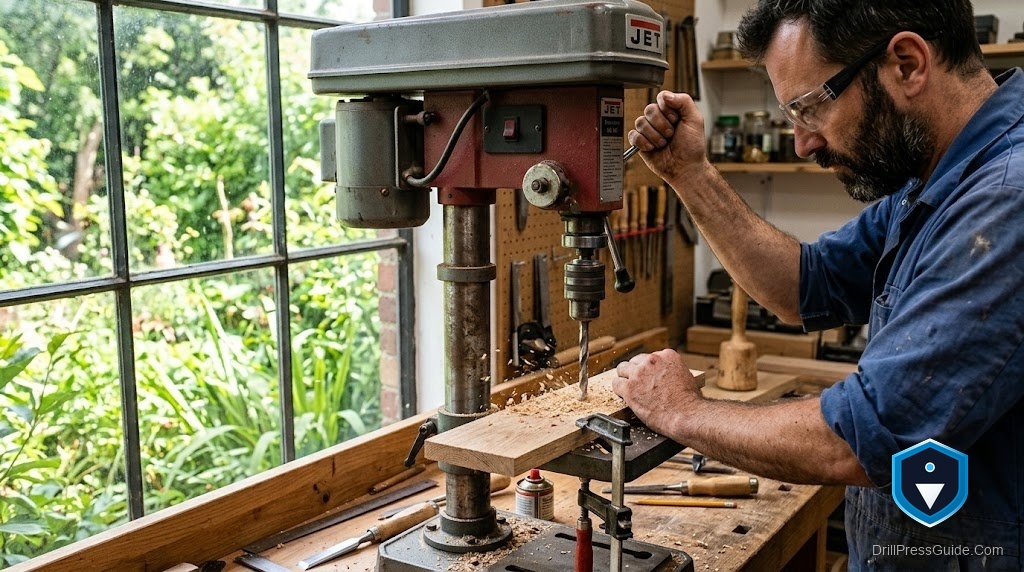
The first time you stand in front of a drill press, it looks like it should be obvious. Pull the handle, hole appears. Then the workpiece spins out of your hand, or the bit screams and turns blue, or the hole comes out shallow on one side, and you realize there is a right way to run this machine. The good news: the right way is short, repeatable, and easy to learn in one session.
What using a drill press really involves
Using a drill press well comes down to four settings and one habit. The settings are speed, depth, table height, and workholding. The habit is checking all four before the motor ever spins. Get those right and the machine does the hard part for you, holding the bit perfectly straight while you feed it down.
That is the mindset. A drill press rewards setup, not muscle. You are not forcing a hole; you are arranging conditions so a clean hole is the only possible outcome.
How do you use a drill press, step by step
Here is the direct answer, in the order you actually do it.
- Set the speed for the bit and material. Small bits and wood run fast. Large bits and metal run slow. Match the speed before anything else, because it drives everything downstream.
- Mount the bit. Open the chuck, seat the bit fully, tighten it, and remove the chuck key. Removing the key every single time is the one rule that prevents the drill press’s most common injury.
- Set the table height and, if needed, the depth stop. Raise the table so the bit clears the work with a little room to spare. If you want every hole the same depth, set the depth stop now on a test piece.
- Clamp the workpiece. Use a drill press vise or a clamp against a fence. Never hand-hold metal, and never hand-hold small parts. If the bit grabs, an unclamped piece becomes a spinning blade.
- Line up the hole. Lower the bit (motor off) to check your mark, then adjust the work.
- Drill. Start the motor, feed the bit down with steady pressure, and ease off as it breaks through the back. Let the bit cut. Forcing it generates heat and dulls the edge.
- Clear the chips and stop. Retract the bit, turn off the machine, and clear swarf with a brush, never your hand.
That sequence covers ninety percent of drill press work. The other ten percent is angle drilling, sanding, and mortising, which are variations on the same setup discipline.
Speed: the setting people get wrong
Speed is where most beginners struggle, and it is worth its own moment. A large bit has a big cutting edge that travels a long way per turn, so it needs a slow RPM or it overheats. A small bit needs a fast RPM to cut at all. When you drill steel and see smoke or blue chips, the speed is too high. When a big Forstner bit chatters and tears in wood, the speed is too high there too.
A variable-speed machine like the WEN 4212T 10-inch drill press lets you dial speed with a handle, which makes matching speed to the job painless. On a step-pulley machine you move the belt instead, which takes a minute but works the same way. Either way, the rule holds: big and metal go slow, small and wood go fast.
Clamping versus hand-holding
New users hand-hold work because it feels faster, and it is, right up until it is not. A clamped workpiece cannot spin, cannot climb the bit, and lets you keep both hands clear. Hand-holding feels controlled on small wood pieces and low speeds, but it fails without warning the instant a bit grabs, and it is genuinely dangerous with metal or with large bits. The time you save clamping a part is nothing next to the time you lose to a ruined workpiece or a cut hand. Clamp the work. Every time it is metal, small, or spinning-prone, treat clamping as mandatory, not optional.
My verdict
Using a drill press is a setup skill, not a strength skill. Set the speed, mount the bit, remove the key, set the height and depth, clamp the work, and feed steadily. Do those in order and clean, square, repeatable holes stop being luck and start being routine. The machine is forgiving once you respect the setup, and unforgiving the moment you skip it.
Frequently asked questions
How do you use a drill press safely? Remove the chuck key before starting, clamp the workpiece, wear eye protection, tie back loose clothing and hair, and clear chips with a brush. Never reach near a spinning bit.
How do you set the speed on a drill press? On a variable-speed machine, turn the speed handle. On a step-pulley machine, unplug it, open the cover, and move the belt to a different pulley pair. Slow for big bits and metal, fast for small bits and wood.
How do you use a drill press vise? Bolt or clamp the vise to the table, open the jaws, seat the workpiece against the fixed jaw, and tighten. The vise keeps the part from spinning and keeps your hands clear.
Why does my drill press bit wander or the hole come out crooked? Usually the work moved, the table is not square to the bit, or you started without a center mark. Clamp the work, square the table, and use a punch mark to start.
How deep can a drill press drill? Depth is limited by the spindle travel (quill stroke), typically two to three inches on benchtop machines. For deeper holes you drill, retract to clear chips, and drill again.
Do I need to clamp small pieces? Yes. Small pieces spin fastest and are hardest to hold. A vise or clamp is safer and gives cleaner holes than fingers ever will.
References
- OSHA Woodworking eTool, Drill Presses: https://www.osha.gov/etools/woodworking/production/machines-tools/drill-press
- OSHA Drill Press train-the-trainer script: https://www.osha.gov/sites/default/files/2021-04/Drill%20Press%20-%20Trainer%20Script.pdf
- WEN 4212T product page: https://wenproducts.com/products/wen-4212t-10-in-variable-speed-drill-press


