
What Does a Drill Press Do? The Machine's Job Explained Simply
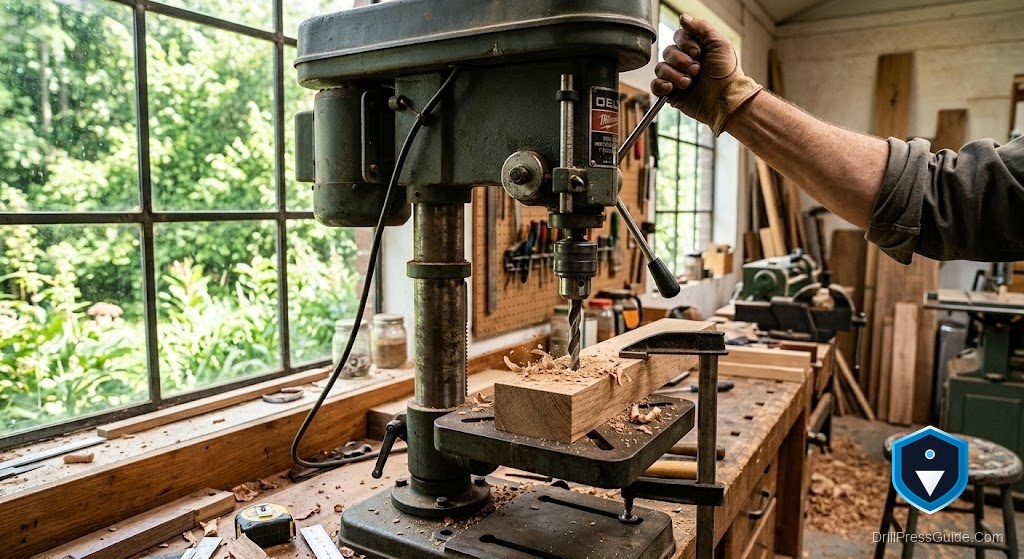
If you have only ever used a handheld drill, the drill press can seem like overkill, a big, heavy machine to do a job your cordless drill already does. So it is fair to ask the plain question: what does a drill press actually do that makes it worth the space? The short version is that it does not just drill holes; it drills them with a precision, control, and force that a handheld drill cannot match, and that difference opens up a whole set of jobs. This guide explains, in simple terms, exactly what the machine does and why its way of doing it matters.
A drill press does one core thing: it spins a bit at a controlled speed and drives it straight down into a workpiece with a lever-operated quill, while the machine holds the bit rigidly perpendicular to the table. In doing that, it turns hole-making from a freehand, wrist-controlled act into a precise, repeatable, machine-controlled operation.
The direct answer to “what does it do”: it drills accurate, perpendicular holes at a chosen speed and depth, with enough force and rigidity to bore large holes cleanly, and with the repeatability to make many identical holes. Everything else it does grows out of that single, well-controlled action.
It controls the angle for you
The first thing a drill press does is guarantee the angle. The spindle travels in a fixed vertical line relative to the table, so every hole is perpendicular without you steadying anything. A handheld drill leaves the angle to your hand, which is why freehand holes lean. By taking the angle out of your hands, the press makes squareness automatic, which matters for dowels, hardware, and any hole that has to be true.
It controls the speed
The second thing it does is let you set the right speed for the job. Through stepped pulleys or a variable-speed drive, you match the spindle RPM to the bit and material, slow for large bits and metal, fast for small bits in wood. Correct speed is what gives clean holes, sharp bits, and no burning. A handheld drill offers only a trigger and a guess; the press offers a set, repeatable speed.
It controls the depth
The third thing it does is control how deep the bit goes. A depth stop lets you halt the quill at an exact point, so you can drill a blind hole to a precise depth or make a whole batch of holes identical. That control is why counterbores, stopped holes, and repeated depths are trivial on a press and fiddly by hand.
It supplies force and rigidity
The fourth thing it does is provide force and stability. The feed lever multiplies your effort and the heavy frame absorbs the load, so large Forstner bits and hole saws that would twist a handheld drill out of your grip cut smoothly and safely. This is what lets a drill press bore big, clean holes that are impractical or dangerous freehand.
What those four things add up to
Control the angle, the speed, the depth, and the force, and you get more than holes. You get repeatable joinery, precise angled holes when the table tilts, drum sanding when you fit a sanding drum, and mortising when you add a hollow-chisel attachment. All of it flows from the machine doing its one core job, driving a bit straight down under control, extremely well. What it does not do is move sideways to mill, turn work like a lathe, or travel to the job, because its whole design is about controlled downward thrust in one place.
The verdict
What a drill press does is take the four variables that make a hole good, angle, speed, depth, and force, and put each one under machine control instead of leaving them to your hand. That is why its holes are square, clean, precisely deep, and repeatable, and why it can bore large holes a handheld drill cannot. Every extra job it does, from angled holes to sanding to mortising, grows from that one well-controlled action. Understand that and the big machine stops looking like overkill and starts looking like the most controlled way to make a hole.
FAQ
What does a drill press do in one sentence? It spins a bit at a controlled speed and drives it straight down into clamped work, holding the bit perpendicular, so holes are square, precise, and repeatable.
How is that different from a handheld drill? The press controls the angle, speed, depth, and force for you, while a handheld drill leaves all of those to your hand, which is why its holes are less accurate.
Does a drill press only drill holes? The core job is controlled drilling, but that same control enables angled holes, drum sanding, and mortising with the right table setting or attachment.
Why can it drill big holes a hand drill cannot? The feed lever multiplies your force and the heavy frame stays rigid, so large Forstner bits and hole saws cut smoothly instead of twisting out of your grip.
What can a drill press not do? It cannot mill sideways, turn work like a lathe, or travel to the job. Its design is built for controlled downward thrust in one fixed place.
Do I need one if I own a good handheld drill? If you need square, precise, repeatable holes or want to bore large holes cleanly, yes. For rough, occasional holes, a handheld drill may be enough.
References
- Woodcraft, drill press shop knowledge guide (function and uses): https://www.woodcraft.com/blogs/shop-knowledge-guides/drill-press-table
- FineWoodworking, drill press capabilities and accessories: https://www.finewoodworking.com/project-guides/shop-machines/shopmade-sanding-drums-for-the-drill-press


