A Plain-English Guide to the Drill Press
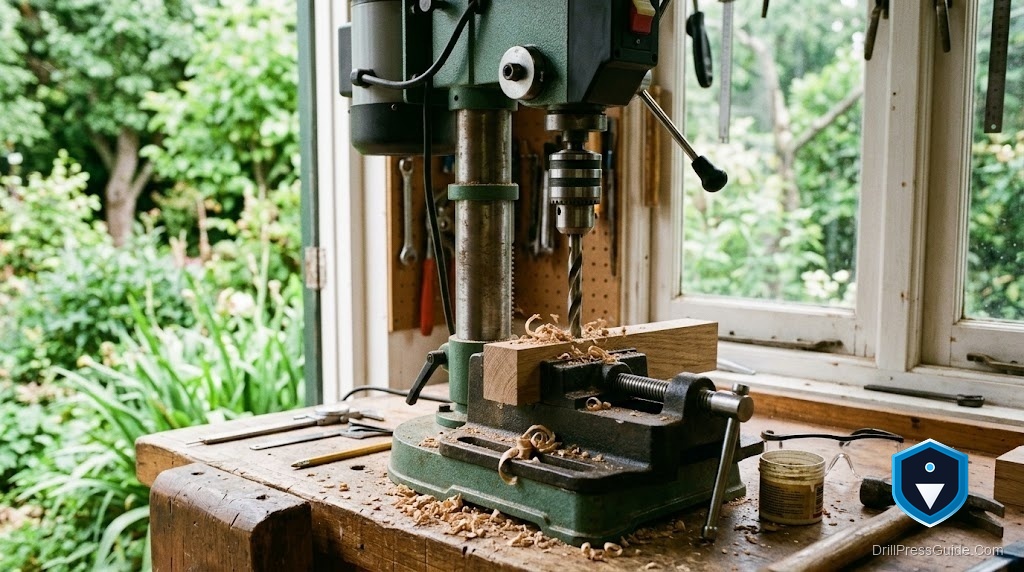
Stand in front of a drill press for the first time and it can look intimidating: a tall column, a heavy head, a wheel on the side, levers, a table that cranks up and down. It is actually one of the simplest machines in the shop once someone explains the parts in plain language. Strip away the jargon and a drill press is just a motor that spins a bit and a lever that pushes that bit straight down into whatever you have clamped to the table. This guide explains what a drill press is, what each main part does, and why the machine drills so much better than the drill in your hand.
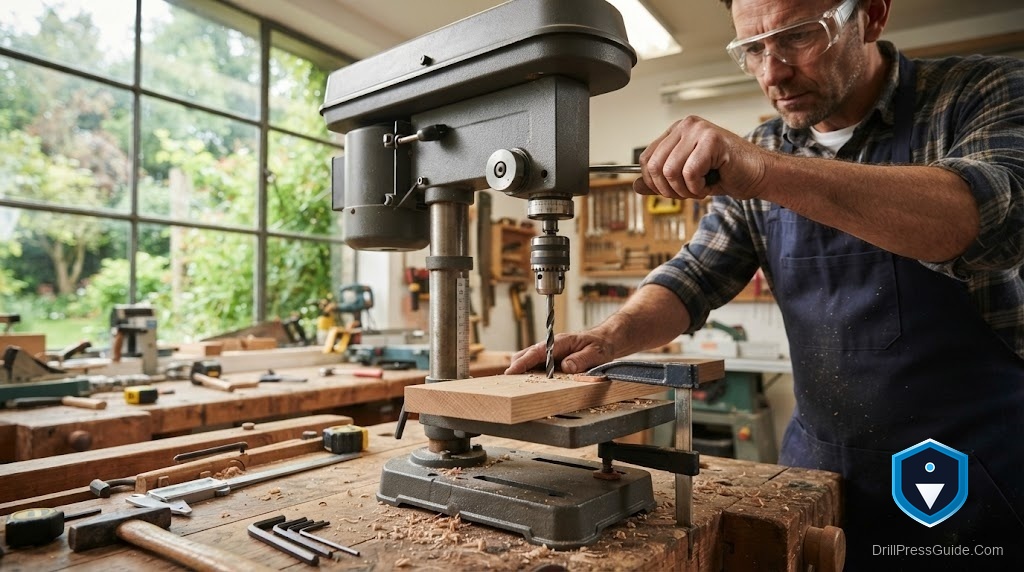
A drill press is a stationary drilling machine. A motor spins a spindle that holds a chuck, the chuck grips the bit, and a hand lever lowers the spinning bit straight down into a workpiece resting on a table. Because the machine fixes the angle and controls the depth, the holes it makes are square, accurate, and repeatable in a way a handheld drill cannot match.
The short answer to “what is it” is this: a drill press trades the portability of a hand drill for control. You give up carrying the tool to the work, and in return you get perfect perpendicular alignment, adjustable speed, controlled depth, and the added force to bore big holes without a fight.
The main parts, in plain words
The base and column are the foundation: a heavy base for stability and a steel column that everything else clamps to. The table is the flat surface your workpiece sits on; it slides up and down the column and usually tilts for angled holes. The head is the business end at the top, containing the motor and the spindle. The chuck is the clamp that grips the bit, tightened with a key on most presses. The quill and feed lever are the mechanism you pull to drive the spinning bit down and let a spring return it up. The speed control, either stepped pulleys with a belt or a variable-speed handle, sets how fast the spindle turns. That is the whole machine.
Why it drills better than a hand drill
Three reasons. First, alignment: the bit is locked perpendicular to the table, so holes are square without you steadying anything. Second, control: a depth stop repeats an exact depth, and the speed control matches the bit and material so nothing burns or grabs. Third, force and rigidity: the feed lever multiplies your effort and the heavy frame absorbs the load, so large bits that would twist a hand drill out of your grip cut smoothly. Those three add up to accuracy a hand drill simply cannot deliver.
Benchtop versus floor models
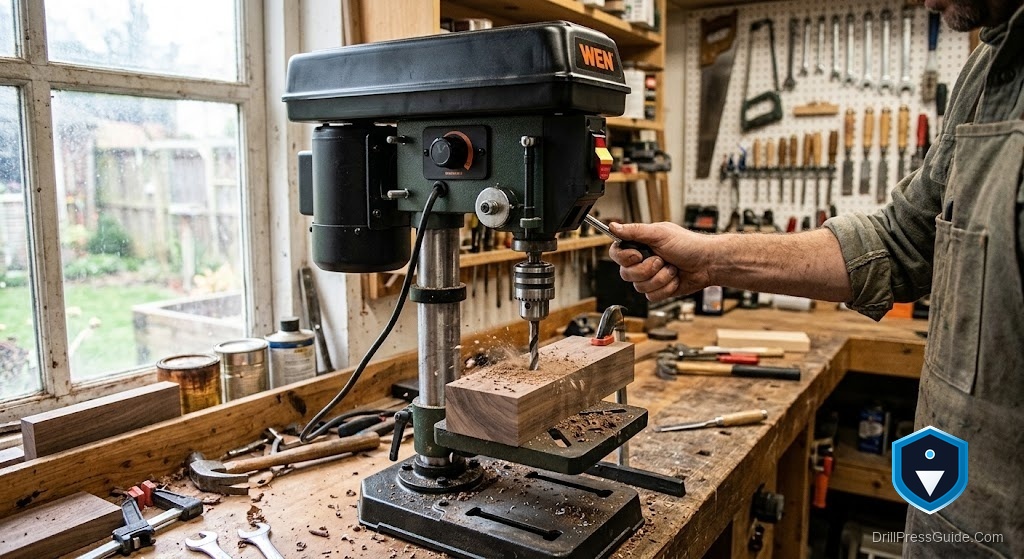
Drill presses come in two broad shapes. Benchtop models sit on a workbench, take less space, and cover the vast majority of home-shop drilling. Floor models stand on the ground, offer more power, more height between the chuck and table, and a bigger swing for larger workpieces. For most people starting out, a benchtop machine like the WEN cast iron variable-speed drill press is plenty: it has an adjustable speed range, a beveling table, and a keyed chuck in a footprint that fits a normal bench. Step up to a floor model when your work outgrows the benchtop’s power or height.
What the numbers on the box mean
A few specs describe any press. Swing is the distance from the column to the spindle centerline, doubled, and it tells you how wide a piece you can center a hole in. Spindle travel is how far the quill plunges, which limits how deep a hole you can drill in one pass. Chuck capacity is the largest bit shank the chuck accepts. Speed range is the span of RPM available. Read those four and you know what a press can and cannot do.
The verdict
A drill press is not complicated once the parts have plain names: a base and column hold a head with a motor, a chuck grips the bit, and a feed lever drives it straight down into work on an adjustable table. It beats a hand drill because it locks the angle, controls the depth and speed, and adds mechanical force for big bits. Choose a benchtop model for most home use and a floor model when your work demands more power and height, and read the swing, travel, chuck capacity, and speed range to know what you are getting. Learn those basics and the intimidating-looking machine becomes the friendliest tool on the bench.
FAQ
What is a drill press in simple terms? A stationary machine that spins a bit and lets you pull it straight down into a clamped workpiece, so holes come out square, accurate, and repeatable.
What are the main parts? A base and column, a table that raises and tilts, a head with the motor and spindle, a chuck that grips the bit, a quill and feed lever, and a speed control.
Why is it better than a handheld drill? It locks the bit perpendicular, controls depth and speed, and adds force and rigidity, so holes are square and big bits cut without twisting out of your grip.
What is the difference between benchtop and floor models? Benchtop presses are smaller and sit on a bench; floor models offer more power, height, and swing for larger, heavier work.
What does swing mean? The distance from the column to the spindle centerline, doubled. It tells you the widest workpiece you can center a hole in.
What specs should a beginner check? Swing, spindle travel, chuck capacity, and speed range. Those four describe what a press can and cannot handle.
References
- Woodcraft, drill press shop knowledge guide (parts and basics): https://www.woodcraft.com/blogs/shop-knowledge-guides/drill-press-table
- WEN cast iron benchtop drill press, product specifications: https://wenproducts.com/products/wen-4212t-10-in-variable-speed-drill-press