
What Is a Drill Press Used For? A Practical Rundown for Any Shop
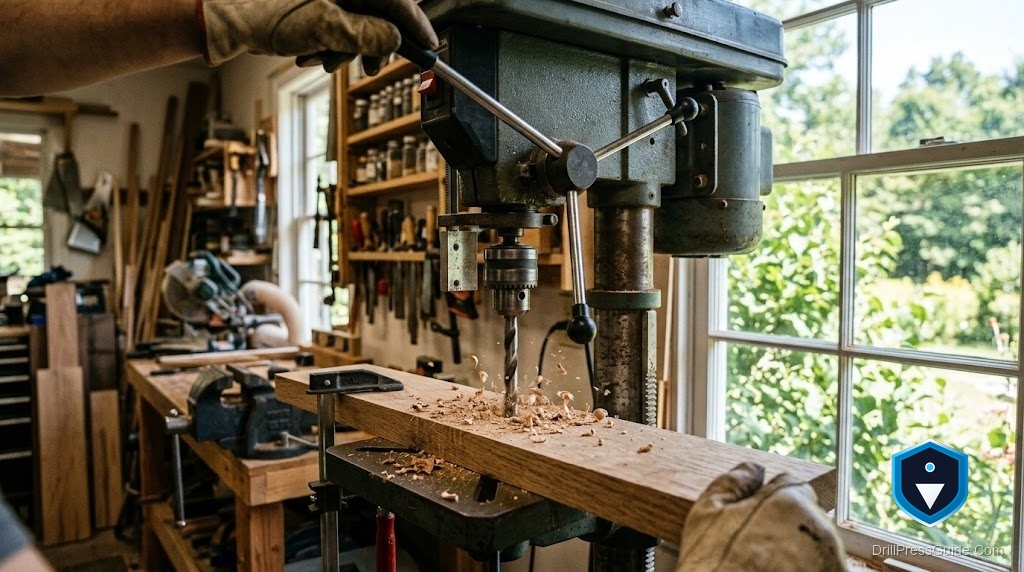
A drill press looks like a one-trick machine: it drills holes. Then you spend a month around one and realize the hole is just the headline. The same tool that bores a perfect vertical hole also sands, cuts square mortises, drills precise angles, and does a dozen repetitive jobs faster and straighter than you ever could by hand. Understanding everything a drill press is used for is the difference between owning a one-trick hole-maker and owning one of the most versatile machines on the bench. This guide lays out what it does, why it does each job better than a handheld drill, and where its limits are.
A drill press is a stationary machine that holds a rotating bit in a spindle and drives it straight down into a clamped workpiece using a lever-operated quill. Because the spindle angle and depth are controlled by the machine rather than your hand, it drills holes that are square, accurately placed, and repeatable, which is the foundation for everything else it does.
The direct answer to what it is used for: precise vertical and angled drilling, controlled-depth holes, large-diameter boring with Forstner bits and hole saws, repetitive identical holes, plus accessory jobs like drum sanding and, with an attachment, square-hole mortising. Its core value is accuracy and repeatability under a controlled downward thrust.
Accurate, square holes
The headline job, done right. A handheld drill leans and wanders; a drill press holds the bit exactly perpendicular to the table every time, so the hole enters and exits where you intend. That squareness matters enormously for dowel joints, hardware that must line up, and any hole that has to be true. It is the single reason most people buy one, and on its own it justifies the machine.
Controlled depth and repetition
A depth stop lets you drill every hole to the exact same depth, so a row of shelf-pin holes or counterbores all match. Because the table and fence hold the work in a fixed relationship to the bit, you can drill the same hole in fifty parts and have all fifty identical. That repeatability is why small production tasks, jigs, and batch work live on the drill press rather than in your hand.
Large-diameter and specialty boring
Big bits are where a handheld drill gives up and a press shines. Forstner bits cut flat-bottomed holes for hinges and joinery, hole saws cut large round openings, and both need the low speed and steady downward force a press provides. Trying to run a large Forstner bit freehand is a wrist-spraining, hole-wrecking exercise; on a press, with the speed dialed down, it is smooth and clean.
Angled holes, sanding, and mortising
Most tables bevel, so you can lock a precise angle and drill it repeatably, something almost impossible freehand. Fit a sanding drum and the press becomes a spindle sander for curved edges. Add a mortising attachment, a hollow chisel around an auger bit, and it cuts the square holes of mortise-and-tenon joinery. These accessory roles are why the machine earns its footprint even in a small shop. A capable, widely used starter machine like the WEN cast iron benchtop drill press covers all of these jobs with a variable speed range and a beveling table, which is why it is such a common first press.
What it is not for
Honesty keeps you safe here. A drill press is not a milling machine; its spindle and quill resist downward thrust, not the sideways force of a cutter, so side-cutting loosens the chuck and is dangerous. It is not a lathe; it cannot support and turn a workpiece safely. And it is not portable; it drills where it stands. Ask it to do those jobs and you will be disappointed at best and hurt at worst.
The verdict
A drill press is used for far more than drilling holes, though it does that better than anything: square and angled holes, controlled-depth and repeated holes, large-diameter boring, drum sanding, and mortising with an attachment. Its whole value is accuracy and repeatability under controlled downward force. Respect its limits, no milling, no turning, no carrying it to the job, and it becomes one of the most-used machines in the shop. Buy one for the holes; keep it for everything else it quietly does well.
FAQ
What is the main thing a drill press is used for? Drilling accurate, square holes. The machine holds the bit perpendicular and at a set depth, so holes are true, precisely placed, and repeatable.
Can a drill press drill at an angle? Yes. Most tables bevel and lock at a set angle, so you can drill precise, repeatable angled holes that are nearly impossible freehand.
What can it do besides drill? With accessories it sands with a drum, cuts square mortises with a hollow-chisel attachment, and bores large holes with Forstner bits and hole saws.
Can I use a drill press as a milling machine? No. Its spindle resists downward thrust, not sideways cutting force. Milling loads loosen the chuck and are unsafe.
Why is a drill press better than a handheld drill for big bits? It supplies steady downward force and a low, controlled speed, so large Forstner bits and hole saws cut smoothly instead of grabbing.
Do I need a floor model or is a benchtop press enough? A benchtop press covers most home-shop drilling, sanding, and mortising. Floor models add power, height, and swing for larger or heavier work.
References
- Woodcraft, drill press shop knowledge guide (uses and setup): https://www.woodcraft.com/blogs/shop-knowledge-guides/drill-press-table
- FineWoodworking, drill press accessory techniques (sanding and boring): https://www.finewoodworking.com/project-guides/shop-machines/shopmade-sanding-drums-for-the-drill-press


