
Getting Better Results from a DeWalt Drill Press Attachment
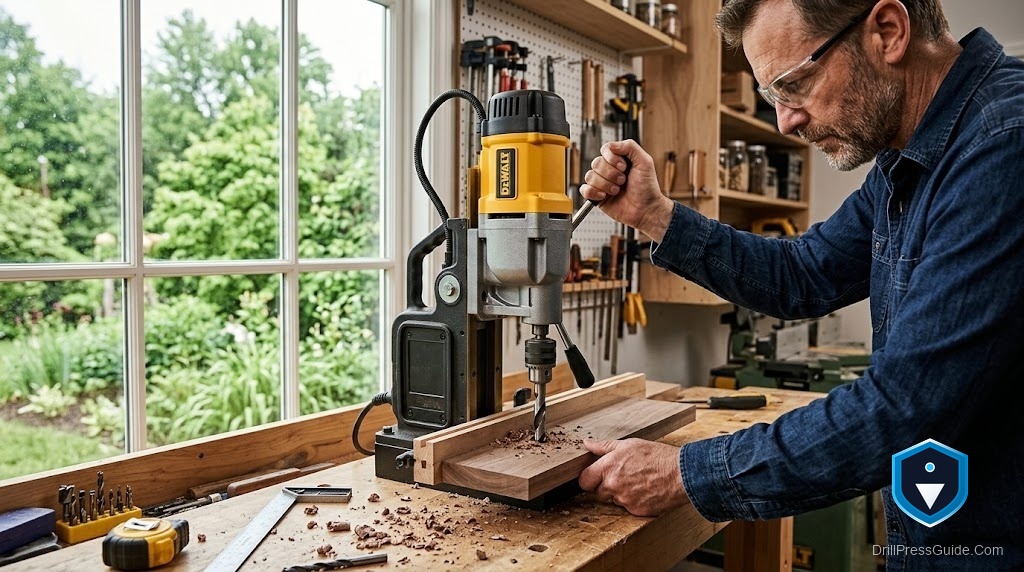
DeWalt owners are loyal for a reason: the drills are strong, the batteries are everywhere, and the yellow tools just work. So it stings a little to learn that DeWalt does not make a drill press attachment that turns your cordless drill into a benchtop press. The good news is you do not need a DeWalt-branded part to get drill-press accuracy out of your DeWalt drill. A universal portable drill guide accepts your drill and gives you the straight, repeatable holes you were after. This guide is about getting genuinely good results from that setup, not just making it work.
A portable drill guide is a compact stand that holds a standard power drill in a spring-loaded carriage and guides the bit straight down, or at a set angle, into the workpiece. Paired with a DeWalt drill, it gives you perpendicular holes, adjustable angles, and a depth stop, which is most of what people actually want from a drill press when a full machine is too big or too far away.
The direct answer: DeWalt does not sell a drill press attachment, so pair your DeWalt drill with a universal portable drill guide that has a 3/8 inch chuck or a collar that grips your drill’s nose. Then the results come down to technique, because these guides are only as accurate as the way you set them up and feed them.
Why there is no DeWalt-branded attachment
DeWalt makes drills, and a handful of larger drilling machines, but not a bolt-on stand that converts a cordless drill into a drill press. The category that solves your problem is the portable drill guide, made by accessory brands, and it is drill-agnostic on purpose so one guide works across brands. That is why matching the guide’s chuck or clamp to your DeWalt drill matters more than any logo.
Match the guide to your DeWalt drill
Two fit styles exist. Some guides have their own 3/8 inch keyed chuck, and you remove the drill’s role entirely by chucking the bit into the guide while your drill drives it; others clamp around the drill’s nose collar. Confirm which style you are buying and that it accepts your DeWalt model, since a bulky drill body may not seat in a nose-clamp guide. Note that guides are made for standard drills, not impact drivers or hammer drills, so use a regular drill/driver for the smoothest results.
The technique that actually improves results
This is where most people leave accuracy on the table. Anchor the workpiece, not just the guide: clamp the board so it cannot creep, because a portable guide does not have the mass of a real press to resist it. Set the depth stop before you drill so repeat holes match. Feed slowly and let the bit cut rather than forcing it, since pushing a light guide hard is what introduces wander. Use the built-in V-groove or centering base for round and narrow stock so the bit starts on center. And keep the guide’s posts clean and lightly lubricated so the carriage glides without stick-slip. These habits are the difference between holes that look drilled by a machine and holes that look drilled by hand.
The tool to buy
For a DeWalt drill, a solid, widely available option is a portable drill guide with an adjustable angle base, which drills straight or angled holes and gives you a depth stop in a package small enough to carry to the work. The honest caveat with every portable guide, including the well-known name-brand ones, is that they have more play than a floor-standing press, so they reward light feed and firm clamping and punish heavy-handed drilling. Bought with that expectation, a good guide plus your DeWalt drill covers a huge share of everyday drilling.
When to step up to a real press
If you drill all day, need to bore wide holes in hardwood, or want the rigidity for precise metalwork, a portable guide will frustrate you and a benchtop drill press is the honest upgrade. The guide shines for portability, occasional use, and jobs where you bring the tool to the work. Know which situation you are in before you blame the tool.
The verdict
There is no DeWalt drill press attachment, but a universal portable drill guide turns your DeWalt drill into a capable stand-in for a press. Match the guide to your drill, then get real results through technique: clamp the work, set the depth stop, feed light, use the centering base, and keep the posts clean. Accept that a portable guide has more play than a floor press, and use it for the portable, occasional, bring-it-to-the-work jobs it is built for. Do that and your yellow drill drills straighter than it ever did in your hand.
FAQ
Does DeWalt make a drill press attachment for its drills? No. Pair your DeWalt drill with a universal portable drill guide, which is made to work across drill brands.
How does a portable drill guide attach to my DeWalt drill? Either the guide has its own 3/8 inch chuck, or it clamps around the drill’s nose collar. Confirm the style fits your DeWalt model before buying.
Can I use an impact driver in a drill guide? No. Guides are made for standard drill/drivers. An impact driver’s hammering action is not suited to a drill guide.
Why are my holes still a little off? Usually the work moved or you fed too hard. Clamp the workpiece firmly and feed slowly so the bit cuts without pushing the light guide off line.
Is a portable guide as accurate as a drill press? No. It has more play than a floor-standing press. It is excellent for portability and occasional work, less so for heavy or precision drilling.
How do I drill straight into round stock? Use the guide’s V-groove or self-centering base so the bit starts on the center of the round workpiece.
References
- Milescraft, DrillMate portable drill guide (portable guide features and use): https://milescraft.com/product/drillmate/
- Rockler, Portable Drill Guide product information: https://www.rockler.com/rockler-portable-drill-guide


