
Wood Lathe Attachment for Drill Press: What to Measure Before You Buy
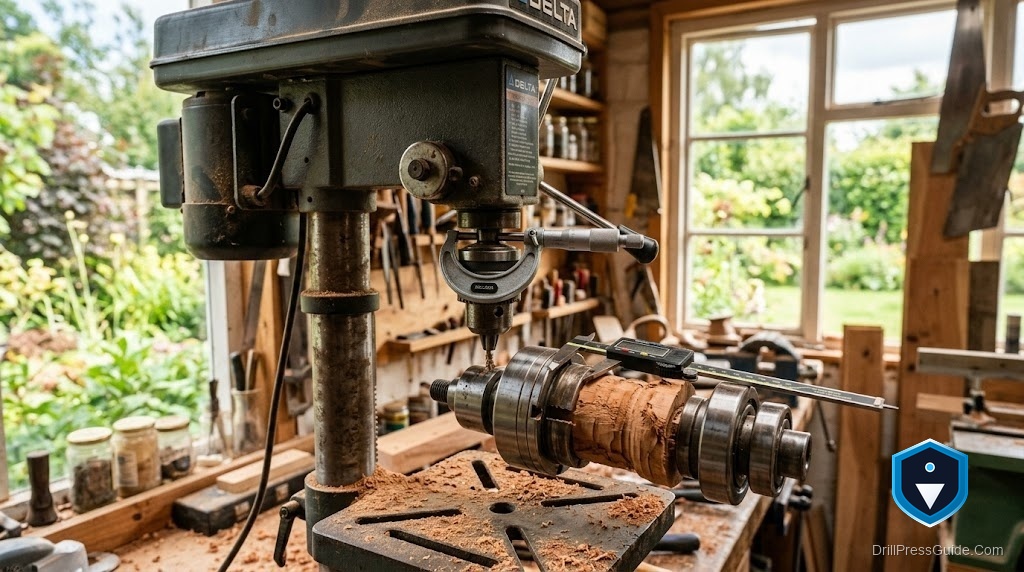
Every few months someone in a woodworking forum asks the same hopeful question: can I bolt a wood lathe attachment onto my drill press and turn a table leg or a pen? The idea makes sense on paper, because both machines spin a workpiece. So before you go measuring your quill and your column for a lathe attachment, here is the honest answer that will save you trouble and possibly your fingers: a drill press is the wrong machine for turning, no attachment fixes that, and the thing you actually want is a proper dedicated lathe. Let me walk through why, and what to measure instead.
A wood lathe spins a workpiece horizontally between two supported points, a drive center and a tailstock, while you rest a chisel on a tool rest and cut along the length of the wood. A drill press spins a bit vertically and pulls it down into a stationary workpiece. Those are opposite geometries, and that difference is the whole problem with turning a drill press into a lathe.
The direct answer: skip the wood lathe attachment for a drill press. A drill press holds work vertically with no tailstock and no tool rest, its chuck is only friction-fit onto a tapered spindle, and side loads from a turning chisel can spin that chuck right off and throw it. What to measure before you buy is not your drill press at all, but the bench space and the spindle-to-bed capacity for a real lathe.
Why the geometry does not work
On a lathe, the workpiece is supported at both ends and the cutting force pushes it against solid steel centers. On a drill press, the workpiece would hang from the chuck alone, unsupported at the bottom, with nothing to steady the free end. The moment you touch a chisel to it, the wood whips. Worse, the cut pushes sideways, and a drill press spindle and chuck are built to resist downward thrust, not lateral load, so the chuck can loosen off its Morse taper and launch. This is not a tuning problem you can dial out; it is the machine being asked to do a job it was never designed for.
The tool rest and tailstock you cannot add
Turning needs two things a drill press cannot give you: a tool rest to brace the chisel right at the cut, and a tailstock to support the far end of the workpiece. Bolt-on gadgets that claim to add these to a vertical spindle leave you cutting on an unsupported, overhung workpiece with a hand tool inches from a spinning chuck. There is no version of that setup that is both useful and safe, which is why no reputable manufacturer sells one.
What to measure and buy instead
A benchtop wood lathe is easier to come by than most people expect and does the job properly. Before you buy one, measure two things: the bench length you can give it, because lathes are long, and the swing and distance between centers you need for your projects, which set the maximum diameter and length you can turn. A small benchtop lathe handles pens, spindles, and small bowls; a larger one turns table legs and deeper bowls. That is the measuring exercise worth doing, not adapting a drill press.
Keep the drill press doing what it does well
Your drill press is still the right machine for plenty of round-work tasks: boring accurate holes, drilling dowel centers, sanding with a drum, and, with a mortising attachment, cutting square holes. Those all use the press in its designed vertical, downward-thrust mode. Turning is simply not on that list. Use the press for what it is excellent at, and let a lathe handle turning.
The verdict
Do not buy a wood lathe attachment for a drill press, because the machine’s vertical orientation, missing tool rest and tailstock, and friction-fit chuck make it both ineffective and dangerous for turning. The measurements that matter are the bench space and the swing and length capacity for a proper benchtop lathe, which is safe and easy to source. Keep your drill press for drilling, sanding, and mortising, and turn wood on a tool built to turn wood. That is not the answer people hope for, but it is the one that keeps all ten fingers attached.
FAQ
Can I turn wood on my drill press with an attachment? No, safely. A drill press holds work vertically with no tailstock or tool rest, and side loads can spin the chuck off its taper. It is the wrong machine for turning.
Why is a drill press chuck dangerous for turning? The chuck is only friction-fit onto a tapered spindle. It resists downward thrust, not the sideways force of a turning chisel, so it can loosen and be thrown.
Is there any safe DIY lathe conversion? Not on a drill press. The vertical, overhung, unsupported setup cannot be made safe. Buy a dedicated lathe instead.
What should I measure before buying a real lathe? The bench length you can dedicate, and the swing (maximum diameter) and distance between centers (maximum length) your projects need.
What can my drill press do with round work? Drill accurate holes, bore dowel centers, sand with a drum, and cut square holes with a mortising attachment. All use its designed vertical mode.
Would a mini lathe handle pens and small spindles? Yes. A small benchtop lathe turns pens, spindles, and small bowls, and is more attainable than most people assume.
References
- Woodcraft, drill press shop knowledge guide (intended uses and limits of a drill press): https://www.woodcraft.com/blogs/shop-knowledge-guides/drill-press-table
- FineWoodworking, drill press techniques and safe accessory use: https://www.finewoodworking.com/project-guides/shop-machines/shopmade-sanding-drums-for-the-drill-press


