
Mortising Adapter for Drill Press: How to Cut Square Holes
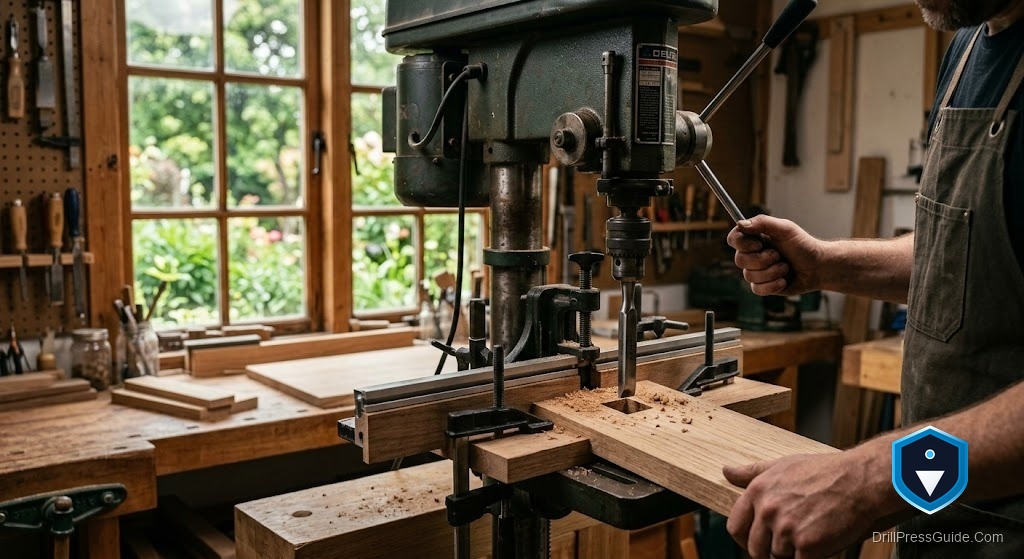
The mortise and tenon joint has held furniture together for centuries, and the thing standing between you and one is a square hole. Drill bits make round holes. A mortising adapter for your drill press is how you make square ones, by wrapping a spinning bit inside a four-sided chisel that pares the corners as the bit clears the waste. Bolt one to a press you already own and you skip buying a dedicated mortising machine. The results can be genuinely clean, or genuinely frustrating, and which one you get comes down to setup and honest expectations.
A mortising adapter for a drill press is a kit that clamps a hollow square chisel around your drill press quill and holds a matching auger bit inside it. As you feed the quill down, the bit bores a round hole and the chisel squares the walls, so each plunge leaves a clean square socket. Move over, plunge again, and you chain those squares into a mortise of any length.
Here is the direct answer: a mortising adapter works on most drill presses as long as the kit’s bushings match your quill diameter and your press has enough quill travel and downforce. It turns a woodworking press into a part-time mortiser for far less than a standalone machine. What it will not do is match the speed and rigidity of a dedicated mortiser, so it suits the hobbyist and the small shop more than a production run.
How the adapter actually works
The heart of the kit is the hollow chisel and bit pair. The chisel is a square steel tube sharpened at the tip, with a hole up the middle; the auger bit rides inside it and pokes out the end. The bit does the heavy cutting and augers chips up and out through a window in the chisel, while the four sharpened corners of the chisel slice the round hole into a square. A cast holder clamps the chisel to your quill, a fence positions the work, and a hold-down keeps the piece from lifting when you retract the chisel.
Checking that it fits your press
The fit question is all about the quill. Mortising kits ship with a set of bushings, and you match the bushing’s inside diameter to your drill press quill diameter, so measure that first. You also want decent quill travel, since the depth of your mortise is limited by how far the quill plunges, and a press with real downforce, because squaring wood with a chisel takes muscle. Small benchtop presses can mortise, but they work best in softer woods and shallower cuts.
A capable kit to start with
For a first setup, the YUEWO mortising attachment kit gives you the cast chisel holder, fence, hold-down, and four chisels with matching bits in common sizes, which is everything you need to start cutting square holes on a press you already own. The honest flaws are the ones every budget kit shares: the chisels arrive sharp enough but not honed to a fine edge, so a few minutes with a cone stone before the first cut makes a real difference, and the fine tuning of chisel-to-bit gap takes patience the first time.
When the included chisels wear or you want cleaner walls, better chisels are worth buying separately. A Delta 17-003 mortising chisel and bit set or a WEN four-piece set with a 3/4 inch shank fits most adapters and cuts a smoother mortise than bargain steel. Think of the adapter as the frame and the chisels as the blades: upgrade the blades and the whole setup improves.
Getting clean results, not burnt ones
Three things separate a crisp mortise from a scorched mess. Set the gap between the bit and the chisel tip to about a coin’s thickness so chips clear without the bit rubbing the chisel and burning. Align the chisel square to the fence so your holes chain in a straight line. And clear the waste in steps rather than forcing a full-depth plunge in one go, letting the bit auger chips out instead of packing them. Keep the chisel sharp, and back up thin stock so it does not blow out the bottom.
The verdict
A mortising adapter is one of the best value additions to a woodworking drill press, turning it into a part-time mortiser for the price of a kit instead of a machine. It rewards a match between the bushings and your quill, a sharp chisel, and patient setup. Buy the all-in-one kit to get started, upgrade the chisels when you want cleaner walls, and step up to a dedicated mortiser only if you cut mortises by the hundred. For everyone else, the adapter puts real joinery within reach of the press in the corner.
FAQ
Will a mortising attachment fit any drill press? Most, if the kit’s bushings match your quill diameter. Measure the quill first, and make sure you have enough quill travel and downforce.
Why is my chisel burning the wood? Usually the gap between the bit and the chisel is too small, or the chisel is dull. Set a small clearance gap and keep the chisel sharp.
How deep a mortise can I cut? As deep as your quill travels, minus the chisel setup height. Deep mortises may need to be cut from both faces.
Do I need to sharpen new chisels? Budget chisels benefit from honing before first use. A cone-shaped mortising stone cleans up the inside edges for a crisper cut.
Can a benchtop drill press handle mortising? Yes, best in softer woods and shallower cuts. Squaring hardwood takes downforce that small presses may lack.
What sizes should I buy? Start with 1/4 and 3/8 inch, which cover most furniture joinery. Add 1/2 inch for larger tenons.
References
- Delta Machinery, 17-003 Professional Mortising Chisel and Bit Set specifications: https://deltamachinery.com/product/17-003-3-8-in-professional-mortising-chisel-and-bit-set/
- Grizzly Industrial, H7789 Mortising Attachment Kit for Drill Presses (bushing and fit details): https://www.grizzly.com/products/grizzly-mortising-attachment-kit-for-drill-presses/h7789


